Narrow Aisle Floor Scrubber Buying Guide: For Mall, Hospital, School & Office
Nov 19, 2026
A shopping mall concourse before opening, a hospital corridor between ward rounds, a school hall after lunch — the same machine is asked to scrub all three. Most walk-behind scrubbers are bought for one number on the datasheet and judged, a month later, on everything it did not say. The 530 mm class earns its place differently: it is engineered to fit a 90 cm aisle and still cover open floor at a genuine pace.
Quick Answer
A 530 mm walk-behind floor scrubber is a compact automatic scrubber for hard floors of roughly 1,000–2,000 square metres per shift. The JIECHI A3 scrubs a 530 mm path at a theoretical 2,200 ㎡/h, carries 50 L of solution against 55 L of recovery, runs a 24 V / 100 Ah battery with matched 550 W brush and suction motors, and measures 1.27 × 0.55 × 1.09 m — narrow enough for a 900 mm aisle. It suits retail aisles, mall concourses, hospital corridors, schools and offices.
Key Takeaways
530 mm deck, 550 mm body, 770 mm squeegee: the deck scrubs, the body decides what it fits, the squeegee decides the dry line.
2,200 ㎡/h is the theoretical rate — deck width times forward pace — reduced in practice by every turn, fixture and refill.
50 L solution against 55 L recovery keeps suction alive longer than the water supply; dual fill ports speed the stop.
24 V / 100 Ah is 2.4 kWh of stored energy (datasheet arithmetic), with matched 550 W brush and 550 W suction motors.
1.27 × 0.55 × 1.09 m body, 155 kg dry: check aisles, doors, lifts and ramps, not just the entry.
One machine covers retail, healthcare, education and office hard floors; the class choice matters more than any single figure.
What This Guide Covers
Inside the 2,200 ㎡/h rating
Water system: 50 L solution, 55 L recovery
Body dimensions and the 900 mm aisle
Motors, battery and weight
Scenario solutions for the 530 mm class
Walk-behind classes compared
Inside the 2,200 ㎡/h Rating
Start with where the number comes from. A 2,200 ㎡/h rate on a 530 mm deck implies a forward pace of about 4.2 km/h — 2,200 divided by 0.53 metres of width, datasheet arithmetic. That is a brisk walk while steering a machine, sustained on straight open runs.
The diagram below shows the same floor twice: the continuous coverage the printed rate assumes, against what a real pass leaves — turn zones at row ends, overlap bands, islands the deck must skirt, a stretch paused when the tank ran dry. None of that is a machine defect; each loss is geometry, and the 530 mm class is dimensioned to keep it small in exactly the buildings it targets.
In open retail floor and long concourses the machine spends most of its minutes scrubbing, and achieved output stays close to the printed figure. Where fixtures chop the floor into short runs, the deck's advantage shifts from speed to access: it fits where larger ride-on decks cannot go at all.
Water System: 50 L Solution, 55 L Recovery
A 530 mm walk-behind floor scrubber with a 50 L solution tank carries 50 litres of clean water and 55 litres of recovery. The recovery tank is deliberately larger: foam and sediment occupy volume, and a full recovery tank shuts down suction before the solution tank runs dry. Keeping the dirty side bigger lets the machine finish its water on the floor rather than stopping with clean water left over.
How much floor one tank covers depends on the application rate in litres per square metre — a buyer input set by your detergent label's dilution instructions and the flow valve setting. Floor area per tank equals 50 litres divided by that rate. Halve the flow and one tank covers twice the floor. A float sensor stops the machine to prevent damage from overfill. However, excessive foam in the recovery tank may still cause water ingress and damage the motor.
Body Dimensions and the 900 mm Aisle
Deck width is not body width, and the difference decides where the machine can work. The A3 scrubs a 530 mm path, but the body is 550 mm wide, 1.27 m long and 1.09 m high. In a 900 mm aisle that leaves roughly 175 mm per side — enough to scrub straight through, tight for turning. This figure separates the compact class from everything larger: ride-on bodies start near a metre wide and do not enter a 90 cm aisle.
The suction side is wider than the scrub side: 770 mm against 530 mm, an overlap of 240 mm. The deck lays the water film, the squeegee lifts it, and the overlap keeps the recovery line over treated ground. It also means the machine's floor footprint is wider than its cleaning path — worth checking against racking and display ends.
Motors, Battery and Weight
The drive package is a matched pair of 550 W motors: one turns the brush, one pulls the vacuum feeding the squeegee. Matching them matters — a suction motor weaker than the brush leaves water behind on a full-width pass; the A3's pair is specified so the recovery line follows the deck line at the rated pace.
The battery is 24 V / 100 Ah: 2.4 kWh stored by datasheet arithmetic. Consumption per square metre depends on soil load, brush pressure and water flow.
Weight rounds out the package: 155 kg dry, roughly 260 kg with full tanks (datasheet arithmetic) — the figure to check against ramps and lift ratings wherever the route changes level.
Scenario Solutions for the 530 mm Class
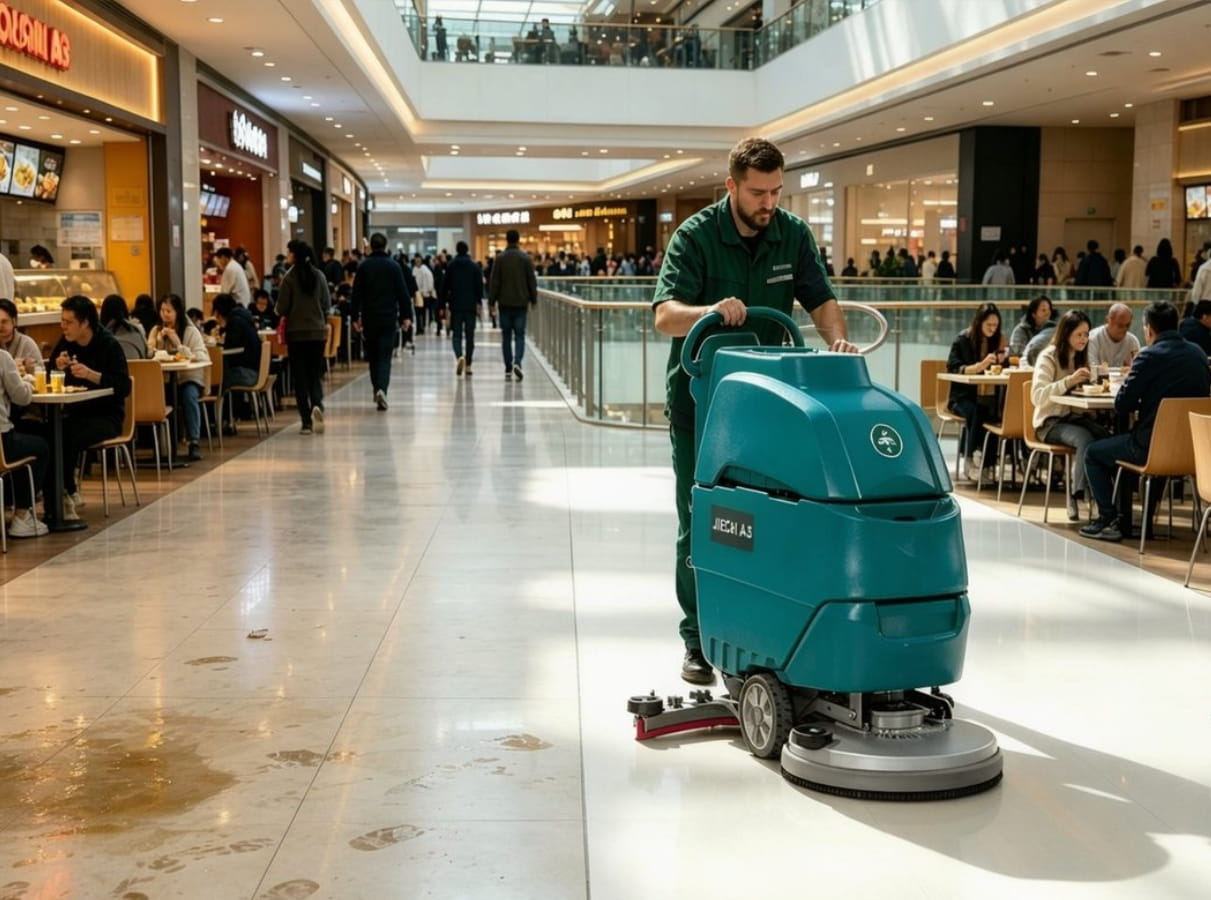
In retail and mall environments the constraint is fixture density: shelving islands, display ends and escalator landings break the floor into short runs. The 530 mm deck and 550 mm body are sized for those runs, and the automatic brush tray keeps every turn a steering action rather than a lifting one. Low-noise operation extends the usable window into trading hours.
In healthcare and education the constraint is the corridor schedule: ward rounds, class changes and meal times define narrow windows on long, straight floors — the geometry where the 2,200 ㎡/h rate is most fully realised. Smooth tile and terrazzo sit in the middle of the A3's surface list. The 1.09 m height clears standard door heads; the 1.27 m length turns in a standard landing.
In offices and back-of-house areas the constraint is mixed floor furniture: workstations, storage, service corridors and lifts. Back-of-house usually mixes a few wide areas with many narrow ones — the profile that justifies one compact machine instead of a large machine plus a mop. One operator runs the whole route: the touch-control panel and self-lifting tray keep training to a single supervised shift.
Walk-Behind Classes Compared
The 530 mm class sits in the middle of a range, and matching the class to the site is the highest-impact decision in this purchase. The table puts the three common walk-behind classes side by side, all figures per datasheet.
Specification
Mini (JIECHI BA350BT class)
Compact (JIECHI A3 class)
Large dual-brush (JIECHI BA860BT/BA660BT class)
Scrub width
350 mm
530 mm
860 mm / 660 mm
Theoretical coverage
850 m²/h
2,200 m²/h
4,200 / 3,600 m²/h
Solution / recovery tank
11 L / 15 L
50 L / 55 L
95 L / 105 L
Battery
24 V / 35 Ah
24 V / 100 Ah
24 V / 200 Ah
Body (L × W × H)
0.72 × 0.44 × 0.90 m
1.27 × 0.55 × 1.09 m
1.50 × 0.95 × 1.24 m
Weight
65 kg
155 kg
per datasheet
If your site is a cluster of small rooms and narrow corridors, an 850 ㎡/h mini walk-behind scrubber with a 350 mm deck goes through doorways the compact class cannot and turns inside single toilets — at the price of small tanks and frequent stops. If the site is open retail or long corridors, dual-brush self-propelled walk-behind floor scrubbers with a 95 L solution tank double the deck and nearly double the tank, stretching both run length and refill interval. The compact 530 mm class between them is the default for mixed buildings: one machine that fits a 900 mm aisle and still covers open floor at a real pace.
Buy for the aisles first, then for the rate: a machine that cannot turn in your corridors never reaches its printed coverage, and a machine that fits them delivers most of it.
Common Questions
Is 2,200 ㎡/h realistic for a walk-behind scrubber?
It is the correct theoretical rate for a 530 mm deck at about 4.2 km/h, achievable in open straight runs. Turn zones, fixtures and refills reduce what a real pass covers: treat the figure as the machine's ceiling and your floor layout as the modifier.
How long does the battery last on one charge?
The 24 V / 100 Ah battery stores 2.4 kWh by datasheet arithmetic, and consumption per square metre depends on soil load, brush pressure and water flow.
Will a 530 mm scrubber fit through a 90 cm aisle?
Yes, for straight passes: the body is 550 mm wide, leaving roughly 175 mm per side in a 900 mm aisle — tight for turning. Also check length (1.27 m) and height (1.09 m) against doorways, lifts and low fittings.
What floor surfaces can it clean?
The datasheet lists concrete, epoxy, cement, tile, terrazzo and stone — the smooth hard-floor range found in retail, healthcare, education and office buildings. Textured or carpeted surfaces belong to other machine types.
Does a walk-behind scrubber need a trained operator?
The learning curve is short, Most operators are productive on their first supervised shift.
Conclusion
The 530 mm walk-behind class is defined by numbers answering different questions: the deck answers how fast, the body answers where it fits, the 50/55 L tanks answer how long between stops, and the battery answers how far in a shift.
Read them against your own aisles, fixtures and surfaces, and the class choice — mini, compact 530 mm, or large dual-brush — follows on its own. Buy for the aisles first, then for the rate.
Sizing up a 530 mm walk-behind floor scrubber?
Send your floor areas, aisle widths and surface types — we will reply with a machine shortlist and the specifications that matter for your building.
Email: kliu@jiechi.com | Phone / WhatsApp: +1 240 314 9021
Contact us

 Phone: +1 2403149021
 Mail: kliu@jiechi.com



 Phone:+1 2403149021
 Email:kliu@jiechi.com



 English


