Industrial vs Commercial Floor Cleaners: What's the Difference and Which One Do You Need?
May 07, 2026
If you're in the market for a floor scrubber or sweeper, you've probably come across two categories: industrial and commercial. At first glance, many machines look similar — they both scrub floors, they both have squeegees, and they both come in walk-behind and ride-on configurations. So what actually sets them apart?
Choosing the wrong category can mean either paying too much for features you don't need or ending up with a machine that can't handle your workload. In this guide, we break down the real differences — shape, size, performance, and price — to help you make a confident decision.
What Is a Commercial Floor Cleaner?
Commercial floor cleaners are designed for lighter-duty, shorter-duration cleaning in environments where aesthetics and cleanliness matter, but floors don't face extreme abuse.
Typical commercial applications:
Retail stores and shopping malls
Office buildings and lobbies
Schools, universities, and libraries
Hotels, restaurants, and hospitality venues
Medical clinics and small healthcare facilities
Gyms and fitness centers
Key characteristics:
Duty cycle: Generally designed for 1–3 hours of continuous operation
Battery: Most use lead-acid (AGM or gel) batteries, with lithium-ion as an upgrade option
Scrubbing width: Typically 17–30 inches (walk-behind) or 30–38 inches (ride-on)
Frame construction: Lightweight steel or plastic body; easier to maneuver but less impact-resistant
Price range: $2,000–$12,000, depending on size and features
Maintenance: Simpler, often serviceable by facility maintenance staff
Commercial machines prioritize ease of use, maneuverability, and value for money. You don't need a heavy-duty drivetrain if you're cleaning a 5,000 sq ft retail floor once a day.
What Is an Industrial Floor Cleaner?
Industrial floor cleaners are built for heavy-duty, extended-hour cleaning in harsh environments where durability and throughput matter most.
Typical industrial applications:
Manufacturing plants and factories
Warehouses and logistics centers (>50,000 sq ft)
Automotive assembly lines
Food and beverage processing facilities
Heavy equipment maintenance bays
Chemical processing plants (with explosion-proof options)
Large parking garages and transportation hubs
Key characteristics:
Duty cycle: Built for 4–8+ hours of continuous operation (can handle multi-shift cleaning)
Battery: Heavy-duty deep-cycle lead-acid or large-capacity lithium-iron-phosphate (LiFePO4) packs; some models offer diesel/LPG options
Scrubbing width: Typically 30–50+ inches; dual-disc or cylindrical brush systems
Frame construction: Welded steel or reinforced polymer chassis; metal bumpers and impact guards
Price range: $8,000–$40,000+
Maintenance: Requires trained technicians; parts are heavier and more expensive
Industrial machines are tools first, vehicles second. They emphasize uptime, cleaning speed, and longevity over polish or ergonomic frills.
Detailed Comparison
Aspect
Commercial
Industrial
Usage Duration
1–3 hours/day
4–8+ hours/day
Floor Types
Tile, VCT, hardwood, sealed concrete
Rough concrete, epoxy, metal, oily/wet floors
Debris Handling
Light dust, dirt, spills
Metal shavings, oil, grease, heavy debris
Battery Life
2–4 hours (lead-acid)
4–8+ hours (high-capacity or lithium)
Cleaning Width
17–30 inches
30–50+ inches
Solution Tank
10–20 gallons
20–50+ gallons
Travel Speed
2.5–3.5 mph
3.5–5+ mph
Frame
Lightweight steel/plastic
Heavy-duty steel, reinforced
Brush System
Single disc or cylindrical
Dual disc, cylindrical, or combo
Typical Lifespan
3–5 years
7–10+ years
Warranty
1–2 years
2–5 years
Starting Price
~$2,000
~$8,000
5 Key Factors to Help You Decide
1. Facility Size → Cleaning Area
Commercial: Under 30,000 sq ft of scrub-able floor space
Industrial: Over 50,000 sq ft, especially if you need to clean that area in a single shift
For spaces between 30,000–50,000 sq ft, the decision depends more on the other factors below.
2. Debris & Soil Load
Commercial: The floor has light dust, tracked-in dirt, and occasional spills. A simple single-disc commercial floor scrubber with a squeegee will do the job.
Industrial: Expect metal chips, oil buildup, grease, heavy particulates, or sticky residues. You'll want a machine with twin cylindrical brushes (better at flinging debris into the hopper) and industrial-grade vacuum systems.
3. Duty Cycle & Shift Requirements
This is the biggest deciding factor. If you need the machine running for two shifts back-to-back, an industrial floor scrubber with lithium batteries and rapid-charge capability is non-negotiable. Commercial machines' lead-acid batteries require 8+ hours of charging — you'd be cleaning half the time.
4. Floor Surface
Commercial-friendly floors: Polished concrete, ceramic tile, vinyl, marble, hardwood — smooth, flat surfaces where a gentle scrubbing action is sufficient.
Industrial-friendly floors: Rough concrete, broom-finish floors, metal grating, epoxy-coated floors with texture — these require more brush down-pressure (often 200–400+ lbs) and aggressive scrubbing profiles.
5. Total Cost of Ownership
An industrial floor cleaner costs more upfront. But consider this:
A commercial machine used 6 hours/day in a factory will likely need replacement in 2 years due to frame fatigue and motor wear
An industrial machine doing the same job can last 7–10 years with proper maintenance
Cost Factor
Commercial
Industrial
Upfront price
Lower
2–4× higher
Annual maintenance
$200–500
$500–1,500
Replacement cycle
3–5 years
7–10+ years
Batteries (life)
Lead-acid (1–2 years)
Lithium (3–5 years)
The long-term math often favors industrial for demanding environments.
What About "Light Industrial"?
Some manufacturers offer a "light industrial" or "medium-duty" tier — machines that sit between the two categories. These typically have commercial-size chassis but with upgraded motors, better brush decks, and optional lithium batteries. If your facility is in the 30,000–50,000 sq ft range with moderate debris, this middle ground can be the sweet spot.
Real-World Examples
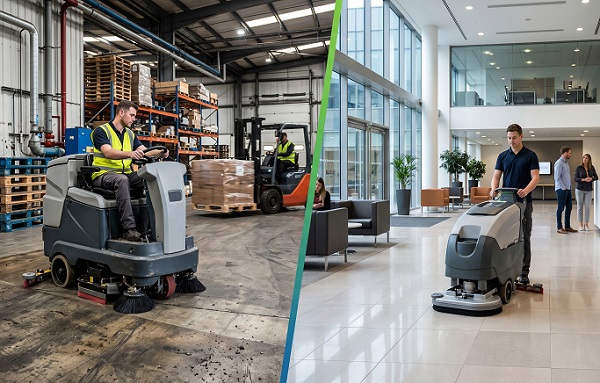
Scenario 1: A 5,000 sq ft retail clothing store→ Commercial walk-behind scrubber (20" width, $3,000–5,000) — runs 1 hour/day, light dust, tile floor. Perfect match.
Scenario 2: A 100,000 sq ft distribution warehouse→ Industrial ride-on scrubber/sweeper combo (40" width, $18,000–30,000) — runs 6 hours/day on rough concrete, picks up packaging debris and dust. Well worth the investment.
Scenario 3: A 35,000 sq ft auto repair shop→ Light industrial walk-behind or small ride-on (28–32" width, $6,000–12,000) — handles oil, grease, and metal shavings without the full industrial price tag.
Final Verdict
Choose commercial if:
Your facility is under 30,000 sq ft
Floors are smooth and clean (tile, sealed concrete, vinyl)
Cleaning runs 1–3 hours per day
Budget is your primary concern
Choose industrial if:
Your facility is over 50,000 sq ft
Floors face heavy dirt, oil, or debris
Cleaning runs 4+ hours per day or multiple shifts
Machine uptime and longevity matter more than upfront cost
Still not sure? Browse Jiechi's complete lineup of floor scrubbers and use our product filters to match by area, floor type, and duty cycle — no guesswork needed.

 Phone: +1 2403149021
 Mail: kliu@jiechi.com



 Phone:+1 2403149021
 Email:kliu@jiechi.com


 English


