Museum and Exhibition Hall Floor Care: Conservation-Safe Methods and Machines
Nov 24, 2026
A cleaner in a shopping mall can try a stronger detergent, but in a gallery the same decision can strip the finish off a marble floor a conservation team spent years stabilising. Museum floor cleaning is a different discipline: the risk is not dirt left behind, it is chemistry, moisture and dust where a heritage floor cannot tolerate them.
This guide explains what makes a method conservation-safe, how each museum floor type behaves, which machines work around plinths and barriers, and how to operate under visitor and humidity limits. Every figure quoted comes from datasheets you can check before buying.
Quick Answer
Conservation-safe museum floor cleaning means: neutral-pH low-residue detergents chosen with your conservator, wet methods that pick the water back up in the same pass, battery-electric machines with no exhaust, and dust-controlled dry polishing. A compact ride-on such as the JIECHI A5 (530 mm scrub path, 65/75 L tanks) covers open halls; a 2,200 rpm cordless polisher maintains gloss on stone and terrazzo; a 40 kg wet vacuum recovers wash water in tight zones. Verify runtime and noise on your own floor before purchase.
Key Takeaways
In heritage interiors the detergent is a conservation decision: high-alkaline degreasers and solvent polishes alter finishes and leave irreversible films.
Floor type sets the method: stone and terrazzo tolerate controlled wet scrubbing; parquet must stay near-dry; carpet needs extraction, not a mop.
Residue, not soil, is the long-term enemy: solids left as wash water evaporates dull the floor and attract the next layer of dirt.
A machine that picks up its own wash water in the same pass is inherently safer on a heritage floor than any flood-and-mop routine.
Battery-electric machines eliminate exhaust — the only realistic powered option in closed exhibition spaces.
Body dimensions decide access: a 0.62 m wide ride-on or a 40 kg vacuum moves around plinths; larger decks do not.
What This Guide Covers
Why standard cleaning products are a risk in galleries
Floor types: stone, parquet, terrazzo, carpet
Residue, off-gassing and VOC limits
Machine access around plinths and barriers
Dust control and filtration
Working around visitors and humidity limits
Why Standard Cleaning Products Are a Risk in Galleries
The products that dominate a janitorial cupboard are built for resilience: high-alkaline degreasers, acidic descalers, oil-based dressings. Each attacks a heritage floor in ways that are slow to appear and hard to undo. Alkaline residues can etch polished marble; acids eat calcite outright; oils darken open-pored stone and migrate into grout where they stay.
The second problem is what products leave behind rather than what they remove. A mop bucket is dirty by the third dip, and string mopping redistributes that water into joints, under plinth edges and into unseen corners. When it dries, a mineral film remains. On terrazzo and polished stone it shows as a loss of gloss depth; on textured surfaces it works as glue for the next layer of tracked-in soil.
Floor Types: Stone, Parquet, Terrazzo, Carpet
Museum floors are rarely one material, and each behaves differently under water. Honed and polished stone — marble, granite, limestone — tolerates controlled wet scrubbing if two conditions hold: the detergent stays neutral, and the wash water is lifted in the same pass. The A5's datasheet names marble and terrazzo among its intended surfaces, with a 530 mm brush deck feeding a 770 mm suction squeegee, so water exists on the floor for seconds, not minutes.
Terrazzo and dense polished concrete follow the same wet logic, but their long-term appearance depends on a gloss-maintenance programme: dry high-speed polishing that removes micro-scratches and restores reflectivity without flooding. That machine class returns in the dust section, because dry polishing makes residue of its own.
Parquet is the exception that proves the rule. Wood moves with moisture, and a heritage parquet floor has moved for a century; soaking it risks cupping, lifting boards and darkened seams. Wet scrubbing machines do not belong on bare parquet — treat it as a dry-dust and hand-cleaning surface. Carpet is a filtration problem: deep pile needs extraction on a schedule your contractor defines, plus aggressive entry matting to keep grit at the door. Each floor type rewards a machine chosen for it.
Residue, Off-Gassing and VOC Limits
Residue is a function of chemistry and of method. Dose too much detergent and the squeegee cannot lift it all; let wash water evaporate instead of vacuuming it, and every dissolved solid becomes a film. The fix is arithmetic you control: the label states a dilution, your team sets the water flow to match it, and the machine recovers the spent solution in the same pass. How much floor one tank covers is tank volume divided by your application rate — a figure your label and floor trials establish.
Off-gassing is the quieter constraint. Solvent-based polishes and some dressings release volatile organic compounds into closed exhibition halls for hours after application, in spaces where the air-change rate is deliberately gentle to protect objects. Machine exhaust matters for the same reason: fuel-burning floor machines, including the propane burnishers common in retail, have no place in a closed gallery. Battery-electric machines produce no exhaust at the point of use — why every machine in this guide runs on batteries.
Machine Access Around Plinths and Barriers
Exhibition floors are chopped into short runs: plinths, vitrines, stanchion lines and barriers break what would be long straight passes. That geometry decides which machine classes can work here. Three cover most museum situations; all figures below come from the datasheets.
Specification
Mini ride-on scrubber (JIECHI A5)
Battery polisher (JIECHI BA2510BT)
Wet vacuum (JIECHI BA500)
Working width
530 mm deck / 770 mm squeegee
530 mm pad
660 mm squeegee tool
Rated output
2,700 m²/h theoretical
2,800 m²/h theoretical
pick-up tool
Tank / bin
65 L solution / 75 L recovery
8 L dustbin
50 L recovery tank
Battery / power
24 V / 100 Ah
36 V / 100 Ah, 2,200 rpm
24 V / 40 Ah, 650 W suction
Body (L × W × H)
1.26 × 0.62 × 1.03 m
1.50 × 0.65 × 1.12 m
0.60 × 0.60 × 0.38 m
Weight
220 kg
220 kg
40 kg
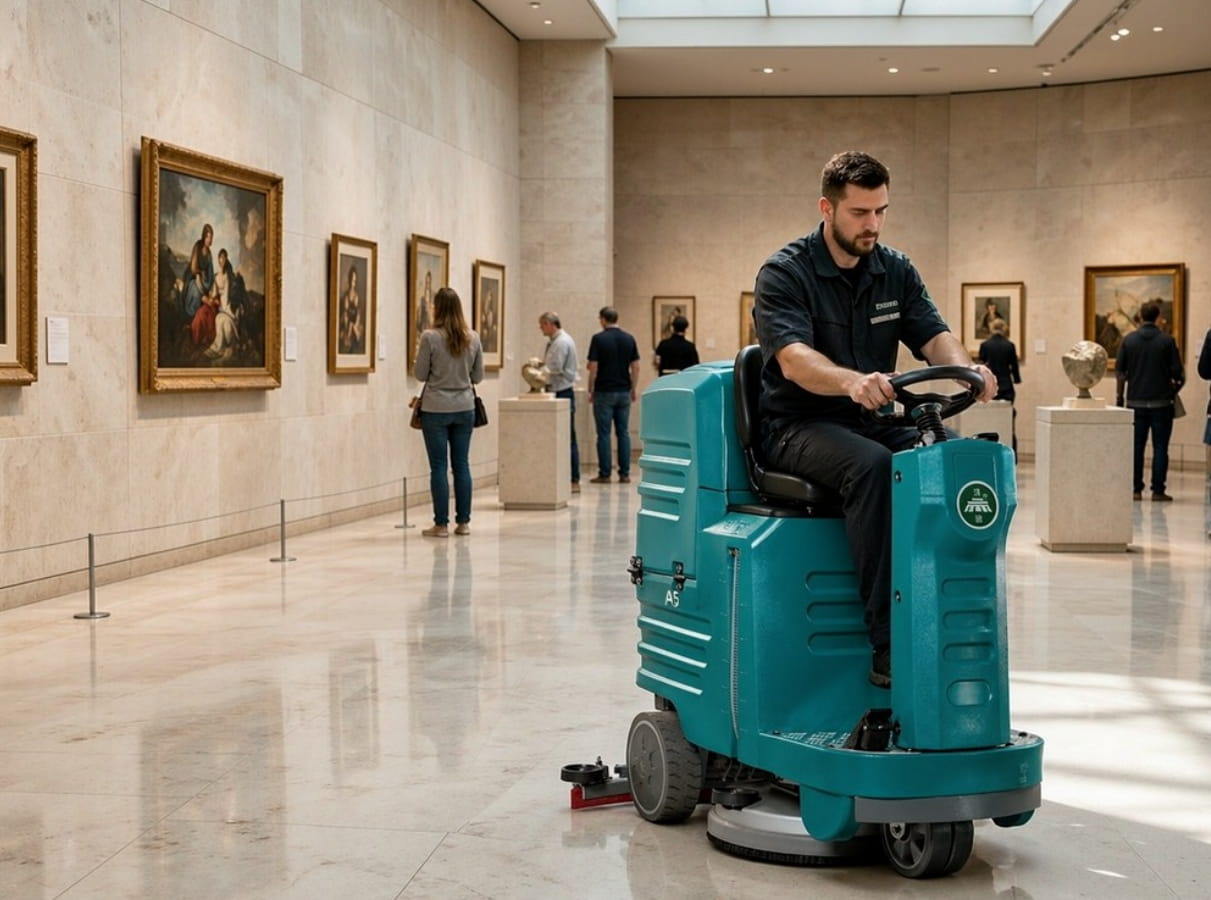
For open halls and long galleries, a 65 L mini ride-on floor scrubber with a 530 mm deck is sized to slip between stanchion rows: a 0.62 m wide body and a 1.26 m turning length. It scrubs and recovers in one pass at up to 2,700 ㎡/h on paper — the theoretical rate your barrier layout will discount. Solution of 65 litres against 75 litres of recovery keeps the vacuum side alive for the whole water supply, and the product page's 4–5 hour continuous rating covers an after-hours window.
Around the plinths themselves, width and weight shrink. a 40 kg commercial wet vacuum with a 50 L recovery tank goes where no ride-on fits — between vitrines, into object-storage corridors, onto mezzanines — and recovers wash water from hand-scrubbed zones the same controlled way. Plan each gallery as two zones: ride-on passes for the open floor, compact pick-up within reach of an object case. The boundary is your turning space, and your building survey sets it.
Dust Control and Filtration
Dry polishing keeps stone and terrazzo looking right, and it makes dust. At 2,200 rotations per minute a polishing pad abrades the microscopic top layer of the finish, and in an open hall that dust becomes airborne — a problem for objects and people unless it is captured where it is created.
The machine for the job is a 530 mm cordless battery polisher running at 2,200 rpm: its dust containment skirt channels polishing residue into an 8 L dustbin instead of letting it settle on plinth tops. Its floating pad driver follows minor floor irregularities, which matters on heritage floors that are never perfectly flat; uneven pad pressure is what leaves swirl marks on old terrazzo. Cord-free running also removes the trailing-cable hazard from visitor routes during daytime touch-ups.
Wet pick-up deserves the same attention. The BA500 draws at 180 mbar through a 650 W suction motor with anti-foam and float protection, so wash water carrying suspended grit reaches the tank instead of the motor. Empty the tank the same evening — slurry dries into exactly the cement-like film you are trying to avoid — and rinse the filter on your own schedule. Put the filtration specification in writing for your conservator's file, and never dry-sweep: a broom aerosolises the fine dust a vacuum would have captured.
Working Around Visitors and Humidity Limits
Most museum floor work happens in the visitor-free window, and that is where the ride-on earns its place: one operator covers the open halls with the A5, tanks refill in a service room, and the floor is dry the moment the squeegee has passed — no drying time between work and opening. Where daytime work is unavoidable, battery-electric machines keep the space usable: no exhaust, and noise low enough for a normal conversation — verify that with a demonstration on your own floor rather than trusting a decibel claim.
Humidity is the last gate, set by your conservator rather than the machine catalogue. Relative humidity bands protect hygroscopic objects, and any wet method must fit inside them: the practical answer is to shorten the wet event, not the water dose below the label's minimum. A scrub-and-vacuum pass leaves seconds of standing water against the minutes a mop leaves — why flood-and-mop routines fail this test near sensitive objects. For parquet and other moisture-critical surfaces the wet event is zero — dry methods only.
A gallery shift then reads: vacuum the tight zones with the 40 kg wet vacuum and hand tools, run the ride-on passes while the building is empty, dry-polish stone and terrazzo on the gloss schedule, and hand-finish edges and plinth bases. Four methods, four machines, one floor that looks unchanged — the conservation standard every method here answers to.
Common Questions
Can you use a floor scrubber on heritage stone floors?
Yes, when the stone is sound and the method is approved: neutral detergent, a soft brush or pad, and vacuum recovery in the same pass. The A5 class was built for this — its 530 mm deck and 770 mm squeegee lift water seconds after it is laid.
Which machines are suitable for daytime cleaning with visitors present?
Battery-electric machines only — no fuel-burning equipment in closed halls. Confirm noise with a live demonstration before purchase, and keep daytime work behind barriers with a walk-clearance plan.
How often should museum floors be cleaned?
Traffic decides, and your visitor counts decide traffic: entry zones and temporary-exhibition corridors need daily attention, low-traffic galleries far less. Set frequencies from your footfall data and the conservator's inspection notes, then hold them constant so any change can be traced.
Planning conservation-safe floor care for a museum or exhibition hall?
Send your floor types, hall areas and access constraints — we will reply with a machine shortlist matched to conservation requirements.
Email: kliu@jiechi.com | Phone / WhatsApp: +1 240 314 9021
Contact us

 Phone: +1 2403149021
 Mail: kliu@jiechi.com



 Phone:+1 2403149021
 Email:kliu@jiechi.com



 English


