Mini Ride-On Floor Scrubber: Aisle Width and Turning Maths Under 130 cm
Nov 25, 2026
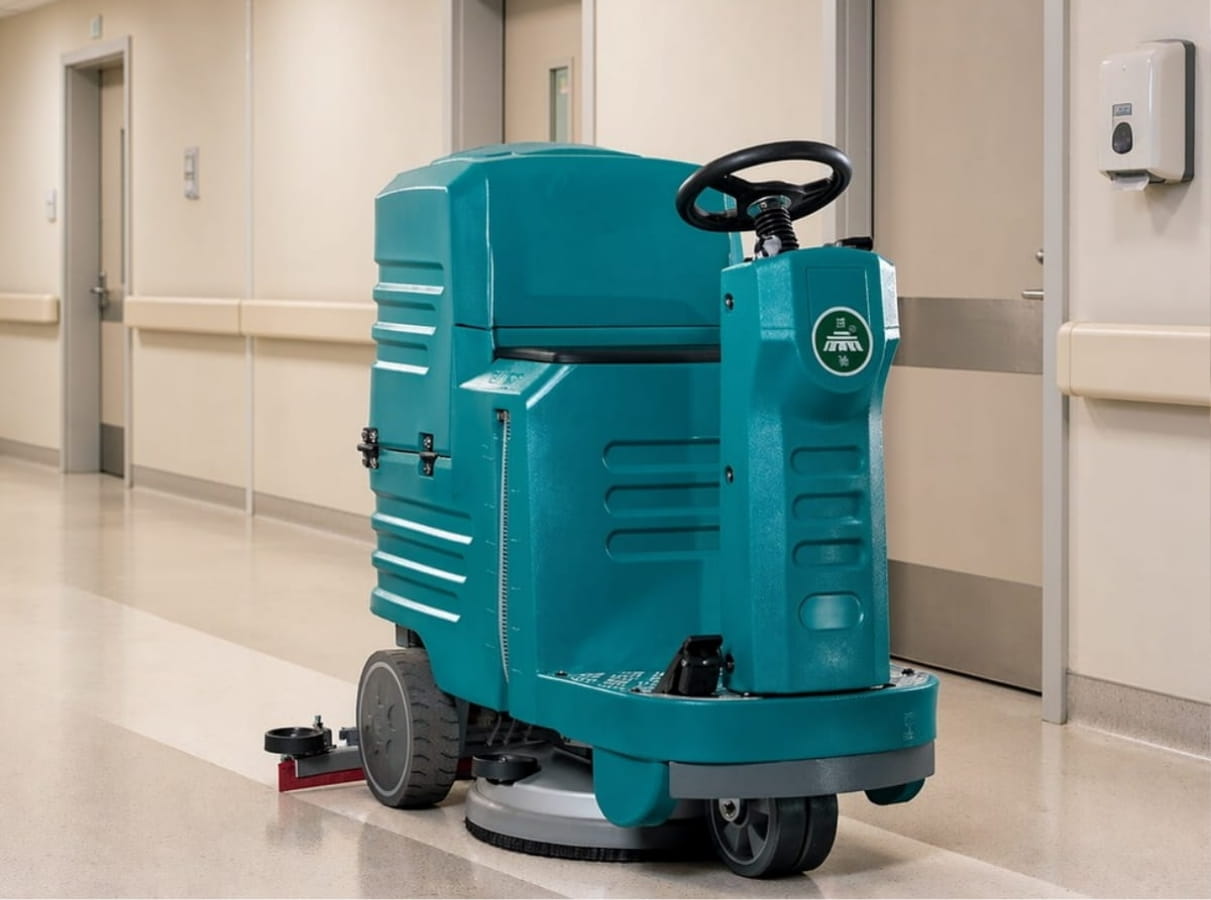
A mini ride-on floor scrubber keeps a seated operator inside a body shorter than 1.30 m: the JIECHI A5 measures 126 × 62 × 103 cm, scrubs a 530 mm deck at up to 2,700 ㎡/h theoretical and carries 65/75 L tanks on a 24 V / 100 Ah battery. Fit is decided by three checks you run yourself: body width plus your clearance margin against the narrowest aisle, a measured U-turn in the tightest dead-end, and door, lift and ramp openings en route. A 660 mm dual-brush compact and a 530 mm walk-behind bracket this class.
Key Takeaways
The footprint is the hard constraint: a 1.26 m × 0.62 m body has a diagonal of roughly 1.40 m, and any aisle narrower than that is a straight pass with no pivot.
Clearance is your rule: body width plus the margin you set on each side defines the aisle you accept.
2,700 ㎡/h is a theoretical ceiling — achievable output is that rate times a utilization factor only your aisles can tell you.
Doors, lifts and ramps decide where the machine travels: a 62 cm body through a 76 cm leaf leaves 14 cm, and 220 kg plus operator must sit inside the lift's load rating.
What This Guide Covers
How narrow is narrow: 126 × 62 cm in real aisles
Turning radius and the three-point turn problem
Why 2,700 ㎡/h needs a rider, not a pusher
The specification set that decides fit
Door, lift and ramp limits
Scenario solutions: matching the body to the layout
How Narrow Is Narrow: 126 × 62 cm in Real Aisles
Start with the body, because everything else is negotiable except geometry. The A5's published dimensions are 126 × 62 × 103 cm, and at 220 kg empty it stays in territory a goods trolley can handle — which matters when the only route to a floor is a lift and a ramp of unknown grade.
Width decides entry. The body is 62 cm across, but that is the sheet-metal figure, not the working figure: add the clearance margin you require on each side and you have your minimum aisle. If your rule is ten centimetres a side, the machine needs 82 cm of clear passage between uprights, racking legs or display ends. Set that margin yourself, then walk the building with a tape and note every bottleneck.
Length quietly constrains turns. The body's diagonal — the distance the machine occupies corner to corner when it swings — works out to roughly 1.40 m by Pythagoras from the datasheet dimensions. Any corridor narrower than that cannot host a pivot: you enter straight and reversing out is the only way round. That is acceptable in through-aisles cleaned in one direction; it rules out lazy habits in dead ends.
Why 2,700 ㎡/h Needs a Rider, Not a Pusher
A coverage rate is just width times speed, and the datasheet lets you do that division yourself. The A5's 2,700 ㎡/h over its 530 mm scrub path implies about 5.1 km/h. Run the same arithmetic on a 530 mm walk-behind rated at 2,200 ㎡/h and you get roughly 4.2 km/h, what a person pushes at. The machines are closer than the headline rates suggest; what separates them is who supplies the energy, and for how long.
A pusher can match the rider's pace for the first hundred metres. Over a four-hour shift the difference is the operator: seated, one person holds a constant line, brush pressure and overlap hour after hour, and the product page rates the A5 for four to five hours of continuous work on its 24 V / 100 Ah battery. Walking behind a vibrating machine, that consistency drains long before the battery does — the 500 W traction motor does not get tired, the person does.
Be equally clear-eyed about the 2,700 figure itself. It assumes continuous straight motion on open floor: every turn, reversal, tank stop and edge pass cuts into it. Achievable output is the theoretical rate times a utilization factor only your floor can give you — run one representative shift, divide cleaned area by elapsed time, and use that number for staffing. Buyers who skip this step staff for a rate; buyers who measure it staff for their building.
The Specification Set That Decides Fit
Three machine classes cover the aisle-width question from below, in the middle and above. The table puts their published numbers side by side, every cell from the product pages.
Specification
Mini ride-on (JIECHI A5)
Small dual-brush ride-on (JIECHI A6)
Walk-behind (JIECHI A3)
Scrub width
530 mm single deck
660 mm dual brush
530 mm
Squeegee width
770 mm
800 mm
770 mm
Theoretical rate
2,700 ㎡/h
3,000 ㎡/h
2,200 ㎡/h
Tanks (solution / recovery)
65 L / 75 L
90 L / 110 L
50 L / 55 L
Battery
24 V / 100 Ah
24 V / 145 Ah
24 V / 100 Ah
Body (L × W × H)
126 × 62 × 103 cm
130 × 72 × 134 cm
127 × 55 × 109 cm
Weight
220 kg
295 kg
155 kg
Brush / traction power
560 W / 500 W
550 W × 2 / 400 W
550 W / 550 W suction
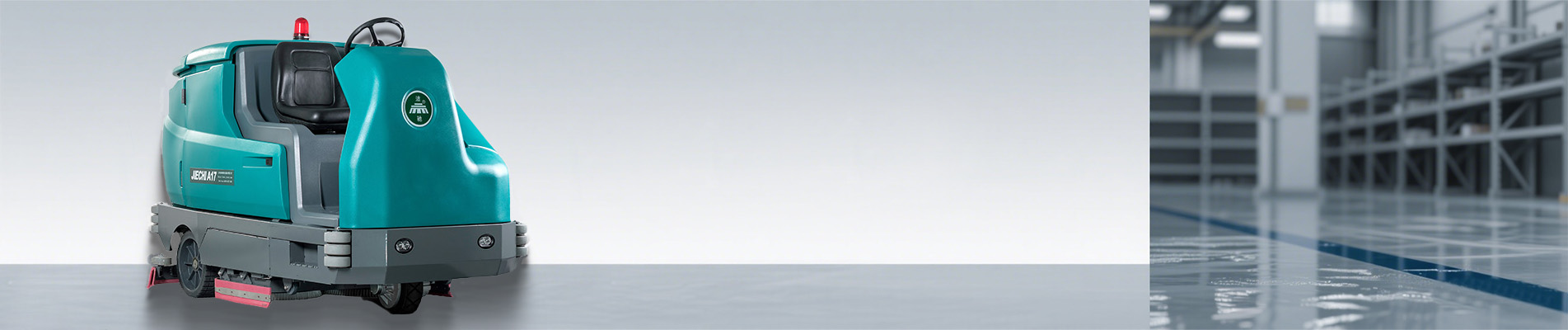
Reading the table as a buyer, three rows carry the decision. Body width: the walk-behind's 55 cm slips where the riders hesitate, while the A6's 72 cm already needs wider back-of-house aisles. Weight: 155 kg can be manhandled over a threshold; 295 kg cannot. And rate per width: the A6's 3,000 ㎡/h over 660 mm implies about 4.5 km/h — dual brushes buy width, not speed. If your aisles are marginal, a 530 mm mini ride-on floor scrubber with a 1.26 m body is the class built for that middle ground.
When open floor dominates and aisle width stops binding, a 660 mm dual-brush ride-on floor scrubber with a 90 L solution tank converts ten extra centimetres of body into more scrub width, bigger tanks and a 145 Ah battery — the right trade once the machine stops squeezing past racking. Where corridors are furniture-choked, a 530 mm walk-behind floor scrubber with a 50 L solution tank does the tight work a seated machine cannot reach.
Door, Lift and Ramp Limits
The machine only earns its keep on the floors you can get it to, so survey the transport route before purchase. Doors first: measure the clear opening, not the leaf — hinges, door stops and mats all steal centimetres. A 62 cm body through a 76 cm leaf leaves 14 cm, seven a side; if your margin rule demands more, the doorway is your bottleneck. Double doors or an alternate route often cost nothing and change the answer.
Lifts add load and depth. The machine weighs 220 kg before the tanks are filled, and the operator rides with it, so check both against the lift's load rating rather than guessing. Car depth matters as much: a 1.26 m body needs room to turn in or reverse out. If the goods lift is shared with trolleys, schedule the transfer off-peak.
Ramps are the quietest risk in this class. The published table lists traction at 500 W but no gradeability figure, so put the question in writing: state your ramp's length and slope and ask the supplier to confirm the machine climbs it fully loaded and stops safely on it. Threshold plates and the lip at lift doors deserve the same treatment — a step a walk-behind hops can ground a ride-on's lower edge.
Scenario Solutions: Matching the Body to the Layout
Map your building against three layouts. The first is the supermarket pattern: long parallel gondola runs with aisles near a metre wide and a wide open front-of-store. There the mini ride-on is the whole answer — it threads the runs in straight passes and covers the open floor at full pace, with the 65/75 L tanks sized so a refill does not interrupt every second aisle.
The second layout is the warehouse or workshop: racking aisles you must enter but mainly travel, plus large open staging floor. The deciding question is whether the A6's 72 cm body clears your racking; if it does, the dual-brush width and 90/110 L tanks pay off on the open floor, and if not, the A5 still handles the racks. The third layout is retail, clinics and schools — short corridors, doorways every few metres, furniture everywhere. That is walk-behind territory: the 155 kg machine, not a rider forced through turns it cannot make.
Many buildings end up with a split fleet, and that is not an admission of failure — it is what the geometry demands: one seated machine for the runs it fits, one compact push machine for the aisles it cannot enter, and a handover point between them.
Common Questions
What aisle width does a mini ride-on floor scrubber need?
Body width is 62 cm; your minimum aisle is that plus the clearance margin you set — ten centimetres a side gives 82 cm. Remember the turning limit too: with a 1.26 m body, aisles under roughly 1.40 m are straight passes with no pivot.
Do I need a driving licence to operate it?
No. The product page states no licence is needed: forward and reverse are simple controls, and staff typically master the machine after brief on-site training. Your own site rules for powered equipment still apply.
What does the 2,700 ㎡/h rating actually mean?
It is the theoretical ceiling: 530 mm of scrub width times an implied speed of about 5.1 km/h. Turns, dead-ends and tank stops cut into it, so measure your real output over one representative shift.
Can it travel in a passenger or goods lift?
If the numbers allow. The machine weighs 220 kg empty and the operator rides along, so check both against the rated load, and confirm the car offers depth for a 1.26 m body.
What floor surfaces can it clean?
The product page lists epoxy, cement, terrazzo, tile, marble and PVC — all flat indoor hard floors, not carpet or severely uneven ground; for speciality surfaces confirm brush, pad and detergent first.
How long does it run on one charge?
The product page rates four to five hours of continuous work on the 24 V / 100 Ah battery — enough for an after-hours window in most retail settings. Achievable coverage in that window is the utilization factor your own floor gives.
Conclusion
A mini ride-on floor scrubber is decided by geometry before it is decided by cleaning power: a 126 × 62 cm body, a measured U-turn, and the doors, lifts and ramps on the way to the floor.
Match the class to the layout — a 530 mm rider for marginal aisles, a 660 mm dual-brush machine for open floor, a walk-behind for the corridors no rider should enter — and let measurements from your own building settle every claim.
Checking whether a compact ride-on fits your aisles?
Send your aisle widths, door openings and floor types — we will confirm the fit and shortlist the right machine class before you commit.
Email: kliu@jiechi.com | Phone / WhatsApp: +1 240 314 9021
Contact us

 Phone: +1 2403149021
 Mail: kliu@jiechi.com



 Phone:+1 2403149021
 Email:kliu@jiechi.com



 English


