How Autonomous Cleaning Robots Are Redefining Facility Maintenance in 2026
May 16, 2026
Facility managers in 2026 face a familiar set of challenges: rising labor costs, persistent staffing shortages, and an ever-higher bar for cleanliness standards across commercial and industrial spaces. The old answer — throw more people and more mops at the problem — no longer works.
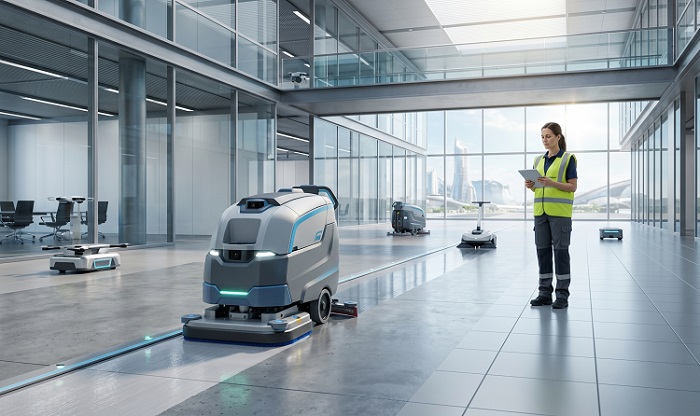
Enter autonomous cleaning robots. These aren't the timid circle-bouncing vacuums of a decade ago. Today's driverless floor scrubbers are sophisticated, AI-powered machines that navigate complex environments, make real-time decisions, and deliver consistent cleaning results without human supervision.
In this article, we explore how autonomous cleaning robots are transforming facility maintenance, what technologies power them, and how JIECHI's intelligent scrubber lineup — the JC80 and JC10 — fits into this revolution.
The Case for Automation in Cleaning
1. Labor Reality
The commercial cleaning industry has long relied on manual labor, but the math is shifting:
Labor shortages are chronic across hospitality, healthcare, retail, and manufacturing
Turnover rates for cleaning staff can exceed 100% annually in some regions
Training costs add up — each new hire needs instruction on equipment, chemicals, and safety protocols
Autonomous robots don't entirely replace human cleaners, but they augment the workforce. They handle repetitive, large-area scrubbing so that human staff can focus on detail work, disinfection, and customer-facing tasks that require judgment.
2. Consistency at Scale
A human cleaner might scrub 500 m² in the morning with full energy, then lose steam by midday. Autonomous robots don't fatigue. They follow programmed routes at consistent speeds, with uniform brush pressure, every single time.
For facilities that span thousands of square meters — shopping malls, logistics warehouses, hospitals, and factory floors — this consistency is transformative.
3. Data and Accountability
Modern cleaning robots generate data: coverage maps, cleaning logs, battery status, and even air quality readings. Facility managers can verify that every zone was cleaned on schedule — capability that manual cleaning simply cannot match.
Key Technologies Behind Autonomous Cleaning Robots
What makes a cleaning robot truly autonomous? It comes down to three core technology pillars:
Perception (Seeing)
Autonomous robots use a combination of sensors to understand their environment:
LiDAR (Laser Radar): Scans surroundings in 270° to 360° to build real-time maps
Depth Cameras & Vision Sensors: Recognize objects, people, and changes in the environment
Ultrasonic Sensors: Detect transparent or reflective obstacles that LiDAR might miss
Anti-collision Bumpers: Physical safety backup if all else fails
The JIECHI JC80 uses a comprehensive sensor suite including panoramic monocular cameras, 270° laser radar, 360° depth cameras, and ultrasonic sensors — providing the perception needed for safe autonomous navigation in dynamic environments.
Navigation (Thinking)
Once the robot sees its environment, it needs to plan a path:
SLAM (Simultaneous Localization and Mapping) allows the robot to build a map while tracking its position within it
Path optimization algorithms calculate the most efficient route to cover an area without skipping spots or wasting time
Dynamic replanning adjusts the route when obstacles appear — a cart left in an aisle, a person walking through
The JC80's vision-plus-laser navigation scheme enables it to plan efficient routes autonomously and switch between auto and manual modes as needed.
Scrubbing and Recovery (Acting)
Autonomous navigation is useless without effective cleaning. Robots combine:
Optimized brush pressure matched to floor type (tile, concrete, epoxy)
Controlled water and chemical dispensing for consistent wetting
Powerful vacuum recovery to leave floors dry and safe immediately after cleaning
The JC80 delivers a cleaning performance of 2,040 m²/hour with a 510 mm cleaning width and a robust 70 L solution / 50 L recovery tank configuration — built for extended autonomous runs.
Real-World Applications
Warehouses and Logistics Centers
Large, open floor plans with minimal pedestrian traffic make warehouses ideal for autonomous cleaning robots. A single JC80 can handle nighttime cleaning of 5,000–8,000 m² of warehouse space, running on a pre-programmed schedule, and returning to its charging station automatically.
Retail and Supermarkets
Cleaning in retail is tricky — you can't close during business hours, and you can't have wet floors in high-traffic aisles. Compact autonomous robots like the JIECHI JC10 operate at under 65 dB, navigate around customers and shelves, and leave floors dry in one pass. They are small enough (52 × 42 × 49 cm) to clean narrow aisles that bigger machines simply cannot reach.
Hospitals and Healthcare
Hygiene standards in healthcare leave no room for error. Autonomous cleaning robots can scrub and disinfect floors on a programmed schedule, ensuring every patient room and corridor is cleaned to the same standard every cycle. The combination of scrubbing and chemical disinfection meets hospital-grade requirements while freeing nursing staff from cleaning duties.
Schools and Universities
Educational facilities benefit from after-hours autonomous cleaning. Robots operate while the building is empty, covering classrooms, libraries, and cafeterias overnight. Staff arrive to clean floors every morning without anyone having to run a mop.
ROI: What Does an Autonomous Robot Deliver?
For facility managers evaluating investment in cleaning robotics, the payback typically comes from:
Labor savings — One robot can replace 2–3 hours of daily manual scrubbing per shift
Reduced water and chemical use — Precise dispensing cuts waste by up to 30% compared to manual mopping
Lower equipment wear — Consistent operation extends machine life versus operator-driven abuse
Fewer accidents — Dry floors immediately after cleaning reduce slip-and-fall risk
Auditable compliance — Digital cleaning records support ISO and health inspections
Most facilities see a full ROI within 12–18 months, with ongoing savings in labor and consumables.
How to Choose the Right Autonomous Cleaning Robot
Not every facility needs the same robot. Consider:
Area size — Large open floors over 5,000 m² → JC80; Small tight spaces under 2,000 m² → JC10
Floor type — Epoxy, concrete, and tile all work with proper brush selection
Traffic pattern — Daytime cleaning needs smaller, quieter, obstacle-aware robots; nighttime cleaning can use larger machines
Integration needs — Look for robots with API or scheduling interfaces for facility management systems
Browse JIECHI's full cleaning robot lineup to find the right match for your facility.
The Future: What's Next for Cleaning Robots?
By 2027–2028, expect:
Fleet coordination — Multiple robots communicating to cover a facility without overlap
Elevator integration — Robots navigating between floors autonomously
Predictive maintenance — AI predicting brush wear, battery degradation, and service intervals
Chemical-free cleaning — UV-C and steam disinfection integrated into autonomous platforms
JIECHI is actively developing these capabilities, leveraging its in-house R&D and manufacturing to bring commercial-grade intelligence to cleaning equipment at a price point accessible to mid-market facilities.
Conclusion
Autonomous cleaning robots are no longer a futuristic concept — they are a practical, ROI-positive solution for facility managers dealing with labor constraints and rising cleanliness demands. Whether you need a large-scale driverless scrubber for an industrial warehouse or a compact smart cleaner for a retail space, today's technology delivers.
The JC80 driverless floor scrubber and JC10 mini cleaning robot represent two ends of the autonomous cleaning spectrum — both engineered and manufactured in-house by JIECHI with full OEM support for global partners.
Interested in bringing autonomous cleaning to your facility? Contact JIECHI to discuss your requirements and get a personalized recommendation.

 Phone: +1 2403149021
 Mail: kliu@jiechi.com



 Phone:+1 2403149021
 Email:kliu@jiechi.com


 English


