other

Commercial Cleaning Equipment

Home

Commercial Cleaning Equipment

  • How Should Supermarket Chains Be Cleaned?
    Jun 09, 2026
    When we shop at supermarkets, we can immediately sense the quality of the store environment. Clean, dry floors make the entire store appear bright and spacious, encouraging customers to step inside. In contrast, some stores have sticky, yellowed floors in the deli section that discourage shopping, while standing water in the fresh produce and seafood sections can lead to safety hazards.   Most major chain supermarkets today combine retail, fresh produce, deli, and food service operations. With high foot traffic and a constant flow of customers, blood, grease, footprints, and dust are a constant problem. Cleaning has long been a top priority for store operations and remains a common challenge for many retailers.   Supermarkets have numerous aisles, dense shelving, and many corners, making it difficult for large equipment to maneuver; Daily dust and water stains in the fresh produce section make manual cleaning time-consuming and require significant manpower; The deli and dining areas operate as a single unit, resulting in frequent grease buildup. This necessitates floor cleaning that dries immediately without disrupting customer shopping. Jiechi’s push-type models—including the BA680BT, BA860BT, A1, and A3—can cover all operational scenarios in supermarket retail spaces.   【A1 and A3 Walk-Behind Floor Scrubbers: The Workhorses for Retail Environments】 With a compact and agile design and smooth steering, these machines can navigate easily between shelves and checkout areas. They scrub and vacuum simultaneously, leaving the floor dry instantly with no standing water. Operation is simple, and cleaning staff can get started after just a brief training session. The A3D model features a self-propelled function, making it even more efficient for large retail spaces.     【BA680BT Walk-Behind Floor Scrubber – Highly Flexible】 With a 68L (clean water) tank capacity, it minimizes the need for frequent refilling and waste disposal. Ideal for deli sections in medium-sized retail stores, it effectively removes bloodstains and animal/vegetable oil residues, keeping fresh food areas dry and hygienic.     【BA860BT Fully Automatic Floor Scrubber – Dual-Brush Efficiency】 With a dual-brush deck cleaning width of 860 mm and self-propelled operation, there’s no need for strenuous pushing. The 95-liter fresh water tank delivers cleaning efficiency several times greater than manual labor. Adjustable brush pressure allows for water and energy savings in lightly soiled areas, significantly reducing cleaning time for large spaces.     Mechanization replaces traditional mops and brooms, significantly reducing the cleaning staff required per store and effectively controlling labor costs; Standardized equipment ensures consistent cleaning results, leaving store floors free of grease and standing water, with even hard-to-reach corners clean and tidy, thereby continuously enhancing the customer shopping experience; Equipment parts are easy to replace, and with Jiechi’s nationwide after-sales service network, maintenance and repairs are handled quickly, ensuring that daily store cleaning operations are not disrupted.   Jiechi cleaning equipment has established a replicable model for cleaning in fresh produce supermarket chains. Catering to all types of general supermarkets and fresh produce markets nationwide, Jiechi meets diverse needs by leveraging mechanized and standardized cleaning to help retail stores reduce costs and improve efficiency, creating a clean and safe shopping environment.    
  • Walk-Behind vs. Ride-On Floor Scrubbers: How to Choose the Right Fleet for Your Facility
    Jun 02, 2026
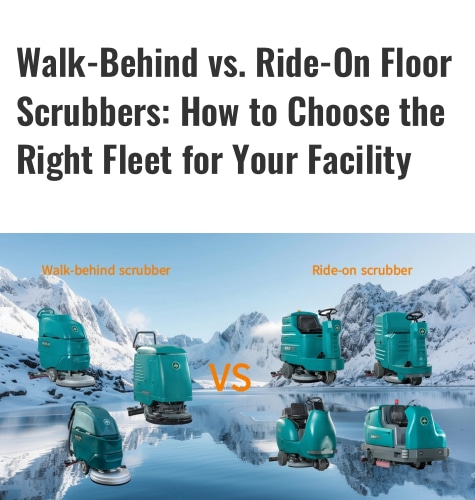
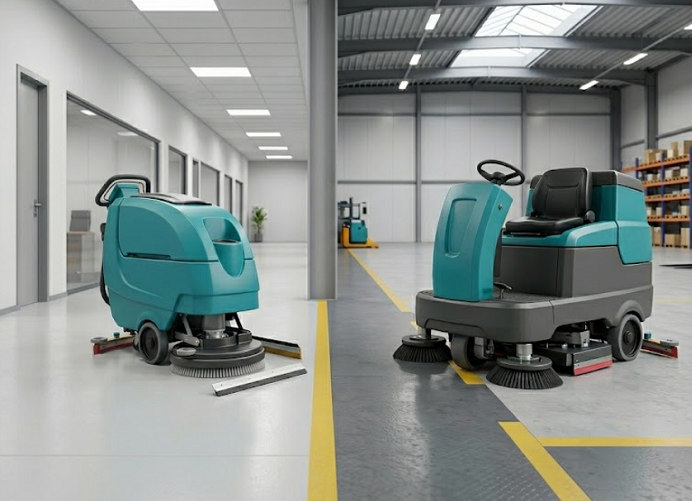
    In the fast-paced world of industrial and commercial facility management, maintaining spotless floors is no longer just about aesthetics—it’s about safety, compliance, and operational efficiency. If you are still relying on traditional mopping, or looking to upgrade your current cleaning fleet, you’ve likely arrived at a critical crossroads: Should you invest in a walk-behind or a ride-on floor scrubber?     As a leading global manufacturer of floor scrubbers and sweepers, Jiechi has helped thousands of factories, warehouses, hospitals, and shopping malls optimize their cleaning protocols. Here is a data-driven breakdown to help you make the smartest investment for your business.     1. The Walk-Behind Scrubber: Agility Meets Precision Walk-behind floor scrubbers (like the Jiechi BA530BT or the A3) are operated by a technician walking behind the machine. Best Suited For:   Tight and Congested Spaces: Narrow aisles, office hallways, and doorways. Smaller Footprints: Facilities under2,000㎡. Corner Cleaning: Superior maneuverability around tight corners and under obstacles.       2. The Ride-On Scrubber: Maximum Productivity for Large Scale Ride-on scrubbers (like the heavy-duty Jiechi A7, BA900BT, A10, A17) allow the operator to sit comfortably while driving the machine.     Best Suited For:   Expansive Areas: Large logistics warehouses, transport hubs, and manufacturing plants. High-Frequency Cleaning: Spaces larger than $3,000\text{ m}^2$ that require rapid turnaround times.   Labor Optimization: When you need to cover double the square footage with half the manpower.   The Jiechi Advantage: Jiechi ride-on models boast high-capacity solution tanks and extended battery life, drastically reducing the time spent on "dump and refill" stops.     The Decision Matrix: How to Choose? To make your decision easier, our engineering team has summarized the key metrics in the comparison table below: Feature Walk-Behind Scrubbers Ride-On Scrubbers Average Cleaning Speed 1,500 - 2,500 ㎡ 3,500 - 6,500+㎡ Maneuverability Exceptional (Turns on a dime) Moderate (Requires wider turning radius) Initial Investment Lower upfront cost Higher upfront cost (Offset by rapid ROI) Labor Efficiency Standard High (Reduces labor costs by up to 50%) Ideal Environments Retail stores, schools, hospitals Warehouses, airports, large factories     The Bottom Line: Calculate Your ROI When choosing between a walk-behind and a ride-on machine, look closely at your Total Cost of Ownership (TCO). While a ride-on scrubber requires a higher initial capital expenditure, it slashes labor hours dramatically. In large facilities, a ride-on machine often pays for itself within the first 6 months purely through labor savings. However, many modern facilities don't just choose one—they deploy a hybrid fleet. For example, utilizing a Jiechi A7 for the main warehouse floor and a Jiechi A1 or A3 for the narrow packing zones.
  • How Do Escalator Cleaners Work Without Disrupting Shopping Mall Traffic?
    May 27, 2026
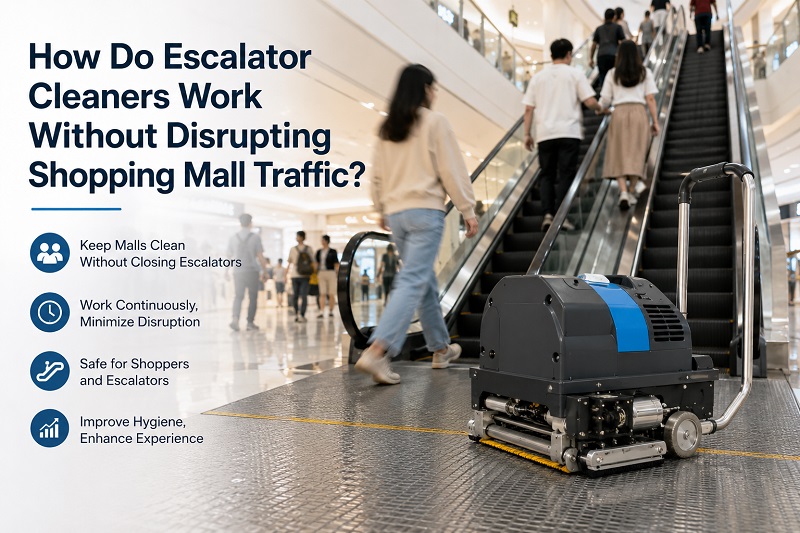
    Shopping malls, airports, and metro stations depend on escalators to move thousands of people every hour. When those escalators get dirty, facility managers face a tricky question: how do you clean them without shutting down the entire vertical transit system? The short answer is — you use purpose-built escalator cleaning machines designed to work alongside moving steps, not against them. Let's break down how these machines actually operate in live traffic. What Makes Escalator Cleaning Different from Floor Cleaning? Escalators are not flat floors. They consist of moving steps that disappear into comb plates at the top and bottom, with narrow gaps, side skirts, and fixed handrails. Dirt accumulates in three zones: Step treads and risers — the visible part riders stand on Side skirt panels — where shoes scrape against the sides Comb plate and landing zone — where debris gets trapped Each zone requires a different cleaning approach. A standard floor scrubber cannot handle step geometry or the constant motion of escalator treads. That is why specialized escalator cleaning equipment exists. The Core Mechanism: How Escalator Cleaners Work Modern escalator cleaners, such as the JIECHI EL510 compact wet/dry escalator cleaning machine, use a combination of rotating brushes, water spray, and vacuum recovery to clean steps while the escalator continues moving. Here is the step-by-step process: 1. Brush Rotation with Step-Safe Geometry The cleaning head is equipped with counter-rotating cylindrical brushes designed to match the pitch and profile of escalator steps. As the steps pass under the machine, the brushes agitate embedded dirt, gum residue, and oil stains from both the tread surface and the riser. The brush material is firm enough to remove stubborn grime yet gentle enough not to damage step surfaces. 2. On-Demand Water or Chemical Spray A built-in water tank supplies a controlled spray of water or diluted cleaning solution onto the brushes. This wet-scrubbing action loosens deposits that dry brushing alone cannot remove. For daily maintenance, water alone often suffices. For deep cleaning, a mild degreaser can be added to tackle the oil and rubber marks that accumulate on steps over time. 3. Instant Vacuum Recovery This is the real secret to non-disruptive cleaning. After the brushes scrub the steps, a powerful wet/dry vacuum immediately extracts the dirty water and debris from the step surface. The result is a clean, nearly dry step within seconds — no puddles, no slippery residue, and no waiting for drying time. The recovered slurry is stored in a separate tank for proper disposal. 4. Continuous Flow Operation Because the machine sits at the bottom landing of the escalator and the steps move toward it, the operator simply positions the cleaning head and lets the escalator mechanism do the work. Each step passes through the cleaning cycle one at a time. The escalator never needs to stop. Pedestrians can continue riding, stepping off at the top, while the machine cleans from the bottom. Why Shopping Mall Traffic Is Not Disrupted Three design features make this possible: No shutdown required — the escalator runs at normal speed throughout the cleaning process No wet floor hazard — vacuum recovery leaves steps dry, eliminating slip-and-fall risks Minimal footprint — the compact machine occupies only the bottom landing area, leaving the rest of the escalator accessible   This is especially important in shopping malls during business hours. Shutting down an escalator for cleaning would force shoppers onto stairs or elevators, creating congestion and reducing foot traffic to upper-level stores. With a non-disruptive escalator cleaner, cleaning can happen during normal operation — even during peak hours. Common Applications Beyond Shopping Malls While we highlight shopping malls, the same technology works in: Airport terminals — clean moving walkways and escalators without delaying passengers Metro and subway stations — maintain high-traffic escalators during transit hours Convention centers — prepare for large events without operational downtime Office buildings and hotels — clean escalators during the workday without blocking access How Often Should Escalators Be Cleaned? Frequency depends on traffic volume: High-traffic (malls, transit hubs) — daily dry brushing with weekly deep wet cleaning Medium-traffic (hotels, offices) — 2–3 times per week dry brushing, bi-weekly deep cleaning Low-traffic (small buildings) — weekly dry brushing, monthly deep cleaning The key is consistency. Regular cleaning prevents the buildup of sticky residues that attract more dirt and wear down step surfaces over time. Choose the Right Partner for Escalator Cleaning Equipment At JIECHI, we manufacture the EL510 compact wet/dry escalator cleaning machine and support OEM customization for distributors and facility management companies worldwide. Our factory in Shanghai and Jiangxi covers over 60,000 m², with in-house R&D, production, and quality control — ensuring you get a reliable cleaning solution built for daily commercial use. Whether you need a single machine for a shopping mall contract or a branded OEM solution for your local market, we are ready to support your cleaning operations. 👉 Contact us today to discuss your escalator cleaning needs. Let's keep your vertical transit clean, safe, and always running.
  • How Often Should You Replace Brushes and Squeegees on Commercial Sweepers? A Practical Maintenance Guide
    May 26, 2026
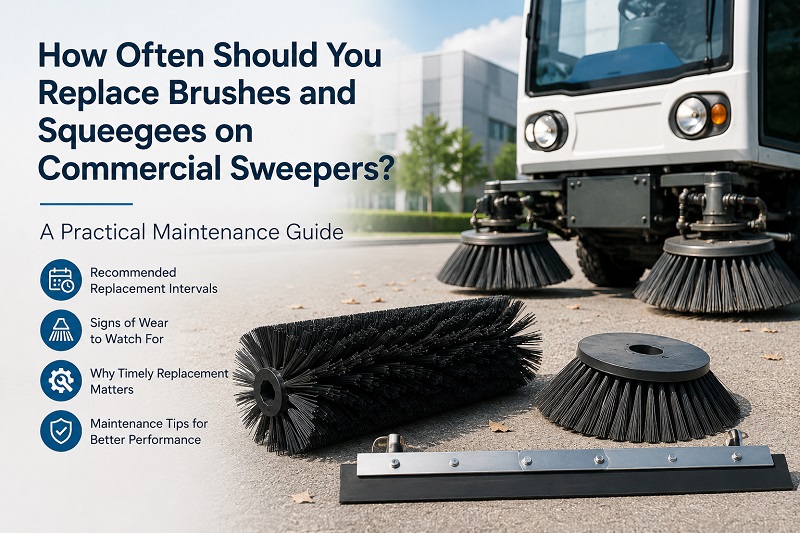
    Investing in a commercial sweeper is a significant decision for any facility. But even the best machine won't perform well if its wearing parts—particularly the brushes and squeegees—are past their prime. So, how often should you actually replace them? The short answer: it depends on usage hours, floor conditions, and the type of debris you sweep. Below is a practical guide to help facility managers and maintenance teams keep their sweepers operating at peak efficiency. How Often Should You Replace Sweeper Brushes? Commercial sweeper brushes include main cylindrical brushes, side brushes, and in some models, stub brushes. Each type wears at a different rate. For main brushes, the general rule of thumb is every 300 to 500 operating hours. Under heavy-duty conditions—warehouses with concrete dust, outdoor lots with sand and grit—replacement may be needed as early as 200 hours. For lighter environments like retail floors or clean manufacturing, brushes can last up to 600 hours. Side brushes, which sweep debris from corners and edges into the main brush's path, typically need replacement every 150 to 250 hours. Their smaller size and exposed position make them wear faster, especially when used against curbs or walls. A visual check is just as important as the hour meter. Signs of wear include bristles that are frayed, bent, broken, or reduced to less than half their original length. When you see the brush losing its "bristle density," sweeping performance drops noticeably. How Often Should You Replace Squeegees? Squeegees—typically found on sweepers that also scrub or on combination sweeper-scrubbers—are made of rubber blades that wear faster than brushes. The standard replacement window is every 100 to 200 operating hours. Why so frequent? Squeegee blades maintain constant contact with the floor, scraping away water and fine dust. Over time, the blade edge rounds off, becomes nicked, or develops a permanent set from sitting in one position. A worn squeegee leaves streaks, fails to pick up water entirely, or allows fine dust to escape behind the machine. Here are the telltale signs: Streaks or moisture trails left behind after cleaning Visible wear marks on the blade edge (rounded, chipped, or torn) Increased noise as the squeegee skips or vibrates across the floor Water left behind in patches, indicating the seal is broken Squeegees should also be rotated or flipped regularly. Many blades are reversible—using both sides before replacement doubles their useful life. Factors That Affect Wear Rate Not all facilities wear down brushes and squeegees at the same pace. Here are the most influential factors: Floor surface is the biggest variable. Rough concrete, asphalt, and tile with heavy grout lines will accelerate wear dramatically versus smooth epoxy or polished concrete. Debris type matters too—fine dust is abrasive and grinds down bristles faster than larger debris that "pushes" rather than "scrapes." Frequency of use is obvious: a machine running two shifts daily will need parts replaced twice as often as one running a single shift. Finally, operator habits play a role—lowering the brush or squeegee too aggressively, turning too sharply, or running over metal obstacles can shorten life considerably. Recommended Replacement Schedule (Quick Reference) Part Light Use Normal Use Heavy Use Main brush 500–600 hrs 300–500 hrs 200–300 hrs Side brush 200–300 hrs 150–250 hrs 100–150 hrs Squeegee blades 150–200 hrs 100–150 hrs 50–100 hrs Squeegee complete assembly 300–500 hrs 200–400 hrs 150–300 hrs Best Practices to Extend Brush and Squeegee Life While replacement is inevitable, proper care can extend the service interval of every wearing part: Clean brushes and squeegees daily. String, wire, tape, and cloth wrap around brush shafts and squeegee blades, causing uneven wear. A few minutes of daily cleanup prevents hot spots that lead to premature failure. Adjust brush height and down-pressure correctly. Brushes that are set too low wear faster and scatter debris rather than sweeping it. Follow the manufacturer's recommended pressure setting—usually 10–15 mm of bristle deflection for main brushes. Rotate and flip squeegees every 30–50 hours. Most squeegee blades are symmetrical; using both edges before replacement effectively doubles the life of each blade. Store the machine with brushes and squeegees raised. Leaving a sweeper parked with the brush or squeegee in contact with the floor can cause permanent deformation—a flat spot on the brush or a set in the squeegee blade. Inspect weekly. A 30-second visual check each Monday morning can catch a worn brush or damaged squeegee before it starts compromising cleaning performance on the job. When in Doubt, Replace A worn brush or squeegee doesn't just clean poorly—it wastes time. The operator has to go over the same area again, and the machine works harder (consuming more battery or fuel) to compensate. In many cases, installing a fresh brush or new squeegee blade restores a sweeper's pick-up performance by 30–50%. Not sure which commercial sweeper is right for your facility? Contact us and we'll recommend the ideal model for your floor type and cleaning frequency.
  • Ride-On vs. Walk-Behind Floor Scrubbers: A Complete Comparison for Facility Managers
    May 23, 2026
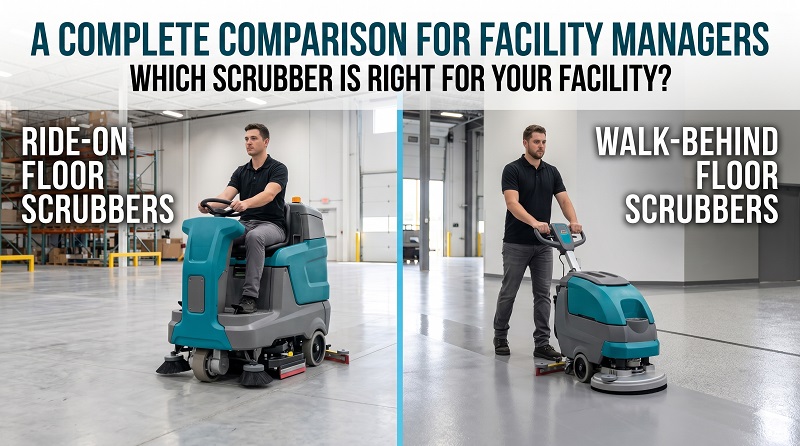
      Choosing the right floor scrubber can significantly impact your facility's cleanliness, operational efficiency, and bottom line. For facility managers and cleaning contractors, one of the most fundamental decisions is whether to invest in a ride-on floor scrubber or a walk-behind floor scrubber. Both machine types serve the same core purpose — cleaning and drying hard floors in commercial, industrial, and institutional settings. But they differ dramatically in productivity, cost, maneuverability, and suitability for different applications. This guide breaks down every aspect to help you make an informed decision. What Are Ride-On Floor Scrubbers? Ride-on floor scrubbers are self-propelled cleaning machines that the operator sits on while driving. They are designed for large open areas where covering significant square footage quickly is the top priority. Typical specifications: Cleaning width: 28–48 inches (700–1200 mm) Solution tank capacity: 30–70+ gallons (110–265+ liters) Coverage rate: 40,000–100,000+ sq ft per hour Battery runtime: 3–6 hours depending on model Ride-on scrubbers are most commonly used in warehouses, distribution centers, large manufacturing plants, big-box retail stores, shopping malls, airport terminals, and parking garages.   What Are Walk-Behind Floor Scrubbers? Walk-behind floor scrubbers are machines that the operator walks behind while guiding them across the floor. They come in two configurations: Walk-behind with rider sulky — The operator walks but can occasionally ride on a small platform for brief rests Standard walk-behind — Fully walk-along operation Typical specifications: Cleaning width: 17–34 inches (430–860 mm) Solution tank capacity: 8–25 gallons (30–95 liters) Coverage rate: 12,000–40,000 sq ft per hour Battery runtime: 2–5 hours Walk-behind scrubbers are ideal for smaller facilities, spaces with tight aisles and corners, multi-room buildings, restaurants, schools, retail stores, hospitals, and office buildings. Head-to-Head Comparison Factor Ride-On Scrubber Walk-Behind Scrubber Productivity 40,000–100,000+ sq ft/hr 12,000–40,000 sq ft/hr Best for 30,000+ sq ft open spaces Under 30,000 sq ft, complex layouts Maneuverability Lower — needs turning radius Higher — can navigate tight spaces Operator fatigue Low — seated operation Higher — walking all shift Initial cost $8,000–$30,000+ $2,500–$12,000 Maintenance cost Higher (more complex) Lower (simpler mechanics) Storage size Requires more space Compact storage Noise level Moderate Low to moderate Battery weight Heavy (integrated) Lighter (removable often possible) Training required More (driving skills) Minimal When to Choose Ride-On Choose a ride-on floor scrubber if your facility meets these criteria: 1. Large open floor area. If your facility has 30,000 square feet or more of contiguous floor space, a ride-on machine will pay for itself in labor savings. An operator on a ride-on scrubber can clean a 50,000 sq ft warehouse floor in about 1 hour — a task that would take a walk-behind operator 2.5 to 3 hours. 2. High cleaning frequency. Facilities that need daily or multiple-times-per-day cleaning, such as busy distribution centers or food processing plants, benefit enormously from ride-on productivity. 3. Long operator shifts. If your cleaning staff works 6–8 hour shifts, a ride-on machine dramatically reduces fatigue and improves cleaning quality. A tired operator using a walk-behind may rush the job or miss spots. 4. Budget for higher investment. While upfront cost is higher, the labor savings of a ride-on scrubber often deliver an ROI in 6–18 months for large facilities. Browse our ride-on floor scrubber collection → When to Choose Walk-Behind Choose a walk-behind floor scrubber if your situation matches these conditions: 1. Smaller facility. For spaces under 30,000 sq ft — or multiple small rooms totaling under that — a walk-behind is the more practical and cost-effective choice. 2. Tight aisles and obstacles. Facilities with narrow aisles (under 5 feet wide), heavy racking, many columns, or complex layouts are better served by walk-behind machines. They can turn in tight spaces and easily maneuver around obstacles. 3. Budget constraints. Walk-behind machines cost significantly less upfront. For small businesses, startups, or facilities with limited capital, they offer outstanding value and quick ROI. 4. Multi-surface or multi-floor cleaning. If the same machine needs to clean a retail store on one floor and an office on another, a walk-behind is much easier to move between floors or transport between job sites. 5. Mixed-use facilities. Schools, hospitals, and office buildings with varied room sizes and different floor types benefit from the versatility of walk-behind scrubbers. Check out our walk-behind scrubber models → Key Decision Matrix Facility Type Recommended Reasoning Warehouse / Distribution Center 50,000+ sq ft Ride-On Large open area, high productivity needed Small workshop 10,000–30,000 sq ft Walk-Behind Better value, adequate coverage Supermarket / big-box retail Ride-On Wide aisles, large floor area Convenience store / small retail Walk-Behind Tight space, lower budget Hospital patient wings Walk-Behind Multiple rooms, noise considerations Hospital main lobby / corridors Ride-On Large continuous area School classrooms & hallways Walk-Behind Multi-room, complex routing Food processing plant Ride-On Large area, frequent cleaning cycles Parking garage Ride-On Expansive sloped surface Office building Walk-Behind Multi-floor, room-to-room Total Cost of Ownership Cost Component Ride-On (48") Walk-Behind (28") Purchase price $18,000 $6,500 Batteries (2-year replacement) $600–$1,200 $300–$600 Brushes / pads (annual) $300–$500 $200–$350 Maintenance (annual) $500–$1,000 $300–$600 Labor cost per year ($15/hr, 50K sq ft daily) $12,000 $30,000 5-year TCO ~$85,000 ~$188,000 The labor savings from a ride-on scrubber in a large facility can easily dwarf the purchase price difference. Why Choose JIECHI for Your Floor Scrubber JIECHI Cleaning manufactures both ride-on and walk-behind floor scrubbers to meet the diverse needs of commercial and industrial facilities worldwide. As a full-factory OEM with over 60,000 m² of manufacturing space, we design and build every machine from the ground up — ensuring consistent quality, reliable performance, and cost-effective pricing. Whether you need a compact walk-behind for a retail store or a heavy-duty ride-on scrubber for a 100,000 sq ft warehouse, we can provide the right solution — and support it with genuine spare parts and responsive after-sales service. Contact us today for a personalized equipment recommendation based on your facility's specific requirements.

  • How Autonomous Cleaning Robots Are Redefining Facility Maintenance in 2026
    May 16, 2026
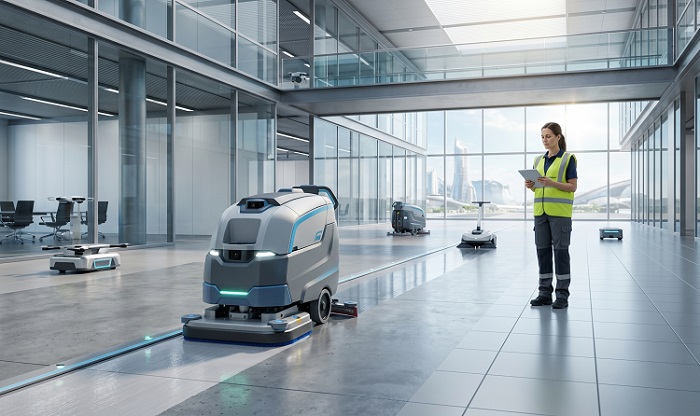
    Facility managers in 2026 face a familiar set of challenges: rising labor costs, persistent staffing shortages, and an ever-higher bar for cleanliness standards across commercial and industrial spaces. The old answer — throw more people and more mops at the problem — no longer works.     Enter autonomous cleaning robots. These aren't the timid circle-bouncing vacuums of a decade ago. Today's driverless floor scrubbers are sophisticated, AI-powered machines that navigate complex environments, make real-time decisions, and deliver consistent cleaning results without human supervision. In this article, we explore how autonomous cleaning robots are transforming facility maintenance, what technologies power them, and how JIECHI's intelligent scrubber lineup — the JC80 and JC10 — fits into this revolution.   The Case for Automation in Cleaning 1. Labor Reality The commercial cleaning industry has long relied on manual labor, but the math is shifting: Labor shortages are chronic across hospitality, healthcare, retail, and manufacturing Turnover rates for cleaning staff can exceed 100% annually in some regions Training costs add up — each new hire needs instruction on equipment, chemicals, and safety protocols Autonomous robots don't entirely replace human cleaners, but they augment the workforce. They handle repetitive, large-area scrubbing so that human staff can focus on detail work, disinfection, and customer-facing tasks that require judgment. 2. Consistency at Scale A human cleaner might scrub 500 m² in the morning with full energy, then lose steam by midday. Autonomous robots don't fatigue. They follow programmed routes at consistent speeds, with uniform brush pressure, every single time. For facilities that span thousands of square meters — shopping malls, logistics warehouses, hospitals, and factory floors — this consistency is transformative. 3. Data and Accountability Modern cleaning robots generate data: coverage maps, cleaning logs, battery status, and even air quality readings. Facility managers can verify that every zone was cleaned on schedule — capability that manual cleaning simply cannot match.   Key Technologies Behind Autonomous Cleaning Robots What makes a cleaning robot truly autonomous? It comes down to three core technology pillars: Perception (Seeing) Autonomous robots use a combination of sensors to understand their environment: LiDAR (Laser Radar): Scans surroundings in 270° to 360° to build real-time maps Depth Cameras & Vision Sensors: Recognize objects, people, and changes in the environment Ultrasonic Sensors: Detect transparent or reflective obstacles that LiDAR might miss Anti-collision Bumpers: Physical safety backup if all else fails The JIECHI JC80 uses a comprehensive sensor suite including panoramic monocular cameras, 270° laser radar, 360° depth cameras, and ultrasonic sensors — providing the perception needed for safe autonomous navigation in dynamic environments. Navigation (Thinking) Once the robot sees its environment, it needs to plan a path: SLAM (Simultaneous Localization and Mapping) allows the robot to build a map while tracking its position within it Path optimization algorithms calculate the most efficient route to cover an area without skipping spots or wasting time Dynamic replanning adjusts the route when obstacles appear — a cart left in an aisle, a person walking through The JC80's vision-plus-laser navigation scheme enables it to plan efficient routes autonomously and switch between auto and manual modes as needed. Scrubbing and Recovery (Acting) Autonomous navigation is useless without effective cleaning. Robots combine: Optimized brush pressure matched to floor type (tile, concrete, epoxy) Controlled water and chemical dispensing for consistent wetting Powerful vacuum recovery to leave floors dry and safe immediately after cleaning The JC80 delivers a cleaning performance of 2,040 m²/hour with a 510 mm cleaning width and a robust 70 L solution / 50 L recovery tank configuration — built for extended autonomous runs.   Real-World Applications Warehouses and Logistics Centers Large, open floor plans with minimal pedestrian traffic make warehouses ideal for autonomous cleaning robots. A single JC80 can handle nighttime cleaning of 5,000–8,000 m² of warehouse space, running on a pre-programmed schedule, and returning to its charging station automatically. Retail and Supermarkets Cleaning in retail is tricky — you can't close during business hours, and you can't have wet floors in high-traffic aisles. Compact autonomous robots like the JIECHI JC10 operate at under 65 dB, navigate around customers and shelves, and leave floors dry in one pass. They are small enough (52 × 42 × 49 cm) to clean narrow aisles that bigger machines simply cannot reach. Hospitals and Healthcare Hygiene standards in healthcare leave no room for error. Autonomous cleaning robots can scrub and disinfect floors on a programmed schedule, ensuring every patient room and corridor is cleaned to the same standard every cycle. The combination of scrubbing and chemical disinfection meets hospital-grade requirements while freeing nursing staff from cleaning duties. Schools and Universities Educational facilities benefit from after-hours autonomous cleaning. Robots operate while the building is empty, covering classrooms, libraries, and cafeterias overnight. Staff arrive to clean floors every morning without anyone having to run a mop.   ROI: What Does an Autonomous Robot Deliver? For facility managers evaluating investment in cleaning robotics, the payback typically comes from: Labor savings — One robot can replace 2–3 hours of daily manual scrubbing per shift Reduced water and chemical use — Precise dispensing cuts waste by up to 30% compared to manual mopping Lower equipment wear — Consistent operation extends machine life versus operator-driven abuse Fewer accidents — Dry floors immediately after cleaning reduce slip-and-fall risk Auditable compliance — Digital cleaning records support ISO and health inspections Most facilities see a full ROI within 12–18 months, with ongoing savings in labor and consumables.   How to Choose the Right Autonomous Cleaning Robot Not every facility needs the same robot. Consider: Area size — Large open floors over 5,000 m² → JC80; Small tight spaces under 2,000 m² → JC10 Floor type — Epoxy, concrete, and tile all work with proper brush selection Traffic pattern — Daytime cleaning needs smaller, quieter, obstacle-aware robots; nighttime cleaning can use larger machines Integration needs — Look for robots with API or scheduling interfaces for facility management systems Browse JIECHI's full cleaning robot lineup to find the right match for your facility.   The Future: What's Next for Cleaning Robots? By 2027–2028, expect: Fleet coordination — Multiple robots communicating to cover a facility without overlap Elevator integration — Robots navigating between floors autonomously Predictive maintenance — AI predicting brush wear, battery degradation, and service intervals Chemical-free cleaning — UV-C and steam disinfection integrated into autonomous platforms JIECHI is actively developing these capabilities, leveraging its in-house R&D and manufacturing to bring commercial-grade intelligence to cleaning equipment at a price point accessible to mid-market facilities.   Conclusion Autonomous cleaning robots are no longer a futuristic concept — they are a practical, ROI-positive solution for facility managers dealing with labor constraints and rising cleanliness demands. Whether you need a large-scale driverless scrubber for an industrial warehouse or a compact smart cleaner for a retail space, today's technology delivers. The JC80 driverless floor scrubber and JC10 mini cleaning robot represent two ends of the autonomous cleaning spectrum — both engineered and manufactured in-house by JIECHI with full OEM support for global partners. Interested in bringing autonomous cleaning to your facility? Contact JIECHI to discuss your requirements and get a personalized recommendation.
  • Walk-Behind vs Ride-On Floor Scrubber: Which One Is Right for Your Facility?
    Apr 29, 2026
    When outfitting a professional cleaning operation, one question comes up again and again: walk-behind or ride-on floor scrubber? The answer isn't one-size-fits-all — it depends on your facility size, layout, and daily traffic. Let's break down the key differences so you can make an informed decision. Walk-Behind Scrubbers: Best for Tight Spaces A walk-behind floor scrubber like the Jiechi A3 is ideal for smaller to mid-sized areas. With a 530mm cleaning width and a compact turning radius, it can easily navigate narrow aisles, retail floors, and congested corridors. It offers excellent maneuverability, intuitive touch-panel controls, and hassle-free maintenance — all at a lower upfront cost. For facilities under 2,000m², a walk-behind model is often the most cost-effective commercial cleaning equipment choice. Ride-On Scrubbers: Built for Large-Scale Productivity When your facility spans thousands of square meters, a ride-on floor scrubber becomes essential. The Jiechi A8/A10 dual-brush ride-on model delivers a cleaning performance of up to 8,600m²/h, paired with a massive 280L solution tank and 300L recovery tank. The dual brush system powers through stubborn grease and grime in warehouses, factories, and logistics hubs. Operators can work longer without fatigue, significantly reducing labor costs in industrial cleaning. Key Maintenance Tips for Longevity No matter which type of commercial cleaning equipment you choose, proper upkeep is critical. Always rinse the recovery tank after each shift to prevent odor. Inspect squeegee blades and brush discs weekly — worn parts reduce cleaning efficiency. For ride-on models, check battery water levels monthly to extend floor scrubber battery life. Following these practices keeps your machine running at peak performance for years. Choose Jiechi — Your Trusted Floor Cleaning Partner Still unsure which type fits your operation? At Jiechi Cleaning, we specialize in manufacturing high-performance floor scrubbers, sweepers, and cleaning robots with factory-direct pricing and full OEM/ODM support. Whether you need a compact walk-behind model for retail spaces or a heavy-duty ride-on for industrial warehouses, we have the right solution for you. For larger debris-prone areas, consider pairing with an industrial floor sweeper as a pre-clean step. Browse our full range of floor scrubbers to find the perfect match. Contact us today — our team is ready to help you choose the right cleaning equipment for your facility!
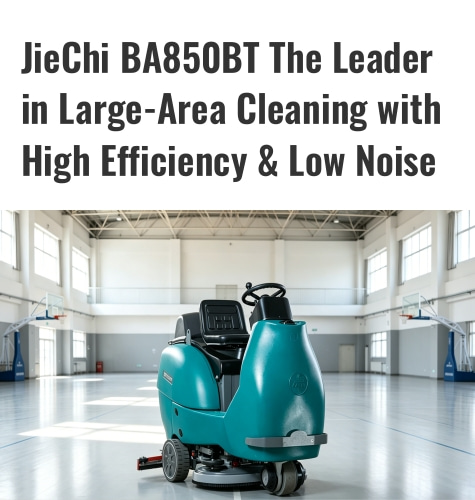
  • JIECHI BA850BT The Leader in Large-Area Cleaning with High Efficiency & Low Noise
    Apr 28, 2026
    Large-scale indoor cleaning scenarios demand higher-performance cleaning equipment. ⚠️Factory workshops struggle with heavy oil stains on floors;  ⚠️hospitals and schools enforce strict standards for hygiene cleanliness and noise control;  ⚠️underground parking lots and logistics warehouses feature vast floor areas where manual sweeping is time-consuming and labor-intensive.   The JieChi BA850BT Large-scale floor scrubber delivers a perfect solution to all these challenges.   JieChi BA850BT Core Advantages   850mm Ultra-wide Cleaning Path Equipped with an extra-large brush disc, it delivers extensive single-pass coverage, minimizing repeated cleaning strokes and drastically boosting efficiency in open areas such as corridors, workshops and parking lots, while cutting labor costs effectively.   180L Clean Water Tank + 195L Sewage Tank Dual large-capacity tanks reduce frequent water refills and sewage disposal, supporting long-duration continuous operation. Even for large-scale logistics warehouses spanning thousands of square meters, one-stop uninterrupted cleaning is achievable to avoid workflow disruptions.   Full-body Anti-collision Strips Protects the equipment from impact damage and prevents scratches on floors, walls and surrounding facilities.   Ultra-quiet Operation Design The suction motor is embedded in a sound-absorbing system with premium noise-dampening materials, ensuring extremely low operating noise.   Applicable Scenarios   Shopping Malls & Supermarkets Efficiently cleans tile and marble floors with instant washing and drying performance, ensuring pedestrian safety and maintaining a neat, tidy shopping environment. Factory Workshops & Industrial Plants Effectively removes oil stains, metal scraps and industrial dust. Compatible with cement floors, epoxy flooring, wear-resistant floors and more, it helps factories meet sanitation standards and ensure safe production. Hospitals, Schools & Office Buildings The low-noise design eliminates noise disturbance, with dust-free and residue-free cleaning results. It meets the stringent hygiene requirements of medical, educational and commercial office spaces for a healthy and sanitary environment. Underground Parking Lots The wide cleaning coverage greatly improves operational efficiency, easily removing dust, sediment and tire marks to prevent dust accumulation and keep parking areas well-maintained. Logistics Warehouses & Distribution Centers Long battery life and large tank capacity fully meet large-area cleaning demands, supporting high-efficiency daily sanitation without disrupting warehousing operations and cargo turnover. Hotel Lobbies & Exhibition Centers Leaves floors spotless and completely dry after cleaning, elevating overall venue hygiene and brand image.     Ideal for property management supervisors, factory administrative teams, shopping mall operators, and facility managers of hospitals and schools, the JieChi BA850BT stands as the top choice for daily large-area indoor cleaning and post-construction site cleanup. It enables full-scenario, high-efficiency, and low-consumption cleaning operations, helping create a cleaner, quieter, and safer working and public environment.

leave a message

leave a message
If you are interested in our products and want to know more details,please leave a message here,we will reply you as soon as we can.
submit

Home

Products

WhatsApp

contact