How to Choose the Right Floor Scrubber for Your Facility Size: Tank Capacity, Cleaning Width & Battery Life Explained
May 12, 2026
Choosing a floor scrubber isn't just about picking the most expensive model or the one with the flashiest features. The single most important factor is matching the machine to your facility's size. Get this wrong, and you either overpay for capacity you don't need or end up with a machine that can't finish the job before running out of battery or water.
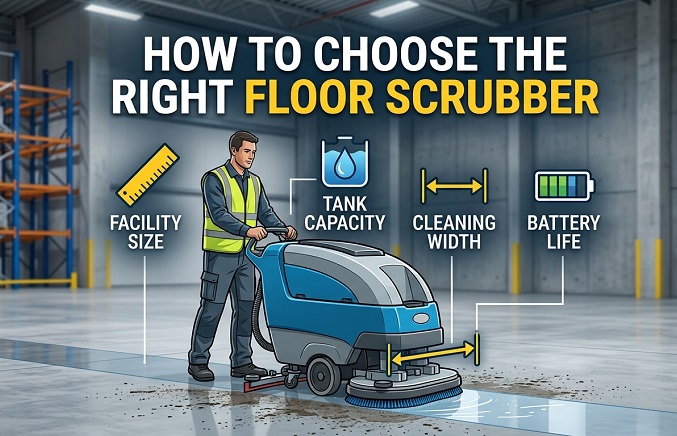
In this guide, we break down the three critical specs — tank capacity, cleaning width, and battery life — and show you exactly how to calculate what your facility needs.
Why Facility Size Matters for Floor Scrubber Selection
Every cleaning manager has faced this scenario: a brand-new scrubber that runs out of water halfway through the warehouse, or a machine that takes twice as long as expected because the cleaning path is too narrow.
The root cause is almost always the same — the machine was chosen without matching its specs to the actual floor area.
Here's a quick decision framework based on facility size:
Small (retail shops, offices, clinics, under 5,000 sq ft): Walk-behind scrubbers (16–20 inch), 10–13 gallon tank
Medium (schools, hotels, supermarkets, 5,000–20,000 sq ft): Walk-behind scrubbers (20–28 inch), 13–20 gallon tank
Large (warehouses, factories, airports, 20,000–100,000+ sq ft): Ride-on scrubbers (28–36 inch), 20–40+ gallon tank
Note: Tank capacity varies by brand and model. Always check the manufacturer's spec sheet.
1. Tank Capacity: How Much Floor Can You Clean Per Refill?
Tank capacity determines how long you can clean without stopping to empty the dirty water tank and refill with fresh solution. This is arguably the most overlooked spec in floor scrubber selection.
The rule of thumb: A floor scrubber typically covers about 10–15 square feet per gallon of solution, depending on the floor type. Porous floors (like unsealed concrete) consume more solution, while smooth floors (like tile or sealed concrete) use less.
Example calculation:
A 10-gallon machine ≈ 100–150 sq ft per tank
A 20-gallon machine ≈ 200–300 sq ft per tank
A 40-gallon machine ≈ 400–600 sq ft per tank
For a 50,000 sq ft warehouse, a machine with a 40-gallon tank would require about 3–4 refills to complete a full cleaning cycle. That's significant downtime.
Here's the bottom line: If your facility requires more than 3 tank refills per cleaning session, consider upgrading to a larger-capacity model.
2. Cleaning Width: How Fast Can You Cover the Floor?
Cleaning width determines productivity — wider means fewer passes, shorter cleaning time, and less labor cost.
The simple formula:
A 20-inch scrubber covers roughly 20,000 sq ft per hour (assuming 2.5 mph walking speed, 85% efficiency for overlap)
A 28-inch scrubber covers roughly 28,000 sq ft per hour
A 34-inch ride-on scrubber covers roughly 38,000–45,000 sq ft per hour
What this means for your facility:
Under 10,000 sq ft: A 17–20 inch walk-behind is sufficient. Cleaning takes roughly 30 minutes.
10,000–30,000 sq ft: A 24–28 inch walk-behind or compact ride-on. Cleaning takes 45–90 minutes.
Over 30,000 sq ft: A 30+ inch ride-on scrubber. Cleaning takes 1–3 hours depending on layout.
If your cleaning team spends more than 2 hours per day on floor cleaning, a wider scrubber could cut labor costs in half over the machine's lifespan.
3. Battery Life: Can Your Scrubber Handle Back-to-Back Shifts?
Battery runtime is the third leg of the stool. Even with the right tank and cleaning width, a dead battery at the wrong time brings everything to a halt.
Key battery considerations:
Lead-acid batteries: Typically provide 3–5 hours of runtime, but require 8+ hours to charge plus cool-down time. Not suitable for multi-shift operations.
Lithium batteries: Provide 4–6 hours of runtime and can be opportunity-charged during breaks (30 minutes of charging gives 1–2 hours of operation). Ideal for multi-shift facilities.
For a 50,000 sq ft facility with a ride-on scrubber:
Lead-acid: May not finish a full shift on one charge. Requires designated charging room with ventilation.
Lithium: Can finish the job and be recharged in time for the next shift.
Pro tip: If your facility operates on two shifts, skip lead-acid entirely and invest in lithium-powered equipment. The upfront cost is higher, but the productivity gain is substantial.
How to Match Floor Scrubber to Your Specific Facility
Here's a step-by-step approach to choosing the right scrubber:
Measure your total cleanable floor area (exclude areas occupied by shelving, machinery, or storage)
Estimate your cleaning budget (minutes per cleaning session and number of shifts)
Calculate the minimum cleaning width you need to stay within that budget
Determine required tank capacity based on frequency of refills your team can tolerate
Choose the battery type that matches your shift schedule
For example, a 30,000 sq ft warehouse with one shift:
Cleaning width needed: 28+ inches (≤90 minute cleaning time)
Tank capacity needed: 20–30 gallons (1–2 refills)
Battery: Lithium recommended for consistent runtime across the shift
Suggested machine: A walk-behind floor scrubber like Jiechi's JD-28B
For a 100,000 sq ft logistics center running two shifts:
Cleaning width needed: 34+ inches ride-on
Tank capacity needed: 40+ gallons
Battery: Lithium mandatory for opportunity charging between shifts
Suggested machine: A ride-on floor scrubber like Jiechi's RS-36
Common Mistakes When Choosing a Floor Scrubber
1. Overestimating cleaning width coverage
A 20-inch scrubber doesn't really clean 20 inches — subtract 1–2 inches for overlap
Real-world efficiency is around 80–85%
2. Buying a scrubber that's too small
Leads to operator fatigue from extra passes
Increases labor costs over the machine's lifetime
Often requires a second cleaning session to finish
3. Ignoring floor type and condition
Rough concrete requires different pad pressure than smooth tile
Uneven floors need larger squeegees or dual-squeegee systems for effective drying performance
Solution consumption varies dramatically by floor porosity
4. Neglecting squeegee system quality
A poor squeegee leaves streaks and wet spots, creating slip hazards
Look for machines with adjustable squeegee pressure and tilt-back protection
Final Recommendation
There's no one-size-fits-all floor scrubber. The right choice depends on your specific facility size, floor type, shift schedule, and cleaning priorities.
For small facilities (<5,000 sq ft): Compact walk-behind with lithium battery. Look for easy maneuverability around obstacles.
For medium facilities (5,000–20,000 sq ft): Mid-size walk-behind with at least 20-inch cleaning width. Prioritize tank capacity and battery runtime.
For large facilities (>20,000 sq ft): Ride-on scrubber with lithium battery and large tank capacity. Consider models with dual squeegee for better drying results and efficiency.
Jiechi Cleaning offers a full range of floor scrubbers designed for facilities of every size — from compact walk-behind models for small shops to heavy-duty ride-on machines for industrial warehouses. Each unit is built with lithium battery compatibility, easy-maintenance squeegee systems, and durable polyethylene tanks.
Ready to find the perfect floor scrubber for your facility? Contact our team for a personalized recommendation based on your floor plan and cleaning schedule. We'll help you calculate the exact specs you need — no guesswork, no overspending.
What's your facility size? Drop us a message and we'll match you with the right machine.

 Phone: +1 2403149021
 Mail: kliu@jiechi.com



 Phone:+1 2403149021
 Email:kliu@jiechi.com


 English


