Lithium vs Lead-Acid Batteries for Floor Scrubbers: Which Power Source Is Right for Your Facility?
May 09, 2026
When buying a floor scrubber, most buyers focus on cleaning width, tank capacity, and brush type. But there's a quieter decision that can make or break your daily operations: the battery.
Walk into any facility using cordless floor scrubbers, and you'll find two camps: those running on traditional lead-acid batteries and those that have switched to lithium. Each has strong advocates. Each has trade-offs.
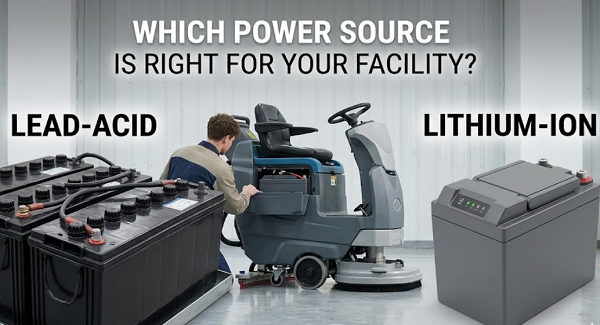
In this guide, we break down the real differences between lithium and lead-acid batteries in floor cleaning equipment — from daily runtime and charging habits to total cost of ownership — so you can pick the right power source for your facility.
Why Battery Choice Matters More Than You Think
A floor scrubber's battery isn't just an accessory — it's the heart of the machine. It determines:
How long you can clean before needing a recharge
When you can clean (during or between shifts)
How much maintenance the cleaning team needs to perform
How long the machine lasts before major component replacement
Choose wrong, and you might end up with a machine that can't finish the day's cleaning, requires mid-shift battery swaps, or needs replacement batteries within two years.
Lead-Acid Batteries: The Old Reliable
Lead-acid batteries have powered industrial cleaning equipment for decades. They're well understood, widely available, and significantly cheaper upfront.
Pros
Lower initial cost — A lead-acid battery pack costs 40–60% less than an equivalent lithium pack
Widely recyclable — Over 99% of lead-acid battery material is recycled in North America and Europe
Simple replacement — Any service technician can source and swap lead-acid batteries
Tolerant of cold — Performance in sub-zero environments is more predictable than early lithium chemistries
Cons
Slow charging — Full charge takes 8–10 hours (overnight only)
Limited partial charging — Deep discharge cycles are recommended; frequent top-ups shorten lifespan
Heavier — A lead-acid pack for a mid-size ride-on scrubber can weigh 300+ kg, adding to machine weight and floor loading
Maintenance required — Regular water topping, terminal cleaning, and equalization charges
Shorter cycle life — Typically 500–800 charge cycles before capacity drops below 70%
Best for: Facilities with single-shift operation, overnight charging schedules, and tighter upfront budgets.
Lithium Batteries (LiFePO4): The Modern Upgrade
Lithium iron phosphate (LiFePO4) has become the gold standard in premium floor scrubbers over the past five years. While more expensive initially, the operational advantages are significant.
Pros
Fast charging — 80% charge in 1–2 hours; full charge in 3–4 hours
Opportunity charging — Top up during breaks without damaging battery life
No maintenance — Sealed unit, no water filling, no terminal cleaning
Lightweight — Typically 40–60% lighter than equivalent lead-acid
Long cycle life — 2,000–5,000 charge cycles depending on depth of discharge
Consistent power — Voltage stays flat throughout the discharge, meaning no performance drop as the battery drains
Built-in BMS — Battery Management System protects against overcharge, over-discharge, and overheating
Cons
Higher upfront cost — 2–3× the price of lead-acid
Temperature sensitivity — Charging below 0°C / 32°F requires built-in heating (available on premium packs)
Specialized replacement — Not all service centers stock lithium packs for older models
Disposal regulations — Requires certified recyclers (though recycling infrastructure is growing fast)
Best for: Multi-shift operations, facilities that can't spare 8+ hours for charging, and buyers optimizing for long-term cost.
Head-to-Head Comparison
Factor
Lead-Acid (AGM/Gel)
Lithium (LiFePO4)
Upfront cost (per kWh)
$150–$250
$400–$800
Full charge time
8–10 hours
2–4 hours
Partial charging
Not recommended
Fully supported
Cycle life
500–800 cycles
2,000–5,000 cycles
Weight (for 24V/200Ah)
~150 kg
~55 kg
Maintenance
Watering, cleaning
None
Voltage sag under load
Moderate to significant
Minimal
Typical lifespan
1.5–3 years
5–10 years
Recyclability
Excellent (99%+)
Growing (60–80%)
Real-World Scenarios
Scenario 1: A 50,000 sq ft warehouse on single-shift operations
Verdict: Lead-acid works well.
The scrubber runs 4 hours per day, charges overnight, and sits idle for 16 hours. Lead-acid's 8-hour charge time is irrelevant here. The $3,000–$5,000 upfront savings on battery cost go straight to the bottom line.
Scenario 2: A 100,000 sq ft distribution center running two shifts
Verdict: Go lithium.
You can't charge a lead-acid battery fast enough between shifts. With lithium, the machine gets topped up during the shift change and lunch breaks (opportunity charging), keeping it running for 12+ hours daily. The lithium pack pays for itself in avoided downtime within 12–18 months.
Scenario 3: A hospital with 24/7 operations
Verdict: Lithium is the only practical choice.
Cleaning happens around the clock — corridors in the morning, patient rooms at night, ORs during off-hours. Opportunity charging between tasks is essential. Plus, lithium's lighter weight makes the machine easier to maneuver in tight spaces and on elevators.
Battery Technology in JIECHI Floor Scrubbers
JIECHI offers both lead-acid and lithium configurations across our product line, allowing buyers to choose the power system that fits their operation.
Walk-behind scrubbers like the large automatic cordless models come standard with 24V/200Ah deep-cycle batteries, with a factory lithium upgrade option for facilities needing opportunity charging. View walk-behind floor scrubber details →
Ride-on scrubbers such as the medium dual-brush series feature a 36V/200Ah system — powerful enough for 5–6 hours of continuous scrubbing on lead-acid, or 8+ hours with the lithium option. Explore ride-on floor scrubber options →
Industrial ride-on scrubbers like the large dual-brush series are available with large-capacity LiFePO4 packs supporting multi-shift operation without battery swaps. Check industrial floor scrubber specs →
Total Cost of Ownership: The Math That Matters
Over 5 years
Lead-Acid
Lithium
Initial battery cost (est.)
$2,500
$6,500
Battery replacements needed
1–2 (year 2–3)
0
Replacement cost
$2,500–$5,000
$0
Maintenance labor (5 years)
$1,000–$2,000
$100
Total (5 years)
$6,000–$9,500
$6,600
Total (10 years)
$12,000–$19,000
$6,600–$13,000
The crossover point typically occurs at 2–3 years for multi-shift operations and 3–4 years for single-shift use.
How to Choose: A Decision Framework
Choose lead-acid if:
Your facility runs one shift per day (≤6 hours of cleaning)
The scrubber can charge for 8+ hours overnight
Upfront budget is your primary constraint
You have maintenance staff to perform regular battery care
Choose lithium if:
Your facility runs multiple shifts or extended hours
You need opportunity charging during breaks
You want zero daily battery maintenance
You plan to keep the machine for 5+ years
Weight matters (multi-story facilities, elevators, sensitive flooring)
You're in a 24/7 environment (hospitals, airports, hotels)
The Bottom Line
There's no universal "better" battery. Lead-acid remains an excellent, cost-effective choice for predictable single-shift operations. Lithium is the clear winner for flexibility, uptime, and long-term ownership.
The good news? Modern floor scrubbers — including JIECHI's full lineup — support both options. You're not locked into one technology for the life of the machine.
👉 Not sure which power system fits your facility? Contact our team for a free consultation. We'll help you match the right battery technology to your cleaning schedule, floor area, and budget.

 Phone: +1 2403149021
 Mail: kliu@jiechi.com



 Phone:+1 2403149021
 Email:kliu@jiechi.com


 English


