How Do Escalator Cleaners Work Without Disrupting Shopping Mall Traffic?
May 27, 2026
Shopping malls, airports, and metro stations depend on escalators to move thousands of people every hour. When those escalators get dirty, facility managers face a tricky question: how do you clean them without shutting down the entire vertical transit system?
The short answer is — you use purpose-built escalator cleaning machines designed to work alongside moving steps, not against them. Let's break down how these machines actually operate in live traffic.
What Makes Escalator Cleaning Different from Floor Cleaning?
Escalators are not flat floors. They consist of moving steps that disappear into comb plates at the top and bottom, with narrow gaps, side skirts, and fixed handrails. Dirt accumulates in three zones:
Step treads and risers — the visible part riders stand on
Side skirt panels — where shoes scrape against the sides
Comb plate and landing zone — where debris gets trapped
Each zone requires a different cleaning approach. A standard floor scrubber cannot handle step geometry or the constant motion of escalator treads. That is why specialized escalator cleaning equipment exists.
The Core Mechanism: How Escalator Cleaners Work
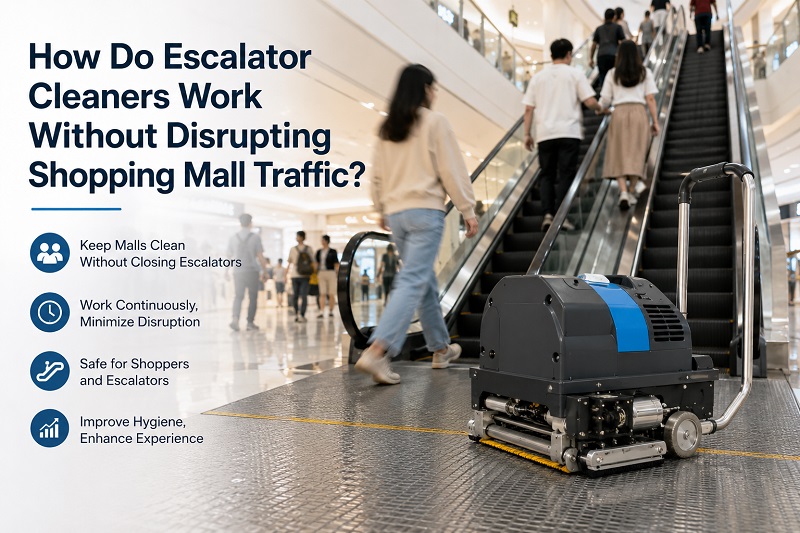
Modern escalator cleaners, such as the JIECHI EL510 compact wet/dry escalator cleaning machine, use a combination of rotating brushes, water spray, and vacuum recovery to clean steps while the escalator continues moving.
Here is the step-by-step process:
1. Brush Rotation with Step-Safe Geometry
The cleaning head is equipped with counter-rotating cylindrical brushes designed to match the pitch and profile of escalator steps. As the steps pass under the machine, the brushes agitate embedded dirt, gum residue, and oil stains from both the tread surface and the riser. The brush material is firm enough to remove stubborn grime yet gentle enough not to damage step surfaces.
2. On-Demand Water or Chemical Spray
A built-in water tank supplies a controlled spray of water or diluted cleaning solution onto the brushes. This wet-scrubbing action loosens deposits that dry brushing alone cannot remove. For daily maintenance, water alone often suffices. For deep cleaning, a mild degreaser can be added to tackle the oil and rubber marks that accumulate on steps over time.
3. Instant Vacuum Recovery
This is the real secret to non-disruptive cleaning. After the brushes scrub the steps, a powerful wet/dry vacuum immediately extracts the dirty water and debris from the step surface. The result is a clean, nearly dry step within seconds — no puddles, no slippery residue, and no waiting for drying time. The recovered slurry is stored in a separate tank for proper disposal.
4. Continuous Flow Operation
Because the machine sits at the bottom landing of the escalator and the steps move toward it, the operator simply positions the cleaning head and lets the escalator mechanism do the work. Each step passes through the cleaning cycle one at a time. The escalator never needs to stop. Pedestrians can continue riding, stepping off at the top, while the machine cleans from the bottom.
Why Shopping Mall Traffic Is Not Disrupted
Three design features make this possible:
No shutdown required — the escalator runs at normal speed throughout the cleaning process
No wet floor hazard — vacuum recovery leaves steps dry, eliminating slip-and-fall risks
Minimal footprint — the compact machine occupies only the bottom landing area, leaving the rest of the escalator accessible
This is especially important in shopping malls during business hours. Shutting down an escalator for cleaning would force shoppers onto stairs or elevators, creating congestion and reducing foot traffic to upper-level stores. With a non-disruptive escalator cleaner, cleaning can happen during normal operation — even during peak hours.
Common Applications Beyond Shopping Malls
While we highlight shopping malls, the same technology works in:
Airport terminals — clean moving walkways and escalators without delaying passengers
Metro and subway stations — maintain high-traffic escalators during transit hours
Convention centers — prepare for large events without operational downtime
Office buildings and hotels — clean escalators during the workday without blocking access
How Often Should Escalators Be Cleaned?
Frequency depends on traffic volume:
High-traffic (malls, transit hubs) — daily dry brushing with weekly deep wet cleaning
Medium-traffic (hotels, offices) — 2–3 times per week dry brushing, bi-weekly deep cleaning
Low-traffic (small buildings) — weekly dry brushing, monthly deep cleaning
The key is consistency. Regular cleaning prevents the buildup of sticky residues that attract more dirt and wear down step surfaces over time.
Choose the Right Partner for Escalator Cleaning Equipment
At JIECHI, we manufacture the EL510 compact wet/dry escalator cleaning machine and support OEM customization for distributors and facility management companies worldwide. Our factory in Shanghai and Jiangxi covers over 60,000 m², with in-house R&D, production, and quality control — ensuring you get a reliable cleaning solution built for daily commercial use.
Whether you need a single machine for a shopping mall contract or a branded OEM solution for your local market, we are ready to support your cleaning operations.
👉 Contact us today to discuss your escalator cleaning needs. Let's keep your vertical transit clean, safe, and always running.

 Phone: +1 2403149021
 Mail: kliu@jiechi.com



 Phone:+1 2403149021
 Email:kliu@jiechi.com


 English


