Walk-Behind vs. Ride-On Floor Scrubbers: How to Choose the Right Fleet for Your Facility
Jun 02, 2026
In the fast-paced world of industrial and commercial facility management, maintaining spotless floors is no longer just about aesthetics—it’s about safety, compliance, and operational efficiency. If you are still relying on traditional mopping, or looking to upgrade your current cleaning fleet, you’ve likely arrived at a critical crossroads: Should you invest in a walk-behind or a ride-on floor scrubber?
As a leading global manufacturer of floor scrubbers and sweepers, Jiechi has helped thousands of factories, warehouses, hospitals, and shopping malls optimize their cleaning protocols.
Here is a data-driven breakdown to help you make the smartest investment for your business.
1. The Walk-Behind Scrubber: Agility Meets Precision
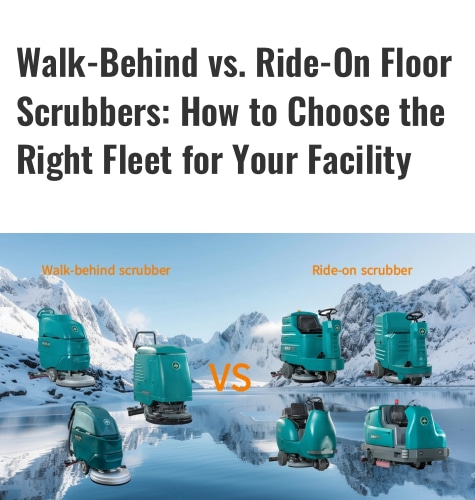
Walk-behind floor scrubbers (like the Jiechi BA530BT or the A3) are operated by a technician walking behind the machine.
Best Suited For:
Tight and Congested Spaces: Narrow aisles, office hallways, and doorways.
Smaller Footprints: Facilities under2,000㎡.
Corner Cleaning: Superior maneuverability around tight corners and under obstacles.
2. The Ride-On Scrubber: Maximum Productivity for Large Scale
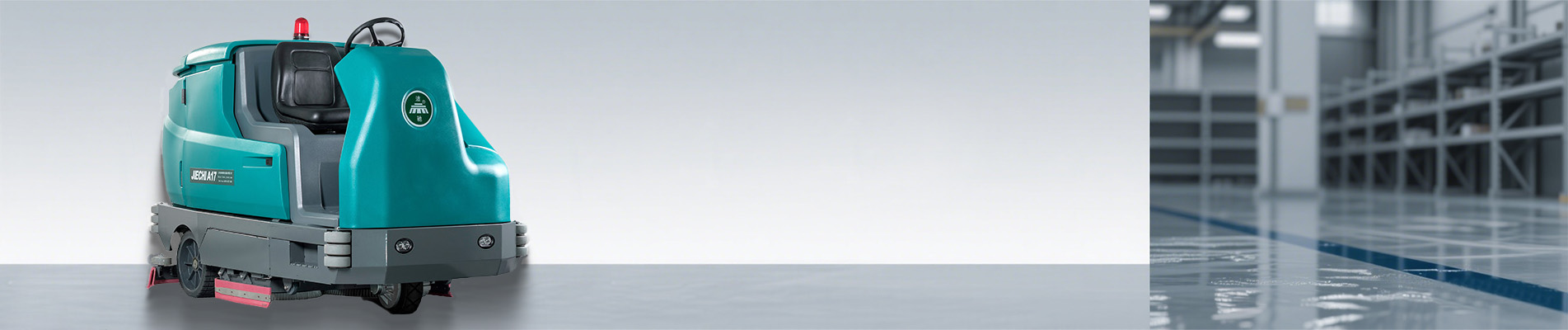
Ride-on scrubbers (like the heavy-duty Jiechi A7、BA900BT、A10 、A17) allow the operator to sit comfortably while driving the machine.
Best Suited For:
Expansive Areas: Large logistics warehouses, transport hubs, and manufacturing plants.
High-Frequency Cleaning: Spaces larger than $3,000\text{ m}^2$ that require rapid turnaround times.
Labor Optimization: When you need to cover double the square footage with half the manpower.
The Jiechi Advantage: Jiechi ride-on models boast high-capacity solution tanks and extended battery life, drastically reducing the time spent on "dump and refill" stops.
The Decision Matrix: How to Choose?
To make your decision easier, our engineering team has summarized the key metrics in the comparison table below:
Feature
Walk-Behind Scrubbers
Ride-On Scrubbers
Average Cleaning Speed
1,500 - 2,500 ㎡
3,500 - 6,500+㎡
Maneuverability
Exceptional (Turns on a dime)
Moderate (Requires wider turning radius)
Initial Investment
Lower upfront cost
Higher upfront cost (Offset by rapid ROI)
Labor Efficiency
Standard
High (Reduces labor costs by up to 50%)
Ideal Environments
Retail stores, schools, hospitals
Warehouses, airports, large factories
The Bottom Line: Calculate Your ROI
When choosing between a walk-behind and a ride-on machine, look closely at your Total Cost of Ownership (TCO). While a ride-on scrubber requires a higher initial capital expenditure, it slashes labor hours dramatically. In large facilities, a ride-on machine often pays for itself within the first 6 months purely through labor savings.
However, many modern facilities don't just choose one—they deploy a hybrid fleet. For example, utilizing a Jiechi A7 for the main warehouse floor and a Jiechi A1 or A3 for the narrow packing zones.

 Phone: +1 2403149021
 Mail: kliu@jiechi.com



 Phone:+1 2403149021
 Email:kliu@jiechi.com


 English


