Floor Scrubber Battery Maintenance: Extend Battery Life and Reduce Replacement Costs
May 14, 2026
Batteries are one of the most expensive components of any floor scrubber. Whether you use a walk-behind floor scrubber or a ride-on floor scrubber, your machine's battery system requires regular attention to perform reliably day after day. Neglecting battery maintenance can lead to reduced runtime, slower charging, and premature failure — which means costly replacement long before you expected it.
This guide covers practical battery maintenance techniques that work across lead-acid and lithium-ion floor scrubber batteries, helping you get the most life out of your power source and keep operating costs under control.
1. Understand Your Battery Type
Before you can maintain a battery properly, you need to know what you're working with. The two most common types in floor scrubbers are:
Flooded Lead-Acid Batteries — Require regular watering, venting, and equalization charging. These are the traditional workhorses, durable but high-maintenance.
Sealed Lead-Acid (AGM/Gel) Batteries — Maintenance-free in terms of watering, but still sensitive to overcharging and deep discharge.
Lithium-Ion Batteries — Lightweight, long cycle life, and virtually zero daily maintenance. However, they need compatible chargers and temperature management.
If you're unsure which type your machine uses, check the battery label or consult your supplier of floor scrubber batteries and chargers. Using the wrong charging profile can damage the battery in a single cycle.
2. Establish a Consistent Charging Routine
How and when you charge matters more than you might think. Here are the essential guidelines:
Charge after every use — Never let a lead-acid battery sit discharged. Even a few hours in a discharged state can cause sulfation, which permanently reduces capacity.
Avoid partial charges on lead-acid — Lead-acid batteries prefer full charge cycles. Frequent topping-off without a full charge shortens their lifespan.
Lithium is more flexible — Lithium-ion batteries tolerate partial charging well. You can top them off without damage.
Use the correct charger — Always use the charger that came with your machine or one approved by the manufacturer. A mismatched charger is one of the fastest ways to destroy a battery.
3. Watering Your Lead-Acid Battery (If Applicable)
For flooded lead-acid batteries, proper watering is critical:
Check water levels weekly — Use distilled water only. Tap water contains minerals that reduce battery life.
Water after charging — Charging causes the electrolyte level to rise. Adding water before charging can cause overflow and acid loss.
Keep plates submerged — Never let the plates be exposed to air. This causes irreversible damage.
Don't overfill — Fill to the level indicated by the manufacturer, typically just above the plates.
4. Clean Battery Terminals and Compartment
Corrosion and dirt can significantly reduce electrical conductivity:
Inspect terminals monthly — Look for white or bluish corrosion around the posts and cable ends.
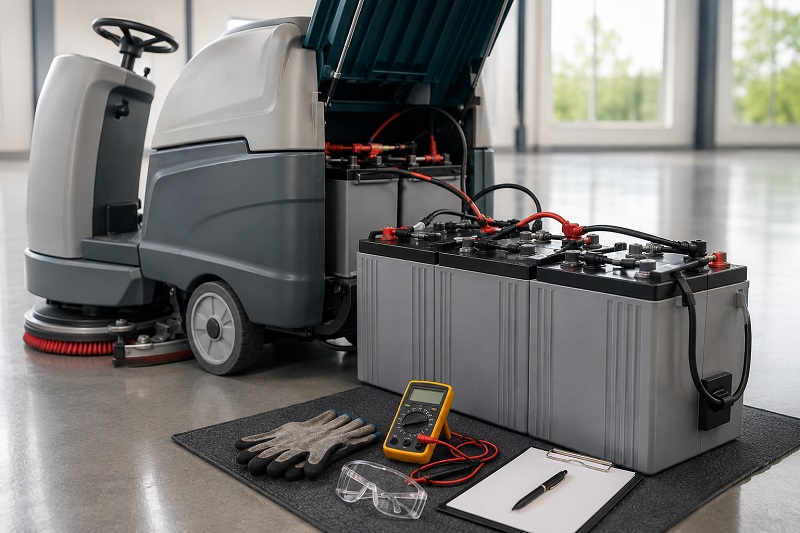
Clean with a baking soda solution — Mix a small amount of baking soda with water, apply to corroded areas, scrub with a brush, and rinse clean.
Apply terminal protectant — A thin layer of petroleum jelly or commercial anti-corrosion spray helps prevent future buildup.
Keep the battery compartment dry — Moisture accelerates corrosion and can cause short circuits. Wipe down the compartment after each cleaning shift.
5. Monitor Charge Cycles and Depth of Discharge
Battery lifespan is measured in charge cycles. Each time you discharge and recharge, you use one cycle. The key to longevity is:
Avoid deep discharges — Lead-acid batteries suffer when discharged below 50%. Lithium batteries are more forgiving but still benefit from staying above 20%.
Track usage patterns — If your machine is consistently running out of power before the shift ends, you may need a higher-capacity battery or an additional charging opportunity during breaks.
Rotate batteries — If your facility uses multiple batteries per machine, rotate them evenly to ensure balanced wear.
A good rule of thumb: a well-maintained lead-acid battery should deliver 1,000 to 1,500 cycles. A lithium battery can deliver 2,000 to 5,000 cycles depending on usage conditions. Read our detailed comparison of lithium vs lead-acid batteries for floor scrubbers to choose the right power source for your facility.
6. Store Batteries Properly During Downtime
If your floor scrubber won't be used for an extended period:
Store in a cool, dry place — High temperatures accelerate chemical reactions that degrade batteries. Ideal storage temperature is 15°C to 25°C (59°F to 77°F).
Charge lead-acid batteries to 100% before storage — Then recharge every 30 days to prevent sulfation.
Store lithium batteries at 50-60% charge — Unlike lead-acid, lithium batteries should not be stored at full charge. This reduces stress on the cells.
Disconnect the battery — If the machine will sit unused, disconnect the battery to avoid parasitic drain from onboard electronics.
7. Know the Warning Signs of Battery Failure
Catch problems early to avoid unexpected downtime:
Reduced runtime — The most common early sign. If a full charge no longer lasts as long as it used to, capacity is degrading.
Slow charging — If charge times increase significantly, internal resistance may be rising.
Swelling or bulging — This is a safety hazard, especially with lithium batteries. Stop using the battery immediately.
Excessive heat during charging — Batteries naturally warm up, but if they become hot to the touch, there may be an internal issue.
Corrosion or acid leaks — Visible acid around terminals or cracks in the battery case means replacement is needed.
8. Schedule Professional Inspections
While daily and weekly checks keep your battery healthy, an annual professional inspection adds an extra layer of protection:
Load testing — Confirms the battery can still deliver its rated capacity under load.
Specific gravity testing (lead-acid) — Measures the health of individual cells.
Internal resistance measurement — Identifies failing cells before they cause operational issues.
If you don't have in-house maintenance staff, many walk-behind floor scrubber dealers and service centers offer battery inspection as part of their maintenance packages.
Conclusion
Your floor scrubber's battery is a significant investment, and protecting it doesn't require complex procedures. A few consistent habits — proper charging, regular cleaning, correct watering, and attentive monitoring — can double the useful life of your battery and save your facility thousands of dollars in replacement costs.
At Jiechi Cleaning, we supply high-quality walk-behind floor scrubbers and ride-on floor scrubbers with reliable battery systems designed for long-term performance. Whether you need a compact unit for tight spaces or a large machine for big facilities, we have solutions tailored to your needs.
Have questions about battery maintenance or floor scrubber selection? Contact our team today — we're here to help you keep your equipment running at its best.

 Phone: +1 2403149021
 Mail: kliu@jiechi.com



 Phone:+1 2403149021
 Email:kliu@jiechi.com


 English


