other

Jiechi Cleaning

Home

Jiechi Cleaning

  • How Should Supermarket Chains Be Cleaned?
    Jun 09, 2026
    When we shop at supermarkets, we can immediately sense the quality of the store environment. Clean, dry floors make the entire store appear bright and spacious, encouraging customers to step inside. In contrast, some stores have sticky, yellowed floors in the deli section that discourage shopping, while standing water in the fresh produce and seafood sections can lead to safety hazards.   Most major chain supermarkets today combine retail, fresh produce, deli, and food service operations. With high foot traffic and a constant flow of customers, blood, grease, footprints, and dust are a constant problem. Cleaning has long been a top priority for store operations and remains a common challenge for many retailers.   Supermarkets have numerous aisles, dense shelving, and many corners, making it difficult for large equipment to maneuver; Daily dust and water stains in the fresh produce section make manual cleaning time-consuming and require significant manpower; The deli and dining areas operate as a single unit, resulting in frequent grease buildup. This necessitates floor cleaning that dries immediately without disrupting customer shopping. Jiechi’s push-type models—including the BA680BT, BA860BT, A1, and A3—can cover all operational scenarios in supermarket retail spaces.   【A1 and A3 Walk-Behind Floor Scrubbers: The Workhorses for Retail Environments】 With a compact and agile design and smooth steering, these machines can navigate easily between shelves and checkout areas. They scrub and vacuum simultaneously, leaving the floor dry instantly with no standing water. Operation is simple, and cleaning staff can get started after just a brief training session. The A3D model features a self-propelled function, making it even more efficient for large retail spaces.     【BA680BT Walk-Behind Floor Scrubber – Highly Flexible】 With a 68L (clean water) tank capacity, it minimizes the need for frequent refilling and waste disposal. Ideal for deli sections in medium-sized retail stores, it effectively removes bloodstains and animal/vegetable oil residues, keeping fresh food areas dry and hygienic.     【BA860BT Fully Automatic Floor Scrubber – Dual-Brush Efficiency】 With a dual-brush deck cleaning width of 860 mm and self-propelled operation, there’s no need for strenuous pushing. The 95-liter fresh water tank delivers cleaning efficiency several times greater than manual labor. Adjustable brush pressure allows for water and energy savings in lightly soiled areas, significantly reducing cleaning time for large spaces.     Mechanization replaces traditional mops and brooms, significantly reducing the cleaning staff required per store and effectively controlling labor costs; Standardized equipment ensures consistent cleaning results, leaving store floors free of grease and standing water, with even hard-to-reach corners clean and tidy, thereby continuously enhancing the customer shopping experience; Equipment parts are easy to replace, and with Jiechi’s nationwide after-sales service network, maintenance and repairs are handled quickly, ensuring that daily store cleaning operations are not disrupted.   Jiechi cleaning equipment has established a replicable model for cleaning in fresh produce supermarket chains. Catering to all types of general supermarkets and fresh produce markets nationwide, Jiechi meets diverse needs by leveraging mechanized and standardized cleaning to help retail stores reduce costs and improve efficiency, creating a clean and safe shopping environment.    
  • Walk-Behind vs. Ride-On Floor Scrubbers: How to Choose the Right Fleet for Your Facility
    Jun 02, 2026
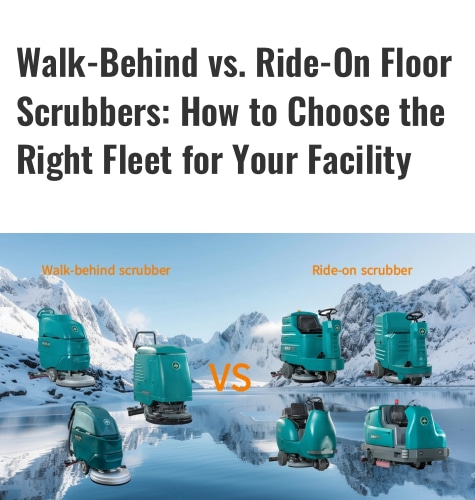
    In the fast-paced world of industrial and commercial facility management, maintaining spotless floors is no longer just about aesthetics—it’s about safety, compliance, and operational efficiency. If you are still relying on traditional mopping, or looking to upgrade your current cleaning fleet, you’ve likely arrived at a critical crossroads: Should you invest in a walk-behind or a ride-on floor scrubber?     As a leading global manufacturer of floor scrubbers and sweepers, Jiechi has helped thousands of factories, warehouses, hospitals, and shopping malls optimize their cleaning protocols. Here is a data-driven breakdown to help you make the smartest investment for your business.     1. The Walk-Behind Scrubber: Agility Meets Precision Walk-behind floor scrubbers (like the Jiechi BA530BT or the A3) are operated by a technician walking behind the machine. Best Suited For:   Tight and Congested Spaces: Narrow aisles, office hallways, and doorways. Smaller Footprints: Facilities under2,000㎡. Corner Cleaning: Superior maneuverability around tight corners and under obstacles.       2. The Ride-On Scrubber: Maximum Productivity for Large Scale Ride-on scrubbers (like the heavy-duty Jiechi A7, BA900BT, A10, A17) allow the operator to sit comfortably while driving the machine.     Best Suited For:   Expansive Areas: Large logistics warehouses, transport hubs, and manufacturing plants. High-Frequency Cleaning: Spaces larger than $3,000\text{ m}^2$ that require rapid turnaround times.   Labor Optimization: When you need to cover double the square footage with half the manpower.   The Jiechi Advantage: Jiechi ride-on models boast high-capacity solution tanks and extended battery life, drastically reducing the time spent on "dump and refill" stops.     The Decision Matrix: How to Choose? To make your decision easier, our engineering team has summarized the key metrics in the comparison table below: Feature Walk-Behind Scrubbers Ride-On Scrubbers Average Cleaning Speed 1,500 - 2,500 ㎡ 3,500 - 6,500+㎡ Maneuverability Exceptional (Turns on a dime) Moderate (Requires wider turning radius) Initial Investment Lower upfront cost Higher upfront cost (Offset by rapid ROI) Labor Efficiency Standard High (Reduces labor costs by up to 50%) Ideal Environments Retail stores, schools, hospitals Warehouses, airports, large factories     The Bottom Line: Calculate Your ROI When choosing between a walk-behind and a ride-on machine, look closely at your Total Cost of Ownership (TCO). While a ride-on scrubber requires a higher initial capital expenditure, it slashes labor hours dramatically. In large facilities, a ride-on machine often pays for itself within the first 6 months purely through labor savings. However, many modern facilities don't just choose one—they deploy a hybrid fleet. For example, utilizing a Jiechi A7 for the main warehouse floor and a Jiechi A1 or A3 for the narrow packing zones.
  • High-Speed vs. Low-Speed Polishers: What Is the Secret to Mirror-Like Hard Floors?
    May 28, 2026
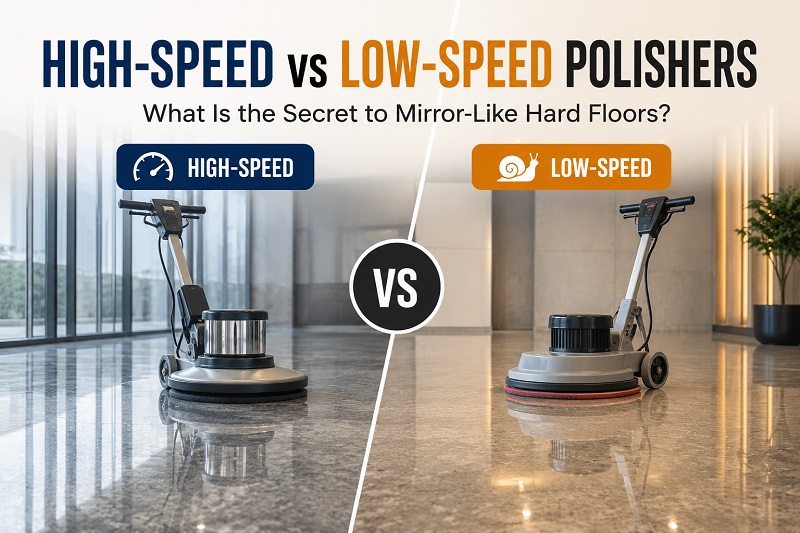
    When walking into a luxury hotel lobby, a high-end retail boutique, or a pristine corporate office, the first thing that catches your eye is often the floor. A flawless, mirror-like finish doesn't just look clean—it reflects professionalism, meticulous maintenance, and high standards. But achieving that breathtaking gloss isn't a matter of luck. It comes down to a fundamental choice in commercial floor care: High-Speed vs. Low-Speed Polishers. If you have ever wondered how to get a high-gloss finish on concrete floors, marble, or vinyl tile, understanding the distinct roles of these two machines is your ultimate secret weapon. Let’s break down how they work, when to use each, and how to master the art of the perfect floor shine. The Core Difference: RPM and Action To the untrained eye, floor polishers might look similar. However, their internal mechanics and intended purposes are miles apart. The primary differentiator is speed, measured in Rotations Per Minute (RPM). Low-Speed Polishers (The Workhorses) Operating generally between 150 to 300 RPM, low-speed polishers (often called floor buffers) rely on friction, weight, and cleaning solutions rather than sheer velocity. Primary Function: Scrubbing, stripping, and deep cleaning. How they work: They move side-to-side, allowing the operator to maneuver across the floor to remove old wax layers, deep-seated dirt, and scuff marks. High-Speed Polishers (The Detailers) Operating anywhere from 1,500 to 3,000+ RPM, high-speed polishers (commonly known as floor burnishers) are built for one specific purpose: generating heat and friction. Primary Function: Polishing and creating that coveted wet-look shine. How they work: They move exclusively in a straight line (forward and backward). The intense speed melts the microscopic top layer of the floor finish just enough to flatten out ridges and scratches, resulting in a perfectly reflective surface. Choosing the Right Tool for the Job You cannot achieve a mirror-like finish by choosing just one machine; rather, it's about knowing how they complement each other in a comprehensive floor care program. Feature Low-Speed Polisher (Buffer) High-Speed Polisher (Burnisher) Speed Range 150 – 300 RPM 1,500 – 3,000+ RPM Motion Side-to-side (Swinging) Straight line (Forward/Backward) Best Used For Stripping wax, heavy scrubbing, shampooing Burnishing, restoring gloss, hardening finish Surface Finish Clean, matte, or satin prep layer Mirror-like, high-gloss "wet look" 1. Prepping the Canvas with Low-Speed Buffers You cannot polish a dirty floor. If you try to run a high-speed burnisher over dirt or old, yellowed wax, you will permanently bake those imperfections into the floor. This is where commercial floor buffers for vinyl tile and stone come into play. Use a low-speed machine to strip away old finishes and scrub the surface completely clean. 2. Creating the Reflection with High-Speed Burnishers Once the floor is clean, dry, and a fresh coat of finish has been applied, it’s time for the magic. The high-speed polisher glides over the floor, flattening the finish and hardening it against future foot traffic. If you are managing natural stone or polished surfaces, choosing the right industrial floor polishing equipment for marble ensures that the delicate stone isn't damaged while achieving maximum clarity. The Step-by-Step Secret to a Mirror-Like Finish If you want to achieve professional-grade results that last, follow this proven sequential process: Clear and Dust Mop: Remove all loose debris and dust. Particles trapped under a high-speed pad can act like sandpaper, ruining your floor finish. Deep Clean/Strip (Low-Speed): Use a low-speed polisher with a stripping pad to remove the old, tired layers of wax. Apply Floor Finish: Apply 2–4 thin, even coats of high-quality floor finish, allowing each coat to dry completely. Burnish (High-Speed): Pass over the completely dry finish with a high-speed burnisher using a specialized polishing pad (like a hog’s hair or synthetic polishing pad). Watch the dull surface instantly transform into a crystal-clear reflection. Elevate Your Floors with Jiechi Cleaning Achieving a flawless, mirror-like hard floor requires the perfect balance of technique, chemistry, and dependable machinery. Low-quality equipment leads to uneven finishes, operator fatigue, and frequent breakdowns. At Jiechi Cleaning, we engineer professional-grade floor care solutions designed for maximum efficiency and durability. Whether you need rugged low-speed buffers to tackle heavy restoration or ultra-high-speed burnishers to unlock that ultimate wet-look shine, our equipment delivers consistent performance with ergonomic handling. Explore our full range of advanced floor maintenance solutions at Jiechi Cleaning and give your facility the premium reflection it deserves.
  • Jiechi A5: A Compact Commercial Cleaning “All-Rounder” That Delivers Efficient Cleaning Even in Tight Spaces
    May 27, 2026
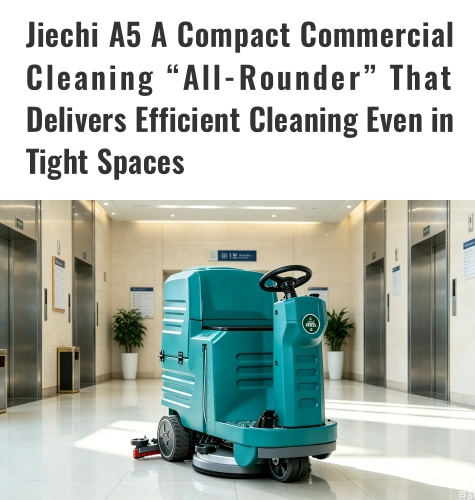
    In small-to-medium commercial settings such as small shopping malls, office buildings, convenience stores, and laboratories, cleaning often faces the dilemma of “narrow spaces, bulky equipment, and low efficiency”: large machines cannot navigate narrow aisles, manual cleaning cannot keep up with foot traffic, and standard floor scrubbers are inefficient and prone to bumping into shelves.   For small-to-medium commercial spaces, the “adaptability” of cleaning equipment is far more important than “bigger is better.” The Jiechi A5 compact ride-on scrubber-dryer addresses the pain points of narrow-aisle cleaning, low efficiency, and difficult operation with its compact and agile body, powerful cleaning performance from imported components, and user-friendly design details. It not only saves on labor costs but also raises cleaning standards.   The A5’s design centers on “adaptability to compact spaces,” with every specification precisely tailored to the cleaning needs of small-to-medium commercial areas, balancing maneuverability and efficiency.   530mm cleaning width + 770mm squeegee: The narrow brush deck design is ideal for tight spaces like aisles between shelves, hallways, and elevator lobbies, ensuring precise coverage in a single pass without wasting cleaning time. 65L Fresh Water Tank + 75L Waste Water Tank: A compact body houses high-capacity tanks, reducing the frequency of refilling and emptying. A single cleaning session can cover nearly 10,000 square meters without interrupting operations. 2,700 m²/h Cleaning Efficiency: Powered by a high-performance motor, it can clean 2,700 m² of floor space per hour—several times more efficient than manual labor—significantly reducing labor costs.   “Compact without compromise”—from maneuverability to cleaning power, every detail of the A5 is tailored for small to medium-sized spaces.   Compact body (126×62×103 cm): Designed specifically for narrow hallways, elevator entrances, and aisles in convenience stores, it easily navigates areas inaccessible to large floor scrubbers, leaving no cleaning blind spots.  Integrated cast aluminum squeegee: Corrosion-resistant with consistent suction, paired with high-quality rubber strips that hug the floor to prevent leaks. It ensures thorough wastewater recovery, leaving no water marks or secondary contamination on the floor. Wastewater tank overflow protection: Automatically shuts down when the tank is full to prevent wastewater backflow from damaging the motor, extending the equipment’s lifespan and reducing maintenance costs. Easy-to-disassemble maintenance design: Brush decks, rubber strips, and filters can all be quickly removed for cleaning. Daily maintenance is simple and requires no specialized tools, saving time and costs.   With its compact body and stable performance, the A5 easily adapts to a variety of small-to-medium commercial settings, making it a true “all-rounder” in cleaning:   Convenience stores / Small supermarkets: Maneuvers flexibly between shelves to quickly clean tile floors, washing and drying instantly without disrupting customer traffic. Office Buildings: Cleans hallways, elevator lobbies, and break rooms with quiet operation that doesn’t disrupt work, leaving floors spotless with no residue. Factory Workshops / Small Production Facilities: Removes grease and dust from floors, suitable for epoxy and concrete surfaces, helping workshops meet environmental standards. Hotels / Restaurants / Parking Garages: Quickly cleans grease and water stains from floors, reducing slip hazards and ensuring kitchen safety and hygiene.   Whether for property maintenance, shopping mall operations, or factory logistics, the A5 is a cost-effective choice for cleaning small to medium-sized commercial spaces. It delivers a hassle-free and efficient cleaning experience to create a clean, safe, and orderly commercial environment.
  • Best Floor Cleaning Machines for Epoxy and Concrete Warehouse Floors
    May 22, 2026
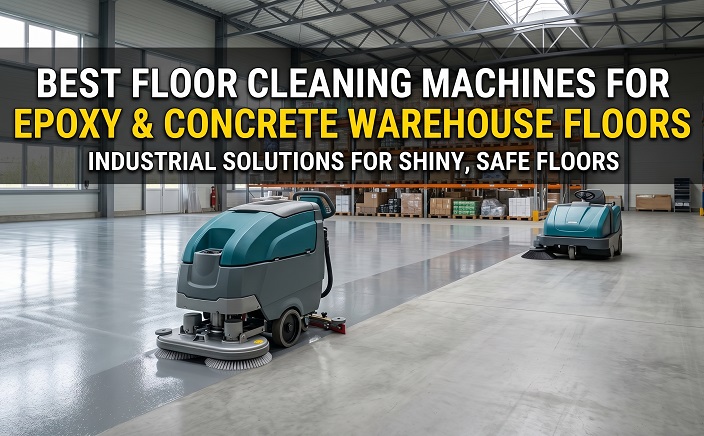
    Choosing the right floor cleaning machine for your warehouse depends heavily on the type of flooring you have. Two of the most common industrial flooring surfaces — epoxy and bare concrete — have very different cleaning requirements, and using the wrong equipment can damage the floor or leave it inadequately cleaned. In this guide, we'll break down the best floor cleaning machines for warehouse floors, so you can make the right investment for your facility. Epoxy vs. Concrete Floors: Key Differences for Cleaning Before selecting a cleaning machine, it helps to understand how these two surfaces differ: Epoxy floors are seamless, non-porous, and highly resistant to chemicals and moisture. They provide a smooth, glossy finish that is easy to clean but also more sensitive to abrasion. Aggressive brush bristles or harsh pad materials can scratch, dull, or even peel epoxy coatings over time. Bare concrete floors are porous, textured, and significantly more abrasive to cleaning equipment. They absorb oils and stains, require more aggressive scrubbing action, and produce more wear on brushes and squeegee blades. These differences matter when selecting both the type of machine and the specific attachments or brushes. Best Machines for Epoxy Warehouse Floors Epoxy floors are best maintained with gentle, consistent cleaning that preserves the coating. The following machines are ideal: 1. Walk-Behind Floor Scrubbers with Soft Brushes A walk-behind floor scrubber equipped with soft nylon or polypropylene brushes (or white/red pad drivers) is the safest and most effective choice for epoxy floors. These machines apply water and cleaning solution, scrub gently, and vacuum up the dirty water in one pass — leaving the epoxy surface clean, dry, and undamaged. Recommended features for epoxy floors: Adjustable brush pressure (lower pressure settings to avoid scratching) Soft brushes or non-abrasive pad drivers Squeegee with soft rubber blades for streak-free drying Solution flow control to avoid pooling water 2. Auto Scrubbers with Pad Drivers For larger epoxy warehouse floors, a ride-on auto scrubber for concrete floors with pad drivers offers higher productivity. Use white polishing pads for daily cleaning and red pads for deeper cleaning when needed. Avoid black or green abrasive pads — they are designed for stripping and will damage epoxy. 3. Floor Sweepers (for Dry Debris Only) If your epoxy floor primarily accumulates dry debris (dust, cardboard particles, packaging), a walk-behind or ride-on floor sweeper is the best choice. Sweepers collect dry debris without water, preventing moisture from seeping into any minor cracks or edges in the epoxy coating. Jiechi's BA series ride-on sweepers, such as the BA1200 and BA1400, are excellent options for large epoxy warehouse floors. Best Machines for Concrete Warehouse Floors Bare concrete floors can handle more aggressive cleaning, but they also need machines capable of dealing with embedded dirt, oil stains, and a rougher surface texture. 1. Heavy-Duty Ride-On Floor Scrubbers For large concrete warehouse floors, a heavy-duty ride-on floor scrubber with aggressive brush action is the most efficient solution. Look for machines with: High brush down-pressure (100+ kg) to scrub ingrained dirt Hard-bristle brushes (blue, green, or black depending on soil level) Large solution and recovery tanks (100+ liters) for extended runtime Durable squeegee blades that can handle rough concrete surfaces Jiechi's ride-on floor scrubber models are built for exactly this application. They feature powerful brush motors, robust drivetrains, and high-capacity tanks to keep your concrete floors clean across long shifts. 2. Combination Scrubber-Sweepers for Concrete Floors Concrete floors in warehouses often have both dry debris (dust, gravel, packaging) and wet/sticky soil (oil drips, tire marks). A combination scrubber-sweeper — like Jiechi's M series combi machines — can sweep dry debris and scrub the floor in a single pass. This is especially valuable in warehouses where sweeping and scrubbing are both needed daily. 3. Industrial Floor Sweepers with High Filtration For concrete warehouses where the primary concern is dust control — such as those handling cement, grain, or powdery materials — a high-filtration industrial floor sweeper with a durable filtration system for floor scrubbers is the right choice. Fully enclosed ride-on sweepers with powerful vacuum systems and large filter areas capture fine dust without spreading it into the air. Brush and Pad Selection Guide This quick reference helps you select the right brushes for each floor type: Epoxy floors → Soft nylon brushes or white/red pad drivers. Avoid abrasive pads. Polished concrete → Soft brushes and white pads to maintain the polished finish. Bare concrete (smooth) → Medium polypropylene brushes or blue pads. Bare concrete (rough/textured) → Hard bristle brushes or green pads for heavy scrubbing. Oil-stained concrete → Black stripping pads (use only in targeted areas, not full-floor). Common Mistakes to Avoid Using aggressive brushes on epoxy floors. Even one pass with a black stripping pad or hard bristle brush can scratch and dull an epoxy coating, requiring costly refinishing. Using too much water on concrete floors. Concrete is porous. Excess water can soak in, leading to moisture problems, mildew, and even structural issues over time. Use a scrubber with proper squeegee pick-up and limit solution flow. Neglecting daily sweeping before scrubbing. On both epoxy and concrete floors, sweeping first removes abrasive debris that can scratch the surface during scrubbing. Always sweep before you scrub for best results. Skipping routine squeegee and brush maintenance. A worn squeegee on concrete leaves streaks; a worn brush on epoxy causes uneven cleaning. Follow proper warehouse floor cleaning equipment maintenance practices to keep both your machine and your floor in top condition. Inspect both regularly and replace as needed. Why Choose Jiechi for Your Warehouse Floor Cleaning Needs At Jiechi Cleaning, we manufacture a full range of floor cleaning machines designed for both epoxy and concrete warehouse floors. Whether you need a gentle walk-behind scrubber for a delicate epoxy showroom floor or a heavy-duty ride-on sweeper for a rough concrete distribution center, we have the right solution. Our factory, spanning over 60,000 m² in Shanghai and Jiangxi, covers everything from R&D and design to production and testing. Every machine is built under direct quality control, ensuring consistent performance and long service life. For B2B partners, we also offer OEM customization, spare parts support, and technical collaboration. Not Sure Which Machine Is Right for Your Floor? Choosing the wrong cleaning equipment can damage your floor and waste your budget. Contact Jiechi today and our engineering team will help you evaluate your floor type, debris load, and cleaning frequency — and recommend the ideal machine for your facility.
  • Eco-Friendly Floor Cleaning: How Floor Scrubbers Reduce Water and Chemical Usage
    May 18, 2026
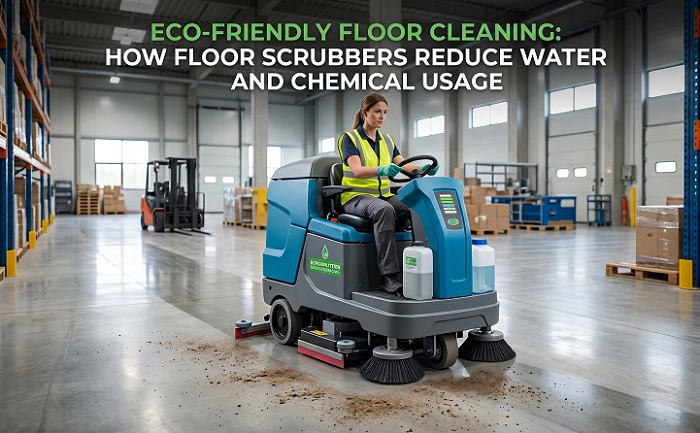
    When it comes to commercial cleaning, sustainability is no longer a nice-to-have — it's a business imperative. Facility managers across warehouses, retail stores, hospitals, and manufacturing plants are increasingly asking the same question: How can we keep our floors spotless while reducing our environmental footprint? The answer lies in modern floor scrubber technology. Today's advanced cleaning machines are designed to achieve superior results with significantly less water and fewer chemicals than traditional methods. This article explores exactly how floor scrubbers make eco-friendly cleaning possible — and why making the switch benefits both your facility and the planet.   How Much Water Do Floor Scrubbers Actually Save? The most dramatic impact of modern floor scrubbers is water conservation. Traditional mopping methods typically consume anywhere from 10 to 30 gallons of water per 1,000 square feet, depending on technique and frequency of bucket changes. In contrast, an automatic floor scrubber uses a fraction of that amount. A typical walk-behind floor scrubber uses approximately 1 to 3 gallons of water per 1,000 square feet — a reduction of up to 90%. Ride-on scrubbers, with their larger tanks and optimized flow systems, achieve similar efficiency on a bigger scale. Over the course of a year, a facility cleaning 50,000 square feet daily could save over 50,000 gallons of water simply by switching from mops to scrubbers. But how does this work? Floor scrubbers are equipped with precision-controlled solution flow systems. Instead of dumping a large volume of water onto the floor and hoping for the best, they dispense a fine, consistent layer of cleaning solution directly in front of the brush or pad. The scrub deck then agitates and lifts dirt, while the squeegee and vacuum system immediately recover the dirty water. This closed-loop process ensures that water is used only where it's needed and recovered promptly — no waste, no unnecessary runoff. Chemical Reduction: Less Is More Equally important is the reduction in cleaning chemical usage. Traditional mopping often requires higher concentrations of detergent to compensate for the inefficiency of the method. With floor scrubbers, the combination of mechanical scrubbing action and precise chemical dispensing means you can achieve better results with 50% to 70% less cleaning solution. Here's why: Mechanical action does the heavy lifting. The rotating brushes or pads physically scrub dirt and grime loose from floor surfaces. This mechanical energy reduces reliance on chemical surfactants to break down soil. Precise dilution control. Many modern floor scrubbers feature built-in chemical dosing systems that automatically mix water and concentrate at the correct ratio. This eliminates guesswork and prevents overuse. Faster drying means less residue. Because scrubbers recover most of the water they dispense, floors dry quickly. This reduces the need for chemical rinse agents, as there's less opportunity for streaking or residue buildup. For facilities using green-certified cleaning products, this combination is especially powerful. A floor scrubber allows you to use lower-concentration, plant-based detergents without sacrificing cleaning performance. Beyond Water and Chemicals: The Broader Environmental Benefits The eco-friendly advantages of floor scrubbers extend beyond direct resource savings. Reduced wastewater disposal. Dirty mop water is typically dumped down drains, carrying chemical residues into local water systems. Floor scrubbers collect used water in a recovery tank, which can be disposed of properly — or in some cases, treated and reused. Lower energy consumption per cleaning cycle. While floor scrubbers do require electricity to operate, the total energy footprint per square foot cleaned is often lower than the combined energy of heating mop water, running a mop wringer, and drying-time ventilation. Extended floor life. Floor scrubbers apply consistent pressure and chemical coverage, reducing wear patterns and surface damage. This means fewer floor restoration projects — saving materials, labor, and waste associated with refinishing or replacing flooring. Healthier indoor air quality. Because scrubbers recover dirty water immediately and floors dry in minutes (rather than the 30+ minutes typical of mopping), there's less moisture left to promote mold, mildew, or bacterial growth. This creates a healthier environment for employees, customers, and patients. Green Cleaning Certifications: What to Look For If environmental compliance is a priority for your facility, look for floor scrubbers and cleaning agents that meet recognized standards: Green Seal (GS-37) — Standard for industrial and institutional cleaners. LEED (Leadership in Energy and Environmental Design) — Points can be earned for using low-chemical cleaning equipment. EPA Safer Choice — Certifies that cleaning chemicals meet stringent human health and environmental criteria. Many modern floor scrubbers from Jiechi Cleaning are compatible with green-certified chemicals and designed to optimize their performance, helping facilities work toward sustainability certifications. Practical Tips to Maximize Eco-Friendly Floor Cleaning Even with the right equipment, small operational adjustments can further reduce your environmental impact: Adjust solution flow settings. Many scrubbers allow you to dial in the exact water flow rate for your floor type. Start low and increase only if needed. Use proper brush or pad pressure. Excessive downward pressure wastes energy and can damage floors. Let the machine's weight and brush design do the work. Schedule efficient routes. Plan cleaning paths to minimize empty travel, saving battery life and reducing overall energy use. Maintain your machine regularly. A well-maintained scrubber recovers more water, dispenses solution accurately, and runs more efficiently. Check squeegee blades, vacuum hoses, and filters frequently. Train operators thoroughly. The most eco-friendly machine in the world is only as green as the person running it. Proper training ensures operators use the correct settings and avoid wasteful habits. Making the Switch: Is an Eco-Friendly Floor Scrubber Right for Your Facility? If your facility currently uses mops and buckets, or operates older scrubber models, upgrading to a modern, water-efficient floor scrubber is one of the most impactful sustainability investments you can make. The water savings alone often offset the equipment cost within the first year, and the chemical reductions provide ongoing operational savings. For facilities already using scrubbers, simple adjustments — like optimizing solution flow rates and switching to concentrated, green-certified chemicals — can deliver measurable environmental gains without any new equipment purchase. Conclusion Eco-friendly floor cleaning is not about sacrificing cleanliness for sustainability. Thanks to modern floor scrubber technology, you can achieve both. By dramatically reducing water consumption, cutting chemical usage in half or more, and improving indoor air quality, automatic floor scrubbers are reshaping what it means to clean responsibly. At Jiechi Cleaning, we are committed to providing efficient, sustainable cleaning solutions that help facilities around the world maintain spotless floors while protecting the environment. Have questions about choosing the right eco-friendly floor scrubber for your facility? Contact our team today — we're here to help you clean smarter, not harder. 🌍

  • How to Choose a Commercial Floor Scrubber for Different Settings?
    May 16, 2026
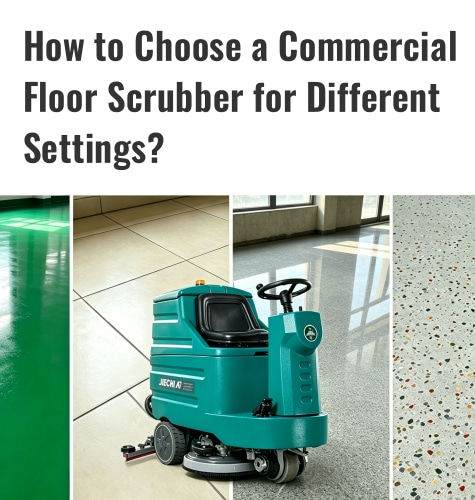
      Whether it’s factories, property management, shopping malls, or transportation hubs, every cleaning scenario has its own “tough challenges”—whether it’s grease that won’t come off, a complex environment that’s hard to manage, or low manual efficiency that costs too much! Don’t worry—Jiechi has already developed tailored cleaning solutions for these four common scenarios, precisely addressing each pain point so you don’t have to lift a finger.   1️⃣ Factories/Industrial Parks (Heavy Grease, Large Particles, Large Areas) Challenges: Vast areas, stubborn engine oil and metal shavings, incomplete manual cleaning, and dust generation. Solution: Choose a ride-on or fully automatic push-type machine based on the area. With powerful scrubbing capabilities, it works on both concrete and epoxy floors, providing deep cleaning while preventing dust-related secondary contamination—compliant and hassle-free.   2️⃣ Property Management/Residential Complexes (Diverse Areas, Quiet Operation, Frequent Cleaning) Challenges: Hallways, garages, and plazas feature diverse layouts and multiple floor materials, requiring quiet operation to avoid disturbing residents. Solution: Compact push-type and ride-on models can navigate narrow elevators and stairwells, enabling a single machine to clean multiple floors. Small-to-medium ride-on floor scrubber cover garages and plazas, protecting epoxy floors and tiles while ensuring scratch-free, residue-free cleaning. They fit in elevators and prevent floor scratches.     3️⃣ Commercial Complexes / Shopping Malls (High Foot Traffic, Need for Rapid Cleaning, Shiny Floors) Challenges: Long operating hours and heavy foot traffic; cleaning must not disrupt shoppers’ experience; floors must dry quickly to prevent slipping and maintain the mall’s image. Solution: Select low-noise, maneuverable push-type or ride-on models based on area size; large-capacity water tanks and long battery life allow for quick cleaning of large areas. Floors are left shiny and streak-free, enhancing the mall’s prestige and customer experience.   4️⃣ Transportation Hubs/Underground Parking Garages (Extremely Large Areas, Heavy Tire Marks, Heavy Dust) Challenges: Open spaces, high cleaning frequency, and extremely low manual cleaning efficiency. Solution: Large ride-on models can clean tens of thousands of square meters daily, efficiently removing tire marks and dust to enhance the hub’s prestige and ensure safe passage, safeguarding the city’s image.   There are no industrial or commercial cleaning challenges we can’t solve—only the wrong cleaning solution! Choose Jiechi to keep every corner spotless!
  • Floor Scrubber Battery Maintenance: Extend Battery Life and Reduce Replacement Costs
    May 14, 2026
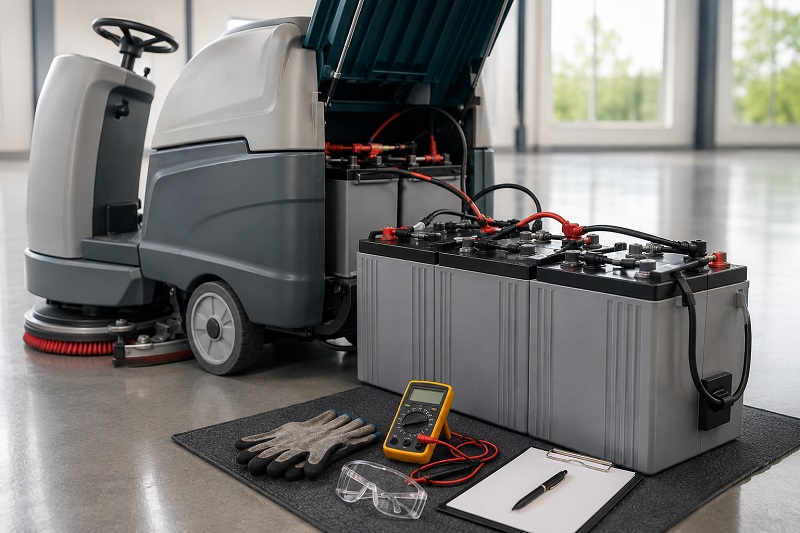
    Batteries are one of the most expensive components of any floor scrubber. Whether you use a walk-behind floor scrubber or a ride-on floor scrubber, your machine's battery system requires regular attention to perform reliably day after day. Neglecting battery maintenance can lead to reduced runtime, slower charging, and premature failure — which means costly replacement long before you expected it. This guide covers practical battery maintenance techniques that work across lead-acid and lithium-ion floor scrubber batteries, helping you get the most life out of your power source and keep operating costs under control. 1. Understand Your Battery Type Before you can maintain a battery properly, you need to know what you're working with. The two most common types in floor scrubbers are: Flooded Lead-Acid Batteries — Require regular watering, venting, and equalization charging. These are the traditional workhorses, durable but high-maintenance. Sealed Lead-Acid (AGM/Gel) Batteries — Maintenance-free in terms of watering, but still sensitive to overcharging and deep discharge. Lithium-Ion Batteries — Lightweight, long cycle life, and virtually zero daily maintenance. However, they need compatible chargers and temperature management. If you're unsure which type your machine uses, check the battery label or consult your supplier of floor scrubber batteries and chargers. Using the wrong charging profile can damage the battery in a single cycle. 2. Establish a Consistent Charging Routine How and when you charge matters more than you might think. Here are the essential guidelines: Charge after every use — Never let a lead-acid battery sit discharged. Even a few hours in a discharged state can cause sulfation, which permanently reduces capacity. Avoid partial charges on lead-acid — Lead-acid batteries prefer full charge cycles. Frequent topping-off without a full charge shortens their lifespan. Lithium is more flexible — Lithium-ion batteries tolerate partial charging well. You can top them off without damage. Use the correct charger — Always use the charger that came with your machine or one approved by the manufacturer. A mismatched charger is one of the fastest ways to destroy a battery. 3. Watering Your Lead-Acid Battery (If Applicable) For flooded lead-acid batteries, proper watering is critical: Check water levels weekly — Use distilled water only. Tap water contains minerals that reduce battery life. Water after charging — Charging causes the electrolyte level to rise. Adding water before charging can cause overflow and acid loss. Keep plates submerged — Never let the plates be exposed to air. This causes irreversible damage. Don't overfill — Fill to the level indicated by the manufacturer, typically just above the plates. 4. Clean Battery Terminals and Compartment Corrosion and dirt can significantly reduce electrical conductivity: Inspect terminals monthly — Look for white or bluish corrosion around the posts and cable ends. Clean with a baking soda solution — Mix a small amount of baking soda with water, apply to corroded areas, scrub with a brush, and rinse clean. Apply terminal protectant — A thin layer of petroleum jelly or commercial anti-corrosion spray helps prevent future buildup. Keep the battery compartment dry — Moisture accelerates corrosion and can cause short circuits. Wipe down the compartment after each cleaning shift. 5. Monitor Charge Cycles and Depth of Discharge Battery lifespan is measured in charge cycles. Each time you discharge and recharge, you use one cycle. The key to longevity is: Avoid deep discharges — Lead-acid batteries suffer when discharged below 50%. Lithium batteries are more forgiving but still benefit from staying above 20%. Track usage patterns — If your machine is consistently running out of power before the shift ends, you may need a higher-capacity battery or an additional charging opportunity during breaks. Rotate batteries — If your facility uses multiple batteries per machine, rotate them evenly to ensure balanced wear. A good rule of thumb: a well-maintained lead-acid battery should deliver 1,000 to 1,500 cycles. A lithium battery can deliver 2,000 to 5,000 cycles depending on usage conditions. Read our detailed comparison of lithium vs lead-acid batteries for floor scrubbers to choose the right power source for your facility. 6. Store Batteries Properly During Downtime If your floor scrubber won't be used for an extended period: Store in a cool, dry place — High temperatures accelerate chemical reactions that degrade batteries. Ideal storage temperature is 15°C to 25°C (59°F to 77°F). Charge lead-acid batteries to 100% before storage — Then recharge every 30 days to prevent sulfation. Store lithium batteries at 50-60% charge — Unlike lead-acid, lithium batteries should not be stored at full charge. This reduces stress on the cells. Disconnect the battery — If the machine will sit unused, disconnect the battery to avoid parasitic drain from onboard electronics. 7. Know the Warning Signs of Battery Failure Catch problems early to avoid unexpected downtime: Reduced runtime — The most common early sign. If a full charge no longer lasts as long as it used to, capacity is degrading. Slow charging — If charge times increase significantly, internal resistance may be rising. Swelling or bulging — This is a safety hazard, especially with lithium batteries. Stop using the battery immediately. Excessive heat during charging — Batteries naturally warm up, but if they become hot to the touch, there may be an internal issue. Corrosion or acid leaks — Visible acid around terminals or cracks in the battery case means replacement is needed. 8. Schedule Professional Inspections While daily and weekly checks keep your battery healthy, an annual professional inspection adds an extra layer of protection: Load testing — Confirms the battery can still deliver its rated capacity under load. Specific gravity testing (lead-acid) — Measures the health of individual cells. Internal resistance measurement — Identifies failing cells before they cause operational issues. If you don't have in-house maintenance staff, many walk-behind floor scrubber dealers and service centers offer battery inspection as part of their maintenance packages. Conclusion Your floor scrubber's battery is a significant investment, and protecting it doesn't require complex procedures. A few consistent habits — proper charging, regular cleaning, correct watering, and attentive monitoring — can double the useful life of your battery and save your facility thousands of dollars in replacement costs. At Jiechi Cleaning, we supply high-quality walk-behind floor scrubbers and ride-on floor scrubbers with reliable battery systems designed for long-term performance. Whether you need a compact unit for tight spaces or a large machine for big facilities, we have solutions tailored to your needs. Have questions about battery maintenance or floor scrubber selection? Contact our team today — we're here to help you keep your equipment running at its best.
  • Complete Guide | Match Your Floor Scrubber by Area & Floor Type
    May 06, 2026
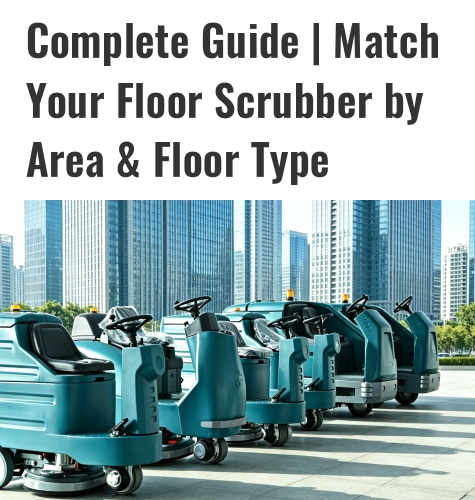
      If you’re the owner or a buyer for a factory, property management company, or retail store, I bet you’ve been driven crazy by cleaning at some point.   The floors remain dusty and dull, which not only hurts customer impressions but also gets you in trouble when management comes for an inspection; When it comes to large-scale cleaning, a few people work until dark and still can’t finish the job.   So, what should you look for when choosing a floor scrubber?   <3,000 sq m (e.g., small campuses, hallways, small workshops): Choose Jiechi’s push-type scrubber! Compact and agile, it fits in elevators and navigates narrow aisles. It’s incredibly easy to operate—cleaning staff can get the hang of it in just five minutes.   3,000–10,000 m² (e.g., medium-sized residential complexes, shopping malls, standard workshops): Choose Jiechi’s small-to-medium-sized ride-on scrubber! They ensure cleaning efficiency while maneuvering flexibly through various areas without being too bulky.   >10,000 m² (e.g., large industrial parks, underground parking garages, heavy industrial plants): Choose Jiechi’s large ride-on models or wash-and-sweep combination machines! Effortless continuous operation allows them to clean tens of thousands of square meters in a single day—no more relying on a large crew working around the clock.   Smart factories or facilities requiring 24/7 cleaning: Go straight for Jiechi’s industrial autonomous floor scrubbers! They automatically plan routes, recharge, and discharge wastewater, plus they support data-driven management—no human supervision required, freeing up your hands completely.   Beyond area size, match the machine to the floor type: - For epoxy floors and tile surfaces, choose soft brush decks to prevent scratching. - For concrete floors and areas with heavy oil stains, choose hard brush decks. You can also pair them with cleaning agents to remove even the most stubborn engine oil and grime.
  • JIECHI BA850BT The Leader in Large-Area Cleaning with High Efficiency & Low Noise
    Apr 28, 2026
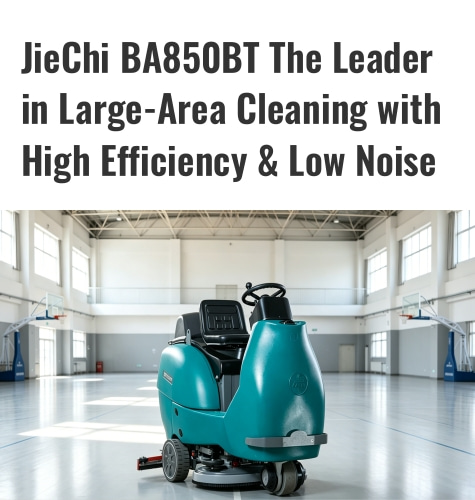
    Large-scale indoor cleaning scenarios demand higher-performance cleaning equipment. ⚠️Factory workshops struggle with heavy oil stains on floors;  ⚠️hospitals and schools enforce strict standards for hygiene cleanliness and noise control;  ⚠️underground parking lots and logistics warehouses feature vast floor areas where manual sweeping is time-consuming and labor-intensive.   The JieChi BA850BT Large-scale floor scrubber delivers a perfect solution to all these challenges.   JieChi BA850BT Core Advantages   850mm Ultra-wide Cleaning Path Equipped with an extra-large brush disc, it delivers extensive single-pass coverage, minimizing repeated cleaning strokes and drastically boosting efficiency in open areas such as corridors, workshops and parking lots, while cutting labor costs effectively.   180L Clean Water Tank + 195L Sewage Tank Dual large-capacity tanks reduce frequent water refills and sewage disposal, supporting long-duration continuous operation. Even for large-scale logistics warehouses spanning thousands of square meters, one-stop uninterrupted cleaning is achievable to avoid workflow disruptions.   Full-body Anti-collision Strips Protects the equipment from impact damage and prevents scratches on floors, walls and surrounding facilities.   Ultra-quiet Operation Design The suction motor is embedded in a sound-absorbing system with premium noise-dampening materials, ensuring extremely low operating noise.   Applicable Scenarios   Shopping Malls & Supermarkets Efficiently cleans tile and marble floors with instant washing and drying performance, ensuring pedestrian safety and maintaining a neat, tidy shopping environment. Factory Workshops & Industrial Plants Effectively removes oil stains, metal scraps and industrial dust. Compatible with cement floors, epoxy flooring, wear-resistant floors and more, it helps factories meet sanitation standards and ensure safe production. Hospitals, Schools & Office Buildings The low-noise design eliminates noise disturbance, with dust-free and residue-free cleaning results. It meets the stringent hygiene requirements of medical, educational and commercial office spaces for a healthy and sanitary environment. Underground Parking Lots The wide cleaning coverage greatly improves operational efficiency, easily removing dust, sediment and tire marks to prevent dust accumulation and keep parking areas well-maintained. Logistics Warehouses & Distribution Centers Long battery life and large tank capacity fully meet large-area cleaning demands, supporting high-efficiency daily sanitation without disrupting warehousing operations and cargo turnover. Hotel Lobbies & Exhibition Centers Leaves floors spotless and completely dry after cleaning, elevating overall venue hygiene and brand image.     Ideal for property management supervisors, factory administrative teams, shopping mall operators, and facility managers of hospitals and schools, the JieChi BA850BT stands as the top choice for daily large-area indoor cleaning and post-construction site cleanup. It enables full-scenario, high-efficiency, and low-consumption cleaning operations, helping create a cleaner, quieter, and safer working and public environment.

leave a message

leave a message
If you are interested in our products and want to know more details,please leave a message here,we will reply you as soon as we can.
submit

Home

Products

WhatsApp

contact