other

walk-behind floor scrubber

Home

walk-behind floor scrubber

  • Eco-Friendly Floor Cleaning: How Floor Scrubbers Reduce Water and Chemical Usage
    May 18, 2026
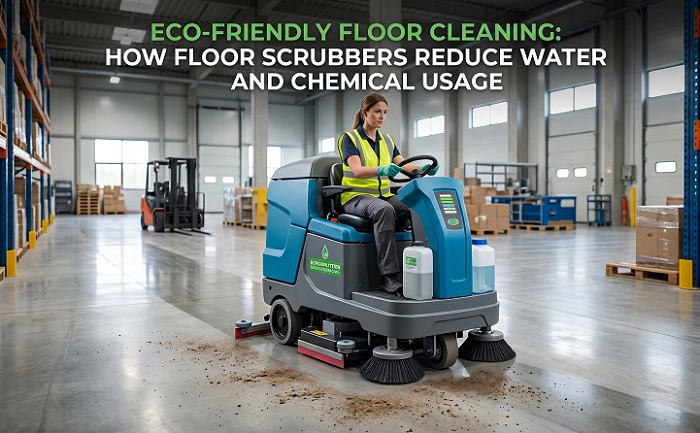
    When it comes to commercial cleaning, sustainability is no longer a nice-to-have — it's a business imperative. Facility managers across warehouses, retail stores, hospitals, and manufacturing plants are increasingly asking the same question: How can we keep our floors spotless while reducing our environmental footprint? The answer lies in modern floor scrubber technology. Today's advanced cleaning machines are designed to achieve superior results with significantly less water and fewer chemicals than traditional methods. This article explores exactly how floor scrubbers make eco-friendly cleaning possible — and why making the switch benefits both your facility and the planet.   How Much Water Do Floor Scrubbers Actually Save? The most dramatic impact of modern floor scrubbers is water conservation. Traditional mopping methods typically consume anywhere from 10 to 30 gallons of water per 1,000 square feet, depending on technique and frequency of bucket changes. In contrast, an automatic floor scrubber uses a fraction of that amount. A typical walk-behind floor scrubber uses approximately 1 to 3 gallons of water per 1,000 square feet — a reduction of up to 90%. Ride-on scrubbers, with their larger tanks and optimized flow systems, achieve similar efficiency on a bigger scale. Over the course of a year, a facility cleaning 50,000 square feet daily could save over 50,000 gallons of water simply by switching from mops to scrubbers. But how does this work? Floor scrubbers are equipped with precision-controlled solution flow systems. Instead of dumping a large volume of water onto the floor and hoping for the best, they dispense a fine, consistent layer of cleaning solution directly in front of the brush or pad. The scrub deck then agitates and lifts dirt, while the squeegee and vacuum system immediately recover the dirty water. This closed-loop process ensures that water is used only where it's needed and recovered promptly — no waste, no unnecessary runoff. Chemical Reduction: Less Is More Equally important is the reduction in cleaning chemical usage. Traditional mopping often requires higher concentrations of detergent to compensate for the inefficiency of the method. With floor scrubbers, the combination of mechanical scrubbing action and precise chemical dispensing means you can achieve better results with 50% to 70% less cleaning solution. Here's why: Mechanical action does the heavy lifting. The rotating brushes or pads physically scrub dirt and grime loose from floor surfaces. This mechanical energy reduces reliance on chemical surfactants to break down soil. Precise dilution control. Many modern floor scrubbers feature built-in chemical dosing systems that automatically mix water and concentrate at the correct ratio. This eliminates guesswork and prevents overuse. Faster drying means less residue. Because scrubbers recover most of the water they dispense, floors dry quickly. This reduces the need for chemical rinse agents, as there's less opportunity for streaking or residue buildup. For facilities using green-certified cleaning products, this combination is especially powerful. A floor scrubber allows you to use lower-concentration, plant-based detergents without sacrificing cleaning performance. Beyond Water and Chemicals: The Broader Environmental Benefits The eco-friendly advantages of floor scrubbers extend beyond direct resource savings. Reduced wastewater disposal. Dirty mop water is typically dumped down drains, carrying chemical residues into local water systems. Floor scrubbers collect used water in a recovery tank, which can be disposed of properly — or in some cases, treated and reused. Lower energy consumption per cleaning cycle. While floor scrubbers do require electricity to operate, the total energy footprint per square foot cleaned is often lower than the combined energy of heating mop water, running a mop wringer, and drying-time ventilation. Extended floor life. Floor scrubbers apply consistent pressure and chemical coverage, reducing wear patterns and surface damage. This means fewer floor restoration projects — saving materials, labor, and waste associated with refinishing or replacing flooring. Healthier indoor air quality. Because scrubbers recover dirty water immediately and floors dry in minutes (rather than the 30+ minutes typical of mopping), there's less moisture left to promote mold, mildew, or bacterial growth. This creates a healthier environment for employees, customers, and patients. Green Cleaning Certifications: What to Look For If environmental compliance is a priority for your facility, look for floor scrubbers and cleaning agents that meet recognized standards: Green Seal (GS-37) — Standard for industrial and institutional cleaners. LEED (Leadership in Energy and Environmental Design) — Points can be earned for using low-chemical cleaning equipment. EPA Safer Choice — Certifies that cleaning chemicals meet stringent human health and environmental criteria. Many modern floor scrubbers from Jiechi Cleaning are compatible with green-certified chemicals and designed to optimize their performance, helping facilities work toward sustainability certifications. Practical Tips to Maximize Eco-Friendly Floor Cleaning Even with the right equipment, small operational adjustments can further reduce your environmental impact: Adjust solution flow settings. Many scrubbers allow you to dial in the exact water flow rate for your floor type. Start low and increase only if needed. Use proper brush or pad pressure. Excessive downward pressure wastes energy and can damage floors. Let the machine's weight and brush design do the work. Schedule efficient routes. Plan cleaning paths to minimize empty travel, saving battery life and reducing overall energy use. Maintain your machine regularly. A well-maintained scrubber recovers more water, dispenses solution accurately, and runs more efficiently. Check squeegee blades, vacuum hoses, and filters frequently. Train operators thoroughly. The most eco-friendly machine in the world is only as green as the person running it. Proper training ensures operators use the correct settings and avoid wasteful habits. Making the Switch: Is an Eco-Friendly Floor Scrubber Right for Your Facility? If your facility currently uses mops and buckets, or operates older scrubber models, upgrading to a modern, water-efficient floor scrubber is one of the most impactful sustainability investments you can make. The water savings alone often offset the equipment cost within the first year, and the chemical reductions provide ongoing operational savings. For facilities already using scrubbers, simple adjustments — like optimizing solution flow rates and switching to concentrated, green-certified chemicals — can deliver measurable environmental gains without any new equipment purchase. Conclusion Eco-friendly floor cleaning is not about sacrificing cleanliness for sustainability. Thanks to modern floor scrubber technology, you can achieve both. By dramatically reducing water consumption, cutting chemical usage in half or more, and improving indoor air quality, automatic floor scrubbers are reshaping what it means to clean responsibly. At Jiechi Cleaning, we are committed to providing efficient, sustainable cleaning solutions that help facilities around the world maintain spotless floors while protecting the environment. Have questions about choosing the right eco-friendly floor scrubber for your facility? Contact our team today — we're here to help you clean smarter, not harder. 🌍

  • Floor Scrubber Battery Maintenance: Extend Battery Life and Reduce Replacement Costs
    May 14, 2026
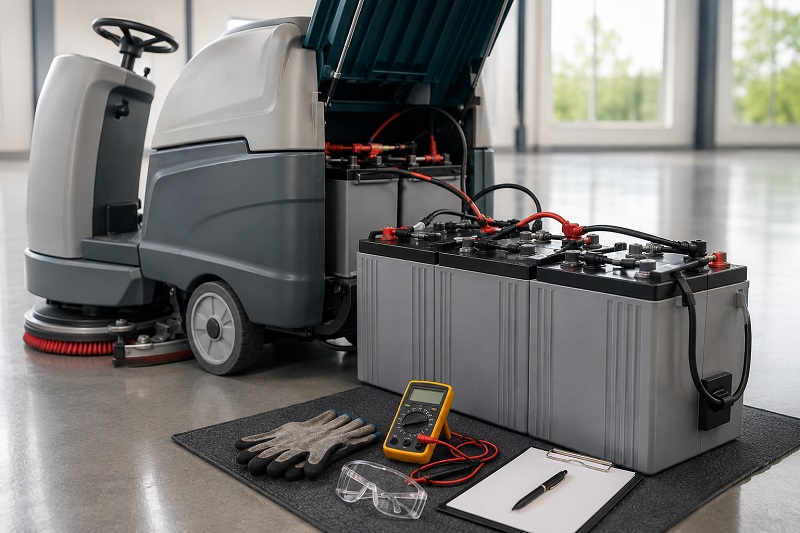
    Batteries are one of the most expensive components of any floor scrubber. Whether you use a walk-behind floor scrubber or a ride-on floor scrubber, your machine's battery system requires regular attention to perform reliably day after day. Neglecting battery maintenance can lead to reduced runtime, slower charging, and premature failure — which means costly replacement long before you expected it. This guide covers practical battery maintenance techniques that work across lead-acid and lithium-ion floor scrubber batteries, helping you get the most life out of your power source and keep operating costs under control. 1. Understand Your Battery Type Before you can maintain a battery properly, you need to know what you're working with. The two most common types in floor scrubbers are: Flooded Lead-Acid Batteries — Require regular watering, venting, and equalization charging. These are the traditional workhorses, durable but high-maintenance. Sealed Lead-Acid (AGM/Gel) Batteries — Maintenance-free in terms of watering, but still sensitive to overcharging and deep discharge. Lithium-Ion Batteries — Lightweight, long cycle life, and virtually zero daily maintenance. However, they need compatible chargers and temperature management. If you're unsure which type your machine uses, check the battery label or consult your supplier of floor scrubber batteries and chargers. Using the wrong charging profile can damage the battery in a single cycle. 2. Establish a Consistent Charging Routine How and when you charge matters more than you might think. Here are the essential guidelines: Charge after every use — Never let a lead-acid battery sit discharged. Even a few hours in a discharged state can cause sulfation, which permanently reduces capacity. Avoid partial charges on lead-acid — Lead-acid batteries prefer full charge cycles. Frequent topping-off without a full charge shortens their lifespan. Lithium is more flexible — Lithium-ion batteries tolerate partial charging well. You can top them off without damage. Use the correct charger — Always use the charger that came with your machine or one approved by the manufacturer. A mismatched charger is one of the fastest ways to destroy a battery. 3. Watering Your Lead-Acid Battery (If Applicable) For flooded lead-acid batteries, proper watering is critical: Check water levels weekly — Use distilled water only. Tap water contains minerals that reduce battery life. Water after charging — Charging causes the electrolyte level to rise. Adding water before charging can cause overflow and acid loss. Keep plates submerged — Never let the plates be exposed to air. This causes irreversible damage. Don't overfill — Fill to the level indicated by the manufacturer, typically just above the plates. 4. Clean Battery Terminals and Compartment Corrosion and dirt can significantly reduce electrical conductivity: Inspect terminals monthly — Look for white or bluish corrosion around the posts and cable ends. Clean with a baking soda solution — Mix a small amount of baking soda with water, apply to corroded areas, scrub with a brush, and rinse clean. Apply terminal protectant — A thin layer of petroleum jelly or commercial anti-corrosion spray helps prevent future buildup. Keep the battery compartment dry — Moisture accelerates corrosion and can cause short circuits. Wipe down the compartment after each cleaning shift. 5. Monitor Charge Cycles and Depth of Discharge Battery lifespan is measured in charge cycles. Each time you discharge and recharge, you use one cycle. The key to longevity is: Avoid deep discharges — Lead-acid batteries suffer when discharged below 50%. Lithium batteries are more forgiving but still benefit from staying above 20%. Track usage patterns — If your machine is consistently running out of power before the shift ends, you may need a higher-capacity battery or an additional charging opportunity during breaks. Rotate batteries — If your facility uses multiple batteries per machine, rotate them evenly to ensure balanced wear. A good rule of thumb: a well-maintained lead-acid battery should deliver 1,000 to 1,500 cycles. A lithium battery can deliver 2,000 to 5,000 cycles depending on usage conditions. Read our detailed comparison of lithium vs lead-acid batteries for floor scrubbers to choose the right power source for your facility. 6. Store Batteries Properly During Downtime If your floor scrubber won't be used for an extended period: Store in a cool, dry place — High temperatures accelerate chemical reactions that degrade batteries. Ideal storage temperature is 15°C to 25°C (59°F to 77°F). Charge lead-acid batteries to 100% before storage — Then recharge every 30 days to prevent sulfation. Store lithium batteries at 50-60% charge — Unlike lead-acid, lithium batteries should not be stored at full charge. This reduces stress on the cells. Disconnect the battery — If the machine will sit unused, disconnect the battery to avoid parasitic drain from onboard electronics. 7. Know the Warning Signs of Battery Failure Catch problems early to avoid unexpected downtime: Reduced runtime — The most common early sign. If a full charge no longer lasts as long as it used to, capacity is degrading. Slow charging — If charge times increase significantly, internal resistance may be rising. Swelling or bulging — This is a safety hazard, especially with lithium batteries. Stop using the battery immediately. Excessive heat during charging — Batteries naturally warm up, but if they become hot to the touch, there may be an internal issue. Corrosion or acid leaks — Visible acid around terminals or cracks in the battery case means replacement is needed. 8. Schedule Professional Inspections While daily and weekly checks keep your battery healthy, an annual professional inspection adds an extra layer of protection: Load testing — Confirms the battery can still deliver its rated capacity under load. Specific gravity testing (lead-acid) — Measures the health of individual cells. Internal resistance measurement — Identifies failing cells before they cause operational issues. If you don't have in-house maintenance staff, many walk-behind floor scrubber dealers and service centers offer battery inspection as part of their maintenance packages. Conclusion Your floor scrubber's battery is a significant investment, and protecting it doesn't require complex procedures. A few consistent habits — proper charging, regular cleaning, correct watering, and attentive monitoring — can double the useful life of your battery and save your facility thousands of dollars in replacement costs. At Jiechi Cleaning, we supply high-quality walk-behind floor scrubbers and ride-on floor scrubbers with reliable battery systems designed for long-term performance. Whether you need a compact unit for tight spaces or a large machine for big facilities, we have solutions tailored to your needs. Have questions about battery maintenance or floor scrubber selection? Contact our team today — we're here to help you keep your equipment running at its best.
  • Walk-Behind vs Ride-On Floor Scrubber: Which One Is Right for Your Facility?
    Apr 29, 2026
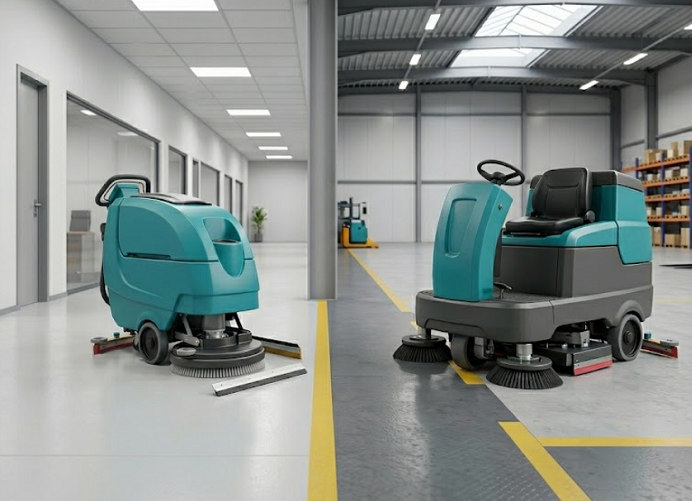
    When outfitting a professional cleaning operation, one question comes up again and again: walk-behind or ride-on floor scrubber? The answer isn't one-size-fits-all — it depends on your facility size, layout, and daily traffic. Let's break down the key differences so you can make an informed decision. Walk-Behind Scrubbers: Best for Tight Spaces A walk-behind floor scrubber like the Jiechi A3 is ideal for smaller to mid-sized areas. With a 530mm cleaning width and a compact turning radius, it can easily navigate narrow aisles, retail floors, and congested corridors. It offers excellent maneuverability, intuitive touch-panel controls, and hassle-free maintenance — all at a lower upfront cost. For facilities under 2,000m², a walk-behind model is often the most cost-effective commercial cleaning equipment choice. Ride-On Scrubbers: Built for Large-Scale Productivity When your facility spans thousands of square meters, a ride-on floor scrubber becomes essential. The Jiechi A8/A10 dual-brush ride-on model delivers a cleaning performance of up to 8,600m²/h, paired with a massive 280L solution tank and 300L recovery tank. The dual brush system powers through stubborn grease and grime in warehouses, factories, and logistics hubs. Operators can work longer without fatigue, significantly reducing labor costs in industrial cleaning. Key Maintenance Tips for Longevity No matter which type of commercial cleaning equipment you choose, proper upkeep is critical. Always rinse the recovery tank after each shift to prevent odor. Inspect squeegee blades and brush discs weekly — worn parts reduce cleaning efficiency. For ride-on models, check battery water levels monthly to extend floor scrubber battery life. Following these practices keeps your machine running at peak performance for years. Choose Jiechi — Your Trusted Floor Cleaning Partner Still unsure which type fits your operation? At Jiechi Cleaning, we specialize in manufacturing high-performance floor scrubbers, sweepers, and cleaning robots with factory-direct pricing and full OEM/ODM support. Whether you need a compact walk-behind model for retail spaces or a heavy-duty ride-on for industrial warehouses, we have the right solution for you. For larger debris-prone areas, consider pairing with an industrial floor sweeper as a pre-clean step. Browse our full range of floor scrubbers to find the perfect match. Contact us today — our team is ready to help you choose the right cleaning equipment for your facility!
  • How Fiercely Competitive Has the World Become in the Intelligent Era?
    Mar 02, 2026
    Recently, we came across the research data of the cleaning industry, which is truly striking: the recruitment of cleaning enterprises in the southeast coastal areas has surged by 80%, yet the profit margin is a meager 2%.   "The market is extremely competitive" has become a catchphrase across all walks of life.   💬How fierce is the competition in your industry now?   The Intelligent Era Is Corporate Cleaning Still Relying on Manual Labor Alone?   As practitioners in the field of professional large-scale cleaning equipment, we have seen numerous predicaments faced by those in the cleaning industry. The core of the fierce competition in the cleaning industry has never been "too many people with low prices", but rather still using "pure manual labor" to do "mechanized" work.   Dimension Real Data Industry Misconception Equipment Investment 70% of small and medium-sized cleaning enterprises lack systematic technical equipment Thinking that "purchasing equipment = increasing costs", without realizing that human-machine collaboration can reduce costs by more than 30%   If enterprises fail to calculate this account clearly, they can only get caught in the internal friction of low prices.Here are several real cases ⬇️   Case 1 A property management company of a residential community in Shanghai is responsible for the cleaning work of 3 communities. At the beginning of last year, they reported to us that:   The main road of the community covers more than 1,600 square meters. 5 cleaning workers worked non-stop from 8 a.m. to 12 p.m., yet there were constant complaints from property owners, and the client almost terminated the cooperation.   After understanding their difficulties, we recommended the Jiechi BA2100T Ride-on Sweeper. Soon after, they gave us feedback: this equipment is such a relief!   1 cleaning worker can operate it by sitting on it and clean more than 1,600 square meters of the main road in about 20 minutes, even sweeping away the dust and fallen leaves in the cracks, and the complaints from owners have decreased. The work that used to take 5 people 4 hours to finish can now be done by 1 person in less than half an hour, saving nearly 20,000 RMB in labor costs every month. What's more reassuring is that a single charge supports continuous work for 6-8 hours, covering both the community corridors and parking lots. Now, they have redeployed the saved labor to do refined cleaning work and finally renewed the cooperation smoothly. Case 2 A food processing factory, mainly engaged in the processing of pastries and cooked food, has been plagued by the problem of workshop cleaning for a long time. Food workshops have extremely high hygiene requirements, and failure in random inspections may even result in forced suspension of production for rectification.   At first, cleaning was entirely done by manual labor. Anyone in the food industry knows how troublesome it is to clean oil stains—it is labor-intensive and time-consuming, and poor handling may cause workers to slip and fall, creating potential safety hazards.   Later, they adopted the Jiechi Walk-behind Floor Scrubber, which is extremely flexible to operate. With a gentle push, all oil stains are cleaned wherever it goes, and the ground is left water-free, completely solving this big worry. After the improvement of the production environment, the order volume has also increased significantly. Case 3 A cleaning aunt at a RT-Mart store once shared her genuine experience of using the Walk-behind Floor Scrubber A3 with us. She said that the supermarket is crowded with people and has dense shelves, making it impossible for large floor scrubbers to maneuver. She used to mop the floor manually, walking tens of thousands of steps every day, and the mopped floor was prone to water stains, worrying that customers might slip and fall accidentally.   Later, the store was equipped with the walk-behind floor scrubber, which is compact in size and can easily weave through the shelves. The floor becomes dry immediately after mopping with no water stains left. The aunt said that it used to take her 4 hours to mop the floor every day, but now it only takes 2 hours. She can do other cleaning work with the remaining time, and her waist is not as sore as before. Facts have proven that instead of struggling in the vicious competition of low prices, it is better to spend a small amount of money on the right equipment. The labor and time saved are pure profits. Regardless of the industry, the core demands for cleaning are "saving time, saving labor, and achieving a thorough clean".   Founded in 2003, Jiechi is a time-honored brand that not only focuses on the R&D and production of cleaning equipment but also has served well-known brands such as China High-speed Railway, Midea, Hema, Country Garden, BYD, etc. With guaranteed quality and after-sales service, we can respond promptly to any problems.   The cleaning industry is now in the "stage of equipment popularization" and is starting to transition to intelligence. Robots cannot work completely independently yet, but the proportion of manual labor will gradually decrease in the future, and equipmentization is definitely an inevitable trend.   Comply with the market trend, and benefit early by adopting equipment early.
  • Hema Fresh Supermarket Cleaning "Secrets"
    Aug 15, 2025
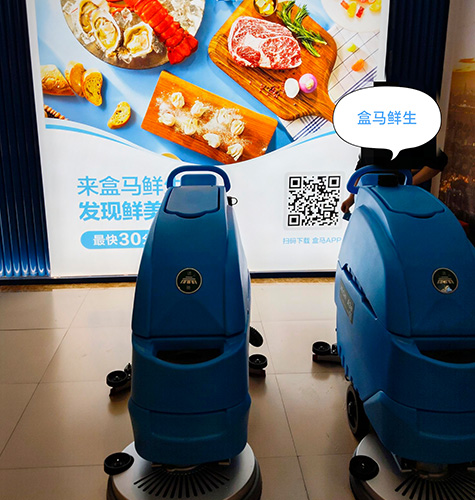
    When Hema Fresh meets Jiechi: I still remember the first time I walked into a Hema store, I was amazed by its clean and bright environment. I never expected that later on, our Shanghai Jiechi Cleaning Equipment Co., Ltd. would actually become a cleaning equipment supplier for Hema!   Over the past few months, we have delivered professional cleaning equipment to many Hema stores across China and taught the store staff step by step how to use it. Seeing our equipment safeguarding the environmental hygiene of Hema every day, I can't help feeling extremely proud.   In this cooperation, we mainly provided two "secret weapons" : 1️ ️ A3e push-type floor scrubber - make large area floor cleaning so easy 2️ ️ A5e ride-on floor scrubber - a strong guarantee for hygiene in the fresh produce area     What moved us the most was that all the Hema team members learned the usage methods of the equipment very seriously and often exchanged their usage experiences with us. This feeling of mutual cooperation and making progress together is really wonderful!   Every time I go shopping at Hema and see the clean and tidy environment, I can't help but feel a little proud: We also have our share of the credit here! In the future, we will continue to provide Hema with better cleaning solutions, allowing every customer to enjoy a safer and more comfortable shopping environment When you go to Hema Fresh, do you pay special attention to their cleanliness and hygiene?

leave a message

leave a message
If you are interested in our products and want to know more details,please leave a message here,we will reply you as soon as we can.
submit

Home

Products

WhatsApp

contact