other

ride-on floor scrubber

Home

ride-on floor scrubber

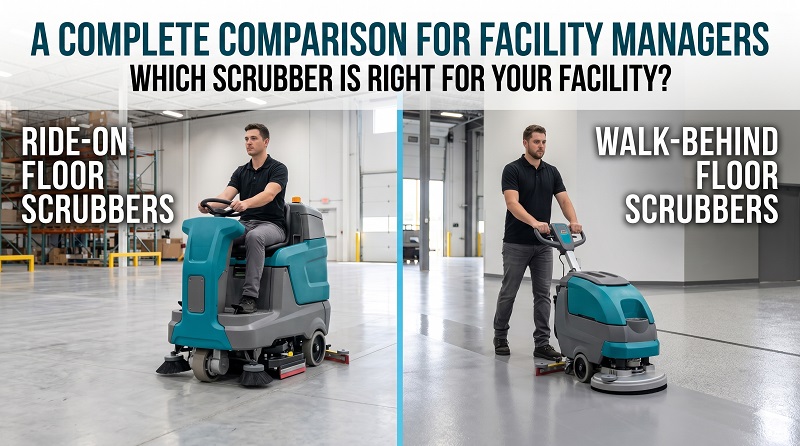
  • Ride-On vs. Walk-Behind Floor Scrubbers: A Complete Comparison for Facility Managers
    May 23, 2026
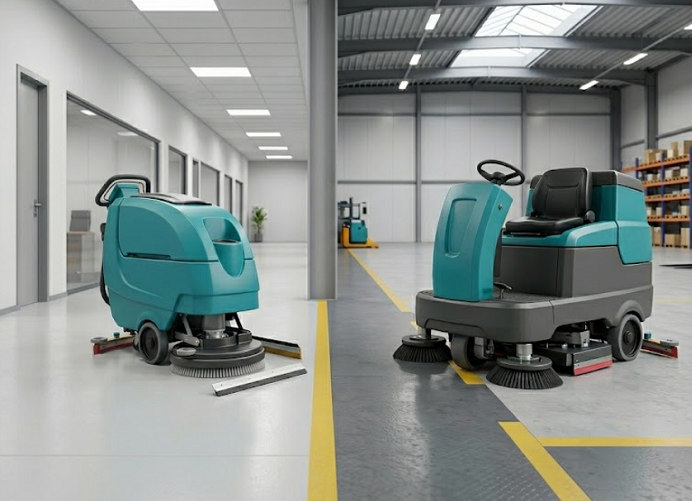
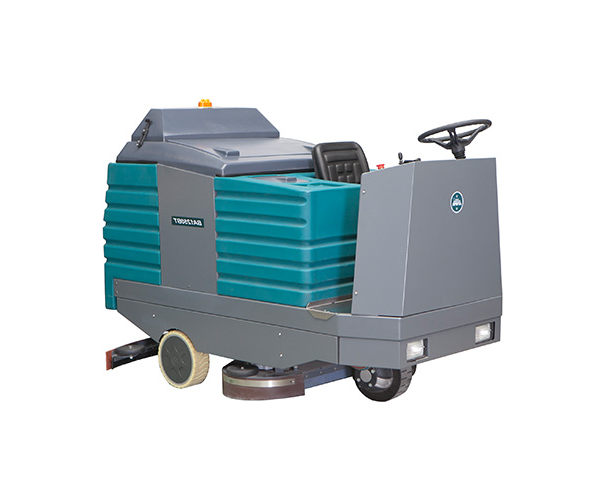
      Choosing the right floor scrubber can significantly impact your facility's cleanliness, operational efficiency, and bottom line. For facility managers and cleaning contractors, one of the most fundamental decisions is whether to invest in a ride-on floor scrubber or a walk-behind floor scrubber. Both machine types serve the same core purpose — cleaning and drying hard floors in commercial, industrial, and institutional settings. But they differ dramatically in productivity, cost, maneuverability, and suitability for different applications. This guide breaks down every aspect to help you make an informed decision. What Are Ride-On Floor Scrubbers? Ride-on floor scrubbers are self-propelled cleaning machines that the operator sits on while driving. They are designed for large open areas where covering significant square footage quickly is the top priority. Typical specifications: Cleaning width: 28–48 inches (700–1200 mm) Solution tank capacity: 30–70+ gallons (110–265+ liters) Coverage rate: 40,000–100,000+ sq ft per hour Battery runtime: 3–6 hours depending on model Ride-on scrubbers are most commonly used in warehouses, distribution centers, large manufacturing plants, big-box retail stores, shopping malls, airport terminals, and parking garages.   What Are Walk-Behind Floor Scrubbers? Walk-behind floor scrubbers are machines that the operator walks behind while guiding them across the floor. They come in two configurations: Walk-behind with rider sulky — The operator walks but can occasionally ride on a small platform for brief rests Standard walk-behind — Fully walk-along operation Typical specifications: Cleaning width: 17–34 inches (430–860 mm) Solution tank capacity: 8–25 gallons (30–95 liters) Coverage rate: 12,000–40,000 sq ft per hour Battery runtime: 2–5 hours Walk-behind scrubbers are ideal for smaller facilities, spaces with tight aisles and corners, multi-room buildings, restaurants, schools, retail stores, hospitals, and office buildings. Head-to-Head Comparison Factor Ride-On Scrubber Walk-Behind Scrubber Productivity 40,000–100,000+ sq ft/hr 12,000–40,000 sq ft/hr Best for 30,000+ sq ft open spaces Under 30,000 sq ft, complex layouts Maneuverability Lower — needs turning radius Higher — can navigate tight spaces Operator fatigue Low — seated operation Higher — walking all shift Initial cost $8,000–$30,000+ $2,500–$12,000 Maintenance cost Higher (more complex) Lower (simpler mechanics) Storage size Requires more space Compact storage Noise level Moderate Low to moderate Battery weight Heavy (integrated) Lighter (removable often possible) Training required More (driving skills) Minimal When to Choose Ride-On Choose a ride-on floor scrubber if your facility meets these criteria: 1. Large open floor area. If your facility has 30,000 square feet or more of contiguous floor space, a ride-on machine will pay for itself in labor savings. An operator on a ride-on scrubber can clean a 50,000 sq ft warehouse floor in about 1 hour — a task that would take a walk-behind operator 2.5 to 3 hours. 2. High cleaning frequency. Facilities that need daily or multiple-times-per-day cleaning, such as busy distribution centers or food processing plants, benefit enormously from ride-on productivity. 3. Long operator shifts. If your cleaning staff works 6–8 hour shifts, a ride-on machine dramatically reduces fatigue and improves cleaning quality. A tired operator using a walk-behind may rush the job or miss spots. 4. Budget for higher investment. While upfront cost is higher, the labor savings of a ride-on scrubber often deliver an ROI in 6–18 months for large facilities. Browse our ride-on floor scrubber collection → When to Choose Walk-Behind Choose a walk-behind floor scrubber if your situation matches these conditions: 1. Smaller facility. For spaces under 30,000 sq ft — or multiple small rooms totaling under that — a walk-behind is the more practical and cost-effective choice. 2. Tight aisles and obstacles. Facilities with narrow aisles (under 5 feet wide), heavy racking, many columns, or complex layouts are better served by walk-behind machines. They can turn in tight spaces and easily maneuver around obstacles. 3. Budget constraints. Walk-behind machines cost significantly less upfront. For small businesses, startups, or facilities with limited capital, they offer outstanding value and quick ROI. 4. Multi-surface or multi-floor cleaning. If the same machine needs to clean a retail store on one floor and an office on another, a walk-behind is much easier to move between floors or transport between job sites. 5. Mixed-use facilities. Schools, hospitals, and office buildings with varied room sizes and different floor types benefit from the versatility of walk-behind scrubbers. Check out our walk-behind scrubber models → Key Decision Matrix Facility Type Recommended Reasoning Warehouse / Distribution Center 50,000+ sq ft Ride-On Large open area, high productivity needed Small workshop 10,000–30,000 sq ft Walk-Behind Better value, adequate coverage Supermarket / big-box retail Ride-On Wide aisles, large floor area Convenience store / small retail Walk-Behind Tight space, lower budget Hospital patient wings Walk-Behind Multiple rooms, noise considerations Hospital main lobby / corridors Ride-On Large continuous area School classrooms & hallways Walk-Behind Multi-room, complex routing Food processing plant Ride-On Large area, frequent cleaning cycles Parking garage Ride-On Expansive sloped surface Office building Walk-Behind Multi-floor, room-to-room Total Cost of Ownership Cost Component Ride-On (48") Walk-Behind (28") Purchase price $18,000 $6,500 Batteries (2-year replacement) $600–$1,200 $300–$600 Brushes / pads (annual) $300–$500 $200–$350 Maintenance (annual) $500–$1,000 $300–$600 Labor cost per year ($15/hr, 50K sq ft daily) $12,000 $30,000 5-year TCO ~$85,000 ~$188,000 The labor savings from a ride-on scrubber in a large facility can easily dwarf the purchase price difference. Why Choose JIECHI for Your Floor Scrubber JIECHI Cleaning manufactures both ride-on and walk-behind floor scrubbers to meet the diverse needs of commercial and industrial facilities worldwide. As a full-factory OEM with over 60,000 m² of manufacturing space, we design and build every machine from the ground up — ensuring consistent quality, reliable performance, and cost-effective pricing. Whether you need a compact walk-behind for a retail store or a heavy-duty ride-on scrubber for a 100,000 sq ft warehouse, we can provide the right solution — and support it with genuine spare parts and responsive after-sales service. Contact us today for a personalized equipment recommendation based on your facility's specific requirements.

  • Floor Scrubber Battery Maintenance: Extend Battery Life and Reduce Replacement Costs
    May 14, 2026
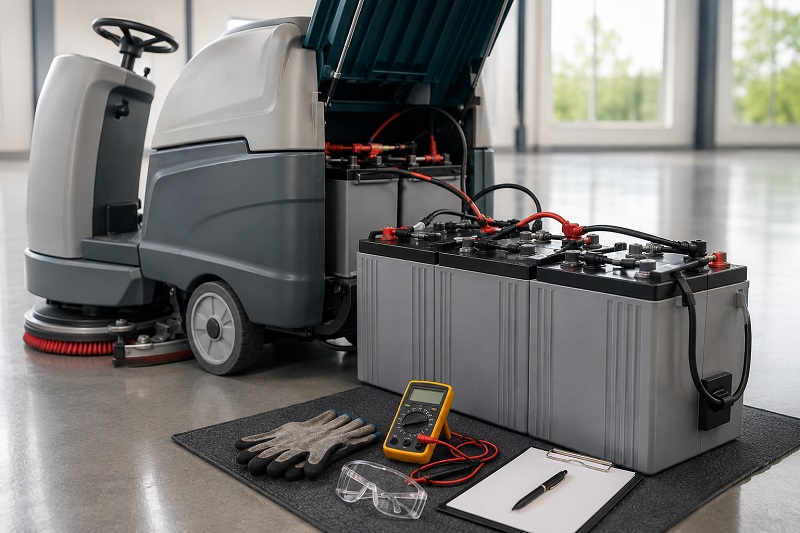
    Batteries are one of the most expensive components of any floor scrubber. Whether you use a walk-behind floor scrubber or a ride-on floor scrubber, your machine's battery system requires regular attention to perform reliably day after day. Neglecting battery maintenance can lead to reduced runtime, slower charging, and premature failure — which means costly replacement long before you expected it. This guide covers practical battery maintenance techniques that work across lead-acid and lithium-ion floor scrubber batteries, helping you get the most life out of your power source and keep operating costs under control. 1. Understand Your Battery Type Before you can maintain a battery properly, you need to know what you're working with. The two most common types in floor scrubbers are: Flooded Lead-Acid Batteries — Require regular watering, venting, and equalization charging. These are the traditional workhorses, durable but high-maintenance. Sealed Lead-Acid (AGM/Gel) Batteries — Maintenance-free in terms of watering, but still sensitive to overcharging and deep discharge. Lithium-Ion Batteries — Lightweight, long cycle life, and virtually zero daily maintenance. However, they need compatible chargers and temperature management. If you're unsure which type your machine uses, check the battery label or consult your supplier of floor scrubber batteries and chargers. Using the wrong charging profile can damage the battery in a single cycle. 2. Establish a Consistent Charging Routine How and when you charge matters more than you might think. Here are the essential guidelines: Charge after every use — Never let a lead-acid battery sit discharged. Even a few hours in a discharged state can cause sulfation, which permanently reduces capacity. Avoid partial charges on lead-acid — Lead-acid batteries prefer full charge cycles. Frequent topping-off without a full charge shortens their lifespan. Lithium is more flexible — Lithium-ion batteries tolerate partial charging well. You can top them off without damage. Use the correct charger — Always use the charger that came with your machine or one approved by the manufacturer. A mismatched charger is one of the fastest ways to destroy a battery. 3. Watering Your Lead-Acid Battery (If Applicable) For flooded lead-acid batteries, proper watering is critical: Check water levels weekly — Use distilled water only. Tap water contains minerals that reduce battery life. Water after charging — Charging causes the electrolyte level to rise. Adding water before charging can cause overflow and acid loss. Keep plates submerged — Never let the plates be exposed to air. This causes irreversible damage. Don't overfill — Fill to the level indicated by the manufacturer, typically just above the plates. 4. Clean Battery Terminals and Compartment Corrosion and dirt can significantly reduce electrical conductivity: Inspect terminals monthly — Look for white or bluish corrosion around the posts and cable ends. Clean with a baking soda solution — Mix a small amount of baking soda with water, apply to corroded areas, scrub with a brush, and rinse clean. Apply terminal protectant — A thin layer of petroleum jelly or commercial anti-corrosion spray helps prevent future buildup. Keep the battery compartment dry — Moisture accelerates corrosion and can cause short circuits. Wipe down the compartment after each cleaning shift. 5. Monitor Charge Cycles and Depth of Discharge Battery lifespan is measured in charge cycles. Each time you discharge and recharge, you use one cycle. The key to longevity is: Avoid deep discharges — Lead-acid batteries suffer when discharged below 50%. Lithium batteries are more forgiving but still benefit from staying above 20%. Track usage patterns — If your machine is consistently running out of power before the shift ends, you may need a higher-capacity battery or an additional charging opportunity during breaks. Rotate batteries — If your facility uses multiple batteries per machine, rotate them evenly to ensure balanced wear. A good rule of thumb: a well-maintained lead-acid battery should deliver 1,000 to 1,500 cycles. A lithium battery can deliver 2,000 to 5,000 cycles depending on usage conditions. Read our detailed comparison of lithium vs lead-acid batteries for floor scrubbers to choose the right power source for your facility. 6. Store Batteries Properly During Downtime If your floor scrubber won't be used for an extended period: Store in a cool, dry place — High temperatures accelerate chemical reactions that degrade batteries. Ideal storage temperature is 15°C to 25°C (59°F to 77°F). Charge lead-acid batteries to 100% before storage — Then recharge every 30 days to prevent sulfation. Store lithium batteries at 50-60% charge — Unlike lead-acid, lithium batteries should not be stored at full charge. This reduces stress on the cells. Disconnect the battery — If the machine will sit unused, disconnect the battery to avoid parasitic drain from onboard electronics. 7. Know the Warning Signs of Battery Failure Catch problems early to avoid unexpected downtime: Reduced runtime — The most common early sign. If a full charge no longer lasts as long as it used to, capacity is degrading. Slow charging — If charge times increase significantly, internal resistance may be rising. Swelling or bulging — This is a safety hazard, especially with lithium batteries. Stop using the battery immediately. Excessive heat during charging — Batteries naturally warm up, but if they become hot to the touch, there may be an internal issue. Corrosion or acid leaks — Visible acid around terminals or cracks in the battery case means replacement is needed. 8. Schedule Professional Inspections While daily and weekly checks keep your battery healthy, an annual professional inspection adds an extra layer of protection: Load testing — Confirms the battery can still deliver its rated capacity under load. Specific gravity testing (lead-acid) — Measures the health of individual cells. Internal resistance measurement — Identifies failing cells before they cause operational issues. If you don't have in-house maintenance staff, many walk-behind floor scrubber dealers and service centers offer battery inspection as part of their maintenance packages. Conclusion Your floor scrubber's battery is a significant investment, and protecting it doesn't require complex procedures. A few consistent habits — proper charging, regular cleaning, correct watering, and attentive monitoring — can double the useful life of your battery and save your facility thousands of dollars in replacement costs. At Jiechi Cleaning, we supply high-quality walk-behind floor scrubbers and ride-on floor scrubbers with reliable battery systems designed for long-term performance. Whether you need a compact unit for tight spaces or a large machine for big facilities, we have solutions tailored to your needs. Have questions about battery maintenance or floor scrubber selection? Contact our team today — we're here to help you keep your equipment running at its best.
  • Walk-Behind vs Ride-On Floor Scrubber: Which One Is Right for Your Facility?
    Apr 29, 2026
    When outfitting a professional cleaning operation, one question comes up again and again: walk-behind or ride-on floor scrubber? The answer isn't one-size-fits-all — it depends on your facility size, layout, and daily traffic. Let's break down the key differences so you can make an informed decision. Walk-Behind Scrubbers: Best for Tight Spaces A walk-behind floor scrubber like the Jiechi A3 is ideal for smaller to mid-sized areas. With a 530mm cleaning width and a compact turning radius, it can easily navigate narrow aisles, retail floors, and congested corridors. It offers excellent maneuverability, intuitive touch-panel controls, and hassle-free maintenance — all at a lower upfront cost. For facilities under 2,000m², a walk-behind model is often the most cost-effective commercial cleaning equipment choice. Ride-On Scrubbers: Built for Large-Scale Productivity When your facility spans thousands of square meters, a ride-on floor scrubber becomes essential. The Jiechi A8/A10 dual-brush ride-on model delivers a cleaning performance of up to 8,600m²/h, paired with a massive 280L solution tank and 300L recovery tank. The dual brush system powers through stubborn grease and grime in warehouses, factories, and logistics hubs. Operators can work longer without fatigue, significantly reducing labor costs in industrial cleaning. Key Maintenance Tips for Longevity No matter which type of commercial cleaning equipment you choose, proper upkeep is critical. Always rinse the recovery tank after each shift to prevent odor. Inspect squeegee blades and brush discs weekly — worn parts reduce cleaning efficiency. For ride-on models, check battery water levels monthly to extend floor scrubber battery life. Following these practices keeps your machine running at peak performance for years. Choose Jiechi — Your Trusted Floor Cleaning Partner Still unsure which type fits your operation? At Jiechi Cleaning, we specialize in manufacturing high-performance floor scrubbers, sweepers, and cleaning robots with factory-direct pricing and full OEM/ODM support. Whether you need a compact walk-behind model for retail spaces or a heavy-duty ride-on for industrial warehouses, we have the right solution for you. For larger debris-prone areas, consider pairing with an industrial floor sweeper as a pre-clean step. Browse our full range of floor scrubbers to find the perfect match. Contact us today — our team is ready to help you choose the right cleaning equipment for your facility!
  • What Are the Key Features of Modern Ride-On Floor Scrubbers?
    Dec 30, 2025
    Walk into a large factory, shopping mall, or logistics warehouse early in the morning, and you will often hear a familiar low hum moving steadily across the floor. That sound usually belongs to a ride-on floor scrubber—quietly doing the kind of work that would otherwise take an entire cleaning team hours to finish.   Over the past decade, ride-on floor scrubbers have evolved far beyond basic cleaning machines. Today’s models combine mechanical power, intelligent control, and user-focused design to meet the growing demands of modern facilities. For businesses responsible for maintaining large areas, understanding what truly defines a modern ride-on scrubber is essential before making an investment.   As a professional manufacturer specializing in floor scrubbers and sweepers, JIECHI has witnessed this evolution firsthand. Below, we explore the key features that separate modern ride-on floor scrubbers from older generations—and why they matter in real-world cleaning operations.     Cleaning Efficiency That Matches Today’s Scale   Large spaces are getting larger. Warehouses are expanding, factories are becoming more automated, and commercial buildings now prioritize open layouts. In response, cleaning equipment must deliver speed without compromising results.   Modern ride-on floor scrubbers are built for high productivity. Wide scrubbing paths allow operators to clean thousands of square meters per hour, while powerful brush pressure removes stubborn dirt, oil residue, and fine dust in a single pass. Unlike traditional cleaning methods that require repeated scrubbing, modern machines are designed to clean and dry floors simultaneously.   This efficiency is especially valuable for operations with tight cleaning windows. Facilities that operate 24/7—such as logistics hubs or production plants—benefit greatly from high productivity ride-on floor scrubbers for large areas, where downtime simply isn’t an option.     Smarter Control, Simpler Operation   One of the most noticeable changes in modern ride-on scrubbers is how intuitive they are to operate. Advanced technology no longer means complicated controls.   Clear dashboards provide real-time information such as battery status, water levels, and operating hours. Many machines now feature simplified control layouts that reduce operator error and shorten training time. Even first-time users can quickly feel comfortable behind the wheel.   Some modern models integrate intelligent monitoring systems that help operators maintain optimal performance. Alerts for maintenance intervals or abnormal operation help prevent breakdowns before they occur. This shift toward smarter control is not about replacing the operator—it’s about supporting them.     Designed for Operator Comfort, Not Just Performance   Cleaning large facilities often means spending hours on the machine. Comfort, once overlooked, has become a defining feature of modern ride-on floor scrubbers.   Ergonomically designed seats, adjustable steering, and vibration-reducing chassis structures all contribute to reduced operator fatigue. Clear visibility—both forward and to the sides—improves safety and allows precise maneuvering even in narrow aisles or around obstacles.   Comfort may seem secondary to performance, but in practice, it directly affects productivity. An operator who feels less strain can maintain consistent cleaning quality throughout the shift. This is one reason many facilities now prioritize ergonomic ride-on scrubber machines for industrial cleaning when upgrading their equipment.     Efficient Use of Water, Power, and Resources   Sustainability is no longer just a buzzword—it’s a practical requirement for many businesses. Modern ride-on floor scrubbers reflect this shift through more efficient resource management.   Advanced water distribution systems ensure that only the necessary amount of water and detergent is used during cleaning. High-efficiency squeegees collect dirty water effectively, leaving floors dry and safe almost immediately after scrubbing.   Battery technology has also improved significantly. Long-lasting batteries provide extended run times, while fast-charging options minimize downtime. Many machines are designed to maintain consistent performance until the battery is nearly depleted, avoiding the gradual power loss common in older models.   Lower water consumption, reduced chemical use, and improved energy efficiency all translate into lower operating costs over time—benefits that go far beyond environmental considerations.     Built to Withstand Demanding Environments   A modern ride-on scrubber is an investment, and durability plays a major role in its long-term value. Today’s machines are built with reinforced frames, corrosion-resistant materials, and heavy-duty components designed for daily use in challenging environments.   Industrial floors often expose equipment to abrasive dust, moisture, and chemical residues. Modern designs take this into account by protecting critical components and simplifying access for routine maintenance. Easy-to-clean tanks, quick-access filters, and modular parts reduce service time and keep machines running longer.   For facilities such as manufacturing plants or warehouses, durability isn’t optional—it’s essential. That’s why many customers specifically look for a commercial ride-on floor scrubber for factory and warehouse use that can handle continuous operation without frequent repairs.     Safety Integrated Into Every Detail   Safety considerations are no longer add-ons; they are built into the core design of modern ride-on floor scrubbers.   Anti-slip tires, stable low-center-of-gravity designs, and responsive braking systems help prevent accidents during operation. Emergency stop functions allow immediate shutdown if unexpected situations arise, while improved lighting and warning signals enhance visibility in busy environments.   Additionally, efficient water recovery systems help prevent slippery surfaces, reducing the risk of slips and falls for both operators and nearby personnel. In high-traffic areas, this feature alone can significantly improve workplace safety.     Flexible Enough for Multiple Applications   Modern facilities rarely have uniform floor conditions. A single building may include smooth epoxy floors, textured concrete, ramps, and narrow corridors. Today’s ride-on scrubbers are designed with flexibility in mind.   Adjustable brush pressure, interchangeable brush types, and variable speed control allow one machine to adapt to different cleaning requirements. This versatility eliminates the need for multiple specialized machines and simplifies equipment management.   From shopping centers and exhibition halls to industrial workshops and logistics centers, modern ride-on floor scrubbers provide consistent performance across a wide range of applications.     The Value of Choosing the Right Manufacturer   While features and specifications matter, the manufacturer behind the machine is just as important. Product quality, parts availability, and technical support all influence the overall ownership experience.   At JIECHI, we focus on more than just manufacturing machines. Our goal is to provide reliable cleaning solutions that align with real operational needs. From design and production to after-sales support, every step is guided by practical experience and continuous improvement.   Modern ride-on floor scrubbers are not just tools—they are long-term partners in maintaining clean, safe, and efficient environments.   Final Thoughts   Modern ride-on floor scrubbers represent a significant step forward in cleaning technology. They combine efficiency, intelligence, comfort, durability, and sustainability into a single solution designed for today’s large-scale facilities.   Whether you manage a factory, warehouse, commercial building, or public space, choosing the right ride-on scrubber can dramatically improve cleaning outcomes while reducing labor and operating costs.   If you are exploring professional cleaning equipment solutions, JIECHI invites you to learn more about our ride-on floor scrubbers and sweepers at https://www.jiechicleaning.com  

leave a message

leave a message
If you are interested in our products and want to know more details,please leave a message here,we will reply you as soon as we can.
submit

Home

Products

WhatsApp

contact