Walk-Behind vs Ride-On Floor Sweeper: What's the Difference in Internal Structure?
May 21, 2026
When choosing a floor sweeper for your facility, one of the first decisions you'll make is whether to go with a walk-behind or a ride-on model. While most buyers focus on size and price, the real difference lies in the internal structure — the chassis, drivetrain, brush system, and dust filtration mechanism. Understanding how these components differ between the two types will help you make a more informed purchasing decision. At Jiechi Cleaning, we offer both walk-behind and ride-on floor sweepers designed for various facility requirements.
1. Chassis and Frame Structure
The foundation of any floor sweeper is its chassis.
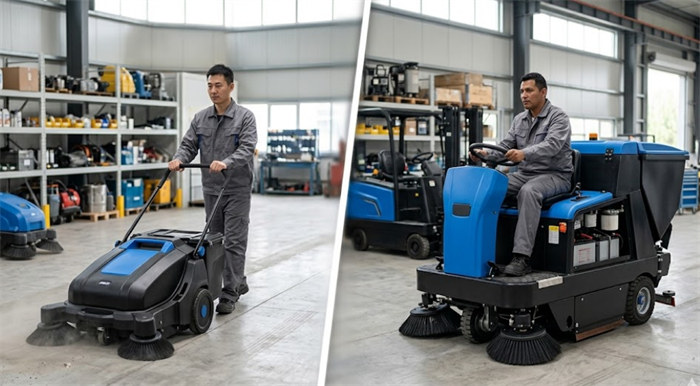
A walk-behind floor sweeper features a compact, lightweight frame. The chassis is typically constructed from welded steel or heavy-duty plastic, designed to keep the machine narrow and maneuverable. The operator controls are mounted directly on the handle, with the engine or battery pack positioned low and centered to maintain balance.
A ride-on floor sweeper, by contrast, has a much larger and heavier chassis. The frame must support not only the sweeping components but also a seat, steering wheel, foot pedals, and the operator's full body weight. The chassis is almost always fabricated from reinforced steel to handle the higher structural loads. The center of gravity is lower and wider, providing stability during high-speed sweeping and turning.
2. Drivetrain and Propulsion System
The way power is delivered to the wheels differs significantly.
Walk-behind sweepers typically use a direct-drive or belt-driven system connected to a small engine or electric motor. The operator walks behind the machine, controlling speed with a throttle or variable-speed trigger. Some models use a transaxle for self-propelled movement, while simpler models rely on the operator's pushing force combined with a rotating broom to pull the machine forward.
Ride-on sweepers are equipped with a hydrostatic or hydro-gear transmission, similar to what you'd find in a compact utility vehicle. This allows the operator to control forward and reverse speed with foot pedals, leaving both hands free for steering. The drivetrain is more robust, often including a differential axle to handle uneven floor surfaces and heavy loads.
3. Main Brush and Side Brush Configuration
Both walk-behind and ride-on sweepers use a combination of main brushes and side brushes, but the configuration and scale differ.
In a walk-behind sweeper, the main brush (typically a cylindrical roller brush) is located in a fixed position beneath the machine. It rotates at high speed to sweep debris into the hopper. The side brush — usually one or two — is mounted on the front corners and sweeps debris from edges and corners toward the main brush path. The sweep width on walk-behind models usually ranges from 20 to 30 inches (50–76 cm).
In a ride-on sweeper, both the main brush and side brushes are larger and more powerful. The main brush is often wider (30–50 inches / 76–127 cm) and may use a dual-brush or counter-rotating design for more aggressive debris pickup. The side brushes are hydraulically or electrically actuated and can be raised or lowered independently. Some ride-on models have two side brushes — one on each side — for full-width edge-to-edge sweeping. Check out our ride-on floor sweeper range for details on brush configurations.
4. Hopper (Debris Collection) System
The hopper — where swept debris is collected — also differs in design.
Walk-behind sweepers typically have a rear-mounted hopper that lifts out manually for emptying. Hopper capacity ranges from 1 to 3 cubic feet (28–85 liters). The hopper is usually made of durable polyethylene or coated steel, with a rubber seal to contain dust. Because of the compact design, the hopper on a walk-behind model may need frequent emptying during large-area cleaning.
Ride-on sweepers feature a larger hopper — often 8 to 20 cubic feet (226–566 liters) or more. The hopper is integrated into the chassis and is typically hydraulically lifted for dumping into a waste bin or dumpster. This hydraulic hopper lift is a key structural difference that adds weight, complexity, and cost — but significantly reduces the labor required for emptying.
5. Dust Filtration and Vacuum System
This is where the internal structure of walk-behind and ride-on sweepers diverges most dramatically.
Walk-behind sweepers often use a simple filter cartridge or filter bag mounted near the hopper. A small vacuum fan pulls dust-laden air through the filter, with some models relying on the brush's centrifugal action to settle dust without a powered fan. The filter may need manual cleaning every few hours using a vibrator or compressed air.
Ride-on sweepers are equipped with a multi-stage dust filtration system. A powerful vacuum fan creates negative pressure inside the hopper, pulling fine dust through a primary filter (often a pleated paper or polyester cartridge) and sometimes a secondary HEPA filter. Most ride-on models feature an automatic filter shaker — a pneumatic or electric mechanism that vibrates the filter at regular intervals, extending cleaning cycles and reducing maintenance.
The larger filter surface area on ride-on models (often 30–70 sq ft / 2.8–6.5 sq m vs. 5–10 sq ft / 0.5–0.9 sq m on walk-behind models) means they can operate longer between filter cleanings and handle finer dust particles. For facilities dealing with fine dust, choosing a ride-on model with advanced filtration options is highly recommended.
6. Engine / Battery and Electrical System
Walk-behind sweepers typically use small gasoline engines (3–6 HP) or single deep-cycle lead-acid batteries (12V or 24V). The electrical system is minimal — a start switch, a battery charge indicator, and simple wiring.
Ride-on sweepers use larger engines (10–25 HP) or multi-battery packs (36V or 48V lithium or lead-acid). The electrical system includes a battery management system, motor controllers (if electric), instrument panel gauges, lights, a horn, and often a backup alarm. The wiring harness is significantly more complex, with relays and solenoids controlling the hydraulic valves and electric actuators.
Comparison Summary Table
Feature
Walk-Behind Sweeper
Ride-On Sweeper
Chassis
Lightweight, compact
Reinforced steel, heavy-duty
Transmission
Direct-drive / belt
Hydrostatic / hydro-gear
Sweep width
20–30 inches
30–50 inches
Hopper capacity
1–3 cu ft
8–20+ cu ft
Hopper lift
Manual
Hydraulic
Filter area
5–10 sq ft
30–70 sq ft
Filter cleaning
Manual
Automatic shaker
Power system
3–6 HP / 12–24V
10–25 HP / 36–48V
Which One Should You Choose?
Choose a walk-behind sweeper if you have limited space, operate in narrow aisles, or need a cost-effective solution for small to medium areas (under 50,000 sq ft). Walk-behind models are easier to transport, simpler to maintain, and require less operator training.
Choose a ride-on sweeper if you cover 50,000+ sq ft daily, need higher productivity, and can invest in a more powerful machine with lower per-hour operating costs. The ride-on design allows operators to work longer shifts with less fatigue, and the larger hopper and filter system reduce downtime.
Need a Floor Sweeper That Fits Your Facility?
At Jiechi Cleaning, we offer a full range of walk-behind and ride-on floor sweepers designed for different facility sizes and cleaning requirements. Whether you need a compact sweeper for a small workshop or a heavy-duty ride-on model for a large warehouse, we have the right solution. Contact us today to discuss your facility's needs and get a professional recommendation.

 Phone: +1 2403149021
 Mail: kliu@jiechi.com



 Phone:+1 2403149021
 Email:kliu@jiechi.com


 English


