other

ride-on sweeper

Home

ride-on sweeper

  • Walk-Behind vs Ride-On Floor Sweeper: What's the Difference in Internal Structure?
    May 21, 2026
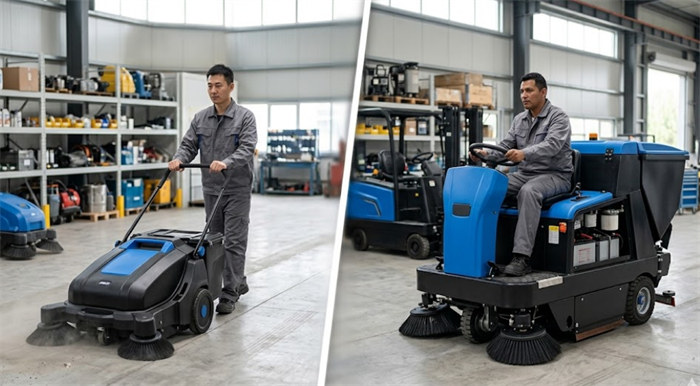
    When choosing a floor sweeper for your facility, one of the first decisions you'll make is whether to go with a walk-behind or a ride-on model. While most buyers focus on size and price, the real difference lies in the internal structure — the chassis, drivetrain, brush system, and dust filtration mechanism. Understanding how these components differ between the two types will help you make a more informed purchasing decision. At Jiechi Cleaning, we offer both walk-behind and ride-on floor sweepers designed for various facility requirements.   1. Chassis and Frame Structure The foundation of any floor sweeper is its chassis. A walk-behind floor sweeper features a compact, lightweight frame. The chassis is typically constructed from welded steel or heavy-duty plastic, designed to keep the machine narrow and maneuverable. The operator controls are mounted directly on the handle, with the engine or battery pack positioned low and centered to maintain balance. A ride-on floor sweeper, by contrast, has a much larger and heavier chassis. The frame must support not only the sweeping components but also a seat, steering wheel, foot pedals, and the operator's full body weight. The chassis is almost always fabricated from reinforced steel to handle the higher structural loads. The center of gravity is lower and wider, providing stability during high-speed sweeping and turning. 2. Drivetrain and Propulsion System The way power is delivered to the wheels differs significantly. Walk-behind sweepers typically use a direct-drive or belt-driven system connected to a small engine or electric motor. The operator walks behind the machine, controlling speed with a throttle or variable-speed trigger. Some models use a transaxle for self-propelled movement, while simpler models rely on the operator's pushing force combined with a rotating broom to pull the machine forward. Ride-on sweepers are equipped with a hydrostatic or hydro-gear transmission, similar to what you'd find in a compact utility vehicle. This allows the operator to control forward and reverse speed with foot pedals, leaving both hands free for steering. The drivetrain is more robust, often including a differential axle to handle uneven floor surfaces and heavy loads. 3. Main Brush and Side Brush Configuration Both walk-behind and ride-on sweepers use a combination of main brushes and side brushes, but the configuration and scale differ. In a walk-behind sweeper, the main brush (typically a cylindrical roller brush) is located in a fixed position beneath the machine. It rotates at high speed to sweep debris into the hopper. The side brush — usually one or two — is mounted on the front corners and sweeps debris from edges and corners toward the main brush path. The sweep width on walk-behind models usually ranges from 20 to 30 inches (50–76 cm). In a ride-on sweeper, both the main brush and side brushes are larger and more powerful. The main brush is often wider (30–50 inches / 76–127 cm) and may use a dual-brush or counter-rotating design for more aggressive debris pickup. The side brushes are hydraulically or electrically actuated and can be raised or lowered independently. Some ride-on models have two side brushes — one on each side — for full-width edge-to-edge sweeping. Check out our ride-on floor sweeper range for details on brush configurations. 4. Hopper (Debris Collection) System The hopper — where swept debris is collected — also differs in design. Walk-behind sweepers typically have a rear-mounted hopper that lifts out manually for emptying. Hopper capacity ranges from 1 to 3 cubic feet (28–85 liters). The hopper is usually made of durable polyethylene or coated steel, with a rubber seal to contain dust. Because of the compact design, the hopper on a walk-behind model may need frequent emptying during large-area cleaning. Ride-on sweepers feature a larger hopper — often 8 to 20 cubic feet (226–566 liters) or more. The hopper is integrated into the chassis and is typically hydraulically lifted for dumping into a waste bin or dumpster. This hydraulic hopper lift is a key structural difference that adds weight, complexity, and cost — but significantly reduces the labor required for emptying. 5. Dust Filtration and Vacuum System This is where the internal structure of walk-behind and ride-on sweepers diverges most dramatically. Walk-behind sweepers often use a simple filter cartridge or filter bag mounted near the hopper. A small vacuum fan pulls dust-laden air through the filter, with some models relying on the brush's centrifugal action to settle dust without a powered fan. The filter may need manual cleaning every few hours using a vibrator or compressed air. Ride-on sweepers are equipped with a multi-stage dust filtration system. A powerful vacuum fan creates negative pressure inside the hopper, pulling fine dust through a primary filter (often a pleated paper or polyester cartridge) and sometimes a secondary HEPA filter. Most ride-on models feature an automatic filter shaker — a pneumatic or electric mechanism that vibrates the filter at regular intervals, extending cleaning cycles and reducing maintenance. The larger filter surface area on ride-on models (often 30–70 sq ft / 2.8–6.5 sq m vs. 5–10 sq ft / 0.5–0.9 sq m on walk-behind models) means they can operate longer between filter cleanings and handle finer dust particles. For facilities dealing with fine dust, choosing a ride-on model with advanced filtration options is highly recommended. 6. Engine / Battery and Electrical System Walk-behind sweepers typically use small gasoline engines (3–6 HP) or single deep-cycle lead-acid batteries (12V or 24V). The electrical system is minimal — a start switch, a battery charge indicator, and simple wiring. Ride-on sweepers use larger engines (10–25 HP) or multi-battery packs (36V or 48V lithium or lead-acid). The electrical system includes a battery management system, motor controllers (if electric), instrument panel gauges, lights, a horn, and often a backup alarm. The wiring harness is significantly more complex, with relays and solenoids controlling the hydraulic valves and electric actuators. Comparison Summary Table Feature Walk-Behind Sweeper Ride-On Sweeper Chassis Lightweight, compact Reinforced steel, heavy-duty Transmission Direct-drive / belt Hydrostatic / hydro-gear Sweep width 20–30 inches 30–50 inches Hopper capacity 1–3 cu ft 8–20+ cu ft Hopper lift Manual Hydraulic Filter area 5–10 sq ft 30–70 sq ft Filter cleaning Manual Automatic shaker Power system 3–6 HP / 12–24V 10–25 HP / 36–48V Which One Should You Choose? Choose a walk-behind sweeper if you have limited space, operate in narrow aisles, or need a cost-effective solution for small to medium areas (under 50,000 sq ft). Walk-behind models are easier to transport, simpler to maintain, and require less operator training. Choose a ride-on sweeper if you cover 50,000+ sq ft daily, need higher productivity, and can invest in a more powerful machine with lower per-hour operating costs. The ride-on design allows operators to work longer shifts with less fatigue, and the larger hopper and filter system reduce downtime. Need a Floor Sweeper That Fits Your Facility? At Jiechi Cleaning, we offer a full range of walk-behind and ride-on floor sweepers designed for different facility sizes and cleaning requirements. Whether you need a compact sweeper for a small workshop or a heavy-duty ride-on model for a large warehouse, we have the right solution. Contact us today to discuss your facility's needs and get a professional recommendation.
  • How Fiercely Competitive Has the World Become in the Intelligent Era?
    Mar 02, 2026
    Recently, we came across the research data of the cleaning industry, which is truly striking: the recruitment of cleaning enterprises in the southeast coastal areas has surged by 80%, yet the profit margin is a meager 2%.   "The market is extremely competitive" has become a catchphrase across all walks of life.   💬How fierce is the competition in your industry now?   The Intelligent Era Is Corporate Cleaning Still Relying on Manual Labor Alone?   As practitioners in the field of professional large-scale cleaning equipment, we have seen numerous predicaments faced by those in the cleaning industry. The core of the fierce competition in the cleaning industry has never been "too many people with low prices", but rather still using "pure manual labor" to do "mechanized" work.   Dimension Real Data Industry Misconception Equipment Investment 70% of small and medium-sized cleaning enterprises lack systematic technical equipment Thinking that "purchasing equipment = increasing costs", without realizing that human-machine collaboration can reduce costs by more than 30%   If enterprises fail to calculate this account clearly, they can only get caught in the internal friction of low prices.Here are several real cases ⬇️   Case 1 A property management company of a residential community in Shanghai is responsible for the cleaning work of 3 communities. At the beginning of last year, they reported to us that:   The main road of the community covers more than 1,600 square meters. 5 cleaning workers worked non-stop from 8 a.m. to 12 p.m., yet there were constant complaints from property owners, and the client almost terminated the cooperation.   After understanding their difficulties, we recommended the Jiechi BA2100T Ride-on Sweeper. Soon after, they gave us feedback: this equipment is such a relief!   1 cleaning worker can operate it by sitting on it and clean more than 1,600 square meters of the main road in about 20 minutes, even sweeping away the dust and fallen leaves in the cracks, and the complaints from owners have decreased. The work that used to take 5 people 4 hours to finish can now be done by 1 person in less than half an hour, saving nearly 20,000 RMB in labor costs every month. What's more reassuring is that a single charge supports continuous work for 6-8 hours, covering both the community corridors and parking lots. Now, they have redeployed the saved labor to do refined cleaning work and finally renewed the cooperation smoothly. Case 2 A food processing factory, mainly engaged in the processing of pastries and cooked food, has been plagued by the problem of workshop cleaning for a long time. Food workshops have extremely high hygiene requirements, and failure in random inspections may even result in forced suspension of production for rectification.   At first, cleaning was entirely done by manual labor. Anyone in the food industry knows how troublesome it is to clean oil stains—it is labor-intensive and time-consuming, and poor handling may cause workers to slip and fall, creating potential safety hazards.   Later, they adopted the Jiechi Walk-behind Floor Scrubber, which is extremely flexible to operate. With a gentle push, all oil stains are cleaned wherever it goes, and the ground is left water-free, completely solving this big worry. After the improvement of the production environment, the order volume has also increased significantly. Case 3 A cleaning aunt at a RT-Mart store once shared her genuine experience of using the Walk-behind Floor Scrubber A3 with us. She said that the supermarket is crowded with people and has dense shelves, making it impossible for large floor scrubbers to maneuver. She used to mop the floor manually, walking tens of thousands of steps every day, and the mopped floor was prone to water stains, worrying that customers might slip and fall accidentally.   Later, the store was equipped with the walk-behind floor scrubber, which is compact in size and can easily weave through the shelves. The floor becomes dry immediately after mopping with no water stains left. The aunt said that it used to take her 4 hours to mop the floor every day, but now it only takes 2 hours. She can do other cleaning work with the remaining time, and her waist is not as sore as before. Facts have proven that instead of struggling in the vicious competition of low prices, it is better to spend a small amount of money on the right equipment. The labor and time saved are pure profits. Regardless of the industry, the core demands for cleaning are "saving time, saving labor, and achieving a thorough clean".   Founded in 2003, Jiechi is a time-honored brand that not only focuses on the R&D and production of cleaning equipment but also has served well-known brands such as China High-speed Railway, Midea, Hema, Country Garden, BYD, etc. With guaranteed quality and after-sales service, we can respond promptly to any problems.   The cleaning industry is now in the "stage of equipment popularization" and is starting to transition to intelligence. Robots cannot work completely independently yet, but the proportion of manual labor will gradually decrease in the future, and equipmentization is definitely an inevitable trend.   Comply with the market trend, and benefit early by adopting equipment early.

leave a message

leave a message
If you are interested in our products and want to know more details,please leave a message here,we will reply you as soon as we can.
submit

Home

Products

WhatsApp

contact