other

Warehouse Cleaning

Home

Warehouse Cleaning

  • Walk-Behind vs. Ride-On Floor Scrubbers: How to Choose the Right Fleet for Your Facility
    Jun 02, 2026
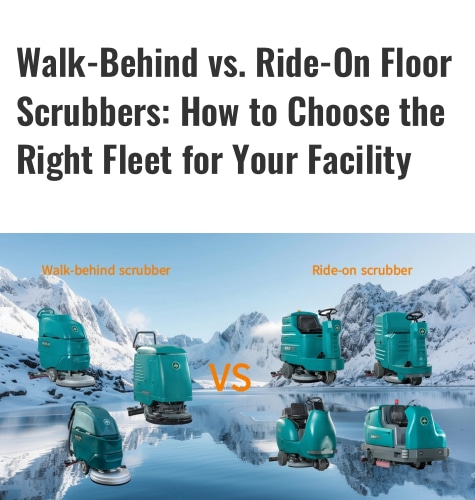
    In the fast-paced world of industrial and commercial facility management, maintaining spotless floors is no longer just about aesthetics—it’s about safety, compliance, and operational efficiency. If you are still relying on traditional mopping, or looking to upgrade your current cleaning fleet, you’ve likely arrived at a critical crossroads: Should you invest in a walk-behind or a ride-on floor scrubber?     As a leading global manufacturer of floor scrubbers and sweepers, Jiechi has helped thousands of factories, warehouses, hospitals, and shopping malls optimize their cleaning protocols. Here is a data-driven breakdown to help you make the smartest investment for your business.     1. The Walk-Behind Scrubber: Agility Meets Precision Walk-behind floor scrubbers (like the Jiechi BA530BT or the A3) are operated by a technician walking behind the machine. Best Suited For:   Tight and Congested Spaces: Narrow aisles, office hallways, and doorways. Smaller Footprints: Facilities under2,000㎡. Corner Cleaning: Superior maneuverability around tight corners and under obstacles.       2. The Ride-On Scrubber: Maximum Productivity for Large Scale Ride-on scrubbers (like the heavy-duty Jiechi A7, BA900BT, A10, A17) allow the operator to sit comfortably while driving the machine.     Best Suited For:   Expansive Areas: Large logistics warehouses, transport hubs, and manufacturing plants. High-Frequency Cleaning: Spaces larger than $3,000\text{ m}^2$ that require rapid turnaround times.   Labor Optimization: When you need to cover double the square footage with half the manpower.   The Jiechi Advantage: Jiechi ride-on models boast high-capacity solution tanks and extended battery life, drastically reducing the time spent on "dump and refill" stops.     The Decision Matrix: How to Choose? To make your decision easier, our engineering team has summarized the key metrics in the comparison table below: Feature Walk-Behind Scrubbers Ride-On Scrubbers Average Cleaning Speed 1,500 - 2,500 ㎡ 3,500 - 6,500+㎡ Maneuverability Exceptional (Turns on a dime) Moderate (Requires wider turning radius) Initial Investment Lower upfront cost Higher upfront cost (Offset by rapid ROI) Labor Efficiency Standard High (Reduces labor costs by up to 50%) Ideal Environments Retail stores, schools, hospitals Warehouses, airports, large factories     The Bottom Line: Calculate Your ROI When choosing between a walk-behind and a ride-on machine, look closely at your Total Cost of Ownership (TCO). While a ride-on scrubber requires a higher initial capital expenditure, it slashes labor hours dramatically. In large facilities, a ride-on machine often pays for itself within the first 6 months purely through labor savings. However, many modern facilities don't just choose one—they deploy a hybrid fleet. For example, utilizing a Jiechi A7 for the main warehouse floor and a Jiechi A1 or A3 for the narrow packing zones.
  • How Often Should You Sweep Your Warehouse Floor? A Practical Guide for Facility Managers
    May 20, 2026
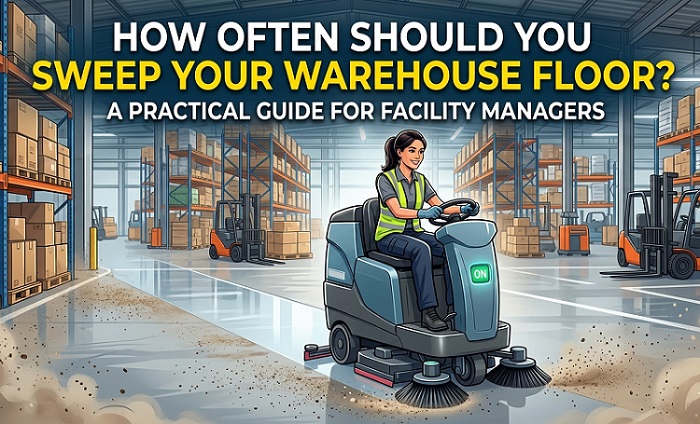
    Keeping a warehouse floor clean is about more than appearances — it directly impacts workplace safety, equipment longevity, and operational efficiency. But how often should you actually run a floor sweeper through your facility? The answer isn't one-size-fits-all. It depends on traffic volume, the type of debris your operation generates, and industry-specific requirements.   Why Regular Sweeping Matters Before diving into frequency, it's worth understanding why consistent sweeping is so important. A clean warehouse floor: Reduces slip and fall risks — Dust, debris, and loose particles create hidden hazards that can cause accidents. Protects equipment — Forklifts, pallet jacks, and other machinery operate less efficiently on dirty floors. Debris can damage tires, clog air filters, and accelerate wear on moving parts. Improves air quality — Fine dust particles that accumulate on floors become airborne when disturbed by traffic. Regular sweeping with a quality industrial floor sweeper equipped with a proper filtration system keeps dust levels under control. Extends floor life — Abrasive debris like gravel, metal shavings, and sand acts like sandpaper under foot and vehicle traffic, gradually wearing down floor coatings and concrete surfaces. Enhances professionalism — Clean facilities make a positive impression on clients, inspectors, and employees alike.   Sweeping Frequency by Facility Type Different types of warehouses have very different cleaning needs. Here's a practical breakdown: High-Traffic Distribution Centers (30,000+ sq ft) These facilities see constant forklift and foot traffic, with debris arriving daily via incoming shipments and outgoing orders. Sweeping should occur at least once per day, and in busier operations, twice daily — once mid-morning and once after the final shift. A ride-on floor sweeper is the most efficient choice here, as it can cover large areas quickly without taking operators away from other tasks for too long. Manufacturing and Production Facilities Workshops that generate metal shavings, wood dust, plastic pellets, or packaging waste need more frequent cleaning. Sweep at least 2–3 times per day, particularly around production lines and loading areas. Heavy debris should be cleaned up immediately to prevent it from being crushed into the floor by machinery. Light Commercial Warehouses (under 20,000 sq ft) Smaller facilities with lower traffic volumes can typically get by with sweeping every 2–3 days. A walk-behind floor sweeper is well-suited for this application, offering good results without the higher cost of a ride-on machine. Cold Storage and Food-Grade Facilities These environments have stricter hygiene requirements. Daily sweeping is mandatory, and many operators choose to sweep after each shift to prevent buildup of food particles that can attract pests. Look for a sweeper with a HEPA filtration system to capture fine dust without spreading contaminants. Outdoor Areas and Loading Docks Loading docks, parking lots, and exterior walkways collect leaves, gravel, and windblown debris. Sweep these areas 2–3 times per week, or more frequently if your location experiences seasonal debris like falling leaves or road salt in winter. Signs You Need to Sweep More Often No matter what schedule you set, pay attention to these warning signs that your current frequency isn't enough: Visible dust buildup on surfaces within hours of cleaning Employees tracking debris from one zone to another Complaints about slippery or dusty floors Frequent maintenance issues with forklifts or other equipment Poor results from indoor air quality monitoring If you notice any of these, increase your sweeping frequency — and consider whether your current floor sweeper is the right model for your debris load. Choosing the Right Floor Sweeper for Your Schedule Your sweeping frequency is only half the equation — your equipment needs to keep up. Here are a few tips: For daily or twice-daily sweeping in large facilities → Invest in a high-capacity ride-on sweeper with a large hopper. You'll minimize trips to empty debris and maximize cleaning time. For every-other-day sweeping in smaller spaces → A compact walk-behind sweeper offers flexibility and lower operating costs. For facilities with fine dust concerns → Choose a sweeper with advanced filtration, such as a dust control system or HEPA filter. Why Jiechi Floor Sweepers Are Built for the Job At Jiechi Cleaning, we design our floor sweepers for real-world industrial and commercial conditions. Whether you need a rugged ride-on model for a busy distribution center or a nimble walk-behind sweeper for a workshop, our machines deliver consistent performance shift after shift. Every Jiechi sweeper features: Efficient sweeping systems that handle everything from fine dust to bulky debris Reliable filtration to keep airborne particles under control Durable construction built to withstand daily use in demanding environments Easy maintenance with readily available spare parts Not Sure What Sweeping Frequency Is Right for You? Every facility is different, and the right schedule depends on your specific operations. Contact Jiechi today and our team can help you evaluate your cleaning needs — and recommend the right floor sweeper and maintenance routine to keep your warehouse safe, clean, and productive.

  • JIECHI BA850BT The Leader in Large-Area Cleaning with High Efficiency & Low Noise
    Apr 28, 2026
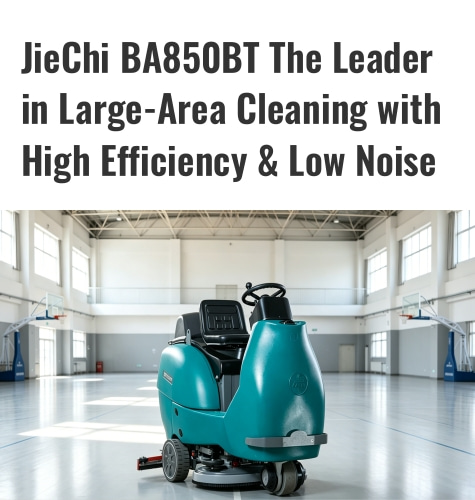
    Large-scale indoor cleaning scenarios demand higher-performance cleaning equipment. ⚠️Factory workshops struggle with heavy oil stains on floors;  ⚠️hospitals and schools enforce strict standards for hygiene cleanliness and noise control;  ⚠️underground parking lots and logistics warehouses feature vast floor areas where manual sweeping is time-consuming and labor-intensive.   The JieChi BA850BT Large-scale floor scrubber delivers a perfect solution to all these challenges.   JieChi BA850BT Core Advantages   850mm Ultra-wide Cleaning Path Equipped with an extra-large brush disc, it delivers extensive single-pass coverage, minimizing repeated cleaning strokes and drastically boosting efficiency in open areas such as corridors, workshops and parking lots, while cutting labor costs effectively.   180L Clean Water Tank + 195L Sewage Tank Dual large-capacity tanks reduce frequent water refills and sewage disposal, supporting long-duration continuous operation. Even for large-scale logistics warehouses spanning thousands of square meters, one-stop uninterrupted cleaning is achievable to avoid workflow disruptions.   Full-body Anti-collision Strips Protects the equipment from impact damage and prevents scratches on floors, walls and surrounding facilities.   Ultra-quiet Operation Design The suction motor is embedded in a sound-absorbing system with premium noise-dampening materials, ensuring extremely low operating noise.   Applicable Scenarios   Shopping Malls & Supermarkets Efficiently cleans tile and marble floors with instant washing and drying performance, ensuring pedestrian safety and maintaining a neat, tidy shopping environment. Factory Workshops & Industrial Plants Effectively removes oil stains, metal scraps and industrial dust. Compatible with cement floors, epoxy flooring, wear-resistant floors and more, it helps factories meet sanitation standards and ensure safe production. Hospitals, Schools & Office Buildings The low-noise design eliminates noise disturbance, with dust-free and residue-free cleaning results. It meets the stringent hygiene requirements of medical, educational and commercial office spaces for a healthy and sanitary environment. Underground Parking Lots The wide cleaning coverage greatly improves operational efficiency, easily removing dust, sediment and tire marks to prevent dust accumulation and keep parking areas well-maintained. Logistics Warehouses & Distribution Centers Long battery life and large tank capacity fully meet large-area cleaning demands, supporting high-efficiency daily sanitation without disrupting warehousing operations and cargo turnover. Hotel Lobbies & Exhibition Centers Leaves floors spotless and completely dry after cleaning, elevating overall venue hygiene and brand image.     Ideal for property management supervisors, factory administrative teams, shopping mall operators, and facility managers of hospitals and schools, the JieChi BA850BT stands as the top choice for daily large-area indoor cleaning and post-construction site cleanup. It enables full-scenario, high-efficiency, and low-consumption cleaning operations, helping create a cleaner, quieter, and safer working and public environment.

leave a message

leave a message
If you are interested in our products and want to know more details,please leave a message here,we will reply you as soon as we can.
submit

Home

Products

WhatsApp

contact