other

Commercial Cleaning

Home

Commercial Cleaning

  • Walk-Behind vs. Ride-On Floor Scrubbers: How to Choose the Right Fleet for Your Facility
    Jun 02, 2026
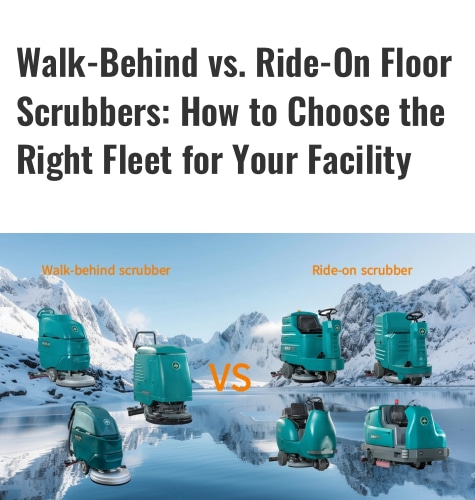
    In the fast-paced world of industrial and commercial facility management, maintaining spotless floors is no longer just about aesthetics—it’s about safety, compliance, and operational efficiency. If you are still relying on traditional mopping, or looking to upgrade your current cleaning fleet, you’ve likely arrived at a critical crossroads: Should you invest in a walk-behind or a ride-on floor scrubber?     As a leading global manufacturer of floor scrubbers and sweepers, Jiechi has helped thousands of factories, warehouses, hospitals, and shopping malls optimize their cleaning protocols. Here is a data-driven breakdown to help you make the smartest investment for your business.     1. The Walk-Behind Scrubber: Agility Meets Precision Walk-behind floor scrubbers (like the Jiechi BA530BT or the A3) are operated by a technician walking behind the machine. Best Suited For:   Tight and Congested Spaces: Narrow aisles, office hallways, and doorways. Smaller Footprints: Facilities under2,000㎡. Corner Cleaning: Superior maneuverability around tight corners and under obstacles.       2. The Ride-On Scrubber: Maximum Productivity for Large Scale Ride-on scrubbers (like the heavy-duty Jiechi A7, BA900BT, A10, A17) allow the operator to sit comfortably while driving the machine.     Best Suited For:   Expansive Areas: Large logistics warehouses, transport hubs, and manufacturing plants. High-Frequency Cleaning: Spaces larger than $3,000\text{ m}^2$ that require rapid turnaround times.   Labor Optimization: When you need to cover double the square footage with half the manpower.   The Jiechi Advantage: Jiechi ride-on models boast high-capacity solution tanks and extended battery life, drastically reducing the time spent on "dump and refill" stops.     The Decision Matrix: How to Choose? To make your decision easier, our engineering team has summarized the key metrics in the comparison table below: Feature Walk-Behind Scrubbers Ride-On Scrubbers Average Cleaning Speed 1,500 - 2,500 ㎡ 3,500 - 6,500+㎡ Maneuverability Exceptional (Turns on a dime) Moderate (Requires wider turning radius) Initial Investment Lower upfront cost Higher upfront cost (Offset by rapid ROI) Labor Efficiency Standard High (Reduces labor costs by up to 50%) Ideal Environments Retail stores, schools, hospitals Warehouses, airports, large factories     The Bottom Line: Calculate Your ROI When choosing between a walk-behind and a ride-on machine, look closely at your Total Cost of Ownership (TCO). While a ride-on scrubber requires a higher initial capital expenditure, it slashes labor hours dramatically. In large facilities, a ride-on machine often pays for itself within the first 6 months purely through labor savings. However, many modern facilities don't just choose one—they deploy a hybrid fleet. For example, utilizing a Jiechi A7 for the main warehouse floor and a Jiechi A1 or A3 for the narrow packing zones.
  • Jiechi A5: A Compact Commercial Cleaning “All-Rounder” That Delivers Efficient Cleaning Even in Tight Spaces
    May 27, 2026
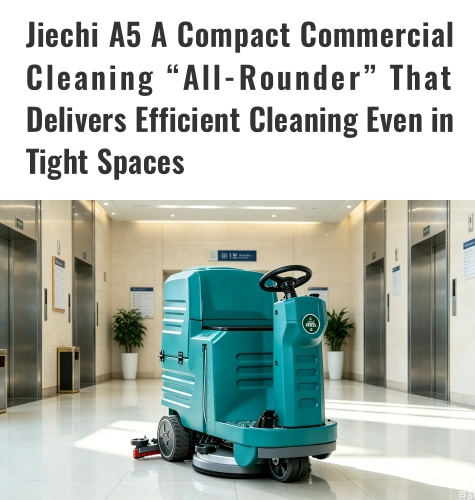
    In small-to-medium commercial settings such as small shopping malls, office buildings, convenience stores, and laboratories, cleaning often faces the dilemma of “narrow spaces, bulky equipment, and low efficiency”: large machines cannot navigate narrow aisles, manual cleaning cannot keep up with foot traffic, and standard floor scrubbers are inefficient and prone to bumping into shelves.   For small-to-medium commercial spaces, the “adaptability” of cleaning equipment is far more important than “bigger is better.” The Jiechi A5 compact ride-on scrubber-dryer addresses the pain points of narrow-aisle cleaning, low efficiency, and difficult operation with its compact and agile body, powerful cleaning performance from imported components, and user-friendly design details. It not only saves on labor costs but also raises cleaning standards.   The A5’s design centers on “adaptability to compact spaces,” with every specification precisely tailored to the cleaning needs of small-to-medium commercial areas, balancing maneuverability and efficiency.   530mm cleaning width + 770mm squeegee: The narrow brush deck design is ideal for tight spaces like aisles between shelves, hallways, and elevator lobbies, ensuring precise coverage in a single pass without wasting cleaning time. 65L Fresh Water Tank + 75L Waste Water Tank: A compact body houses high-capacity tanks, reducing the frequency of refilling and emptying. A single cleaning session can cover nearly 10,000 square meters without interrupting operations. 2,700 m²/h Cleaning Efficiency: Powered by a high-performance motor, it can clean 2,700 m² of floor space per hour—several times more efficient than manual labor—significantly reducing labor costs.   “Compact without compromise”—from maneuverability to cleaning power, every detail of the A5 is tailored for small to medium-sized spaces.   Compact body (126×62×103 cm): Designed specifically for narrow hallways, elevator entrances, and aisles in convenience stores, it easily navigates areas inaccessible to large floor scrubbers, leaving no cleaning blind spots.  Integrated cast aluminum squeegee: Corrosion-resistant with consistent suction, paired with high-quality rubber strips that hug the floor to prevent leaks. It ensures thorough wastewater recovery, leaving no water marks or secondary contamination on the floor. Wastewater tank overflow protection: Automatically shuts down when the tank is full to prevent wastewater backflow from damaging the motor, extending the equipment’s lifespan and reducing maintenance costs. Easy-to-disassemble maintenance design: Brush decks, rubber strips, and filters can all be quickly removed for cleaning. Daily maintenance is simple and requires no specialized tools, saving time and costs.   With its compact body and stable performance, the A5 easily adapts to a variety of small-to-medium commercial settings, making it a true “all-rounder” in cleaning:   Convenience stores / Small supermarkets: Maneuvers flexibly between shelves to quickly clean tile floors, washing and drying instantly without disrupting customer traffic. Office Buildings: Cleans hallways, elevator lobbies, and break rooms with quiet operation that doesn’t disrupt work, leaving floors spotless with no residue. Factory Workshops / Small Production Facilities: Removes grease and dust from floors, suitable for epoxy and concrete surfaces, helping workshops meet environmental standards. Hotels / Restaurants / Parking Garages: Quickly cleans grease and water stains from floors, reducing slip hazards and ensuring kitchen safety and hygiene.   Whether for property maintenance, shopping mall operations, or factory logistics, the A5 is a cost-effective choice for cleaning small to medium-sized commercial spaces. It delivers a hassle-free and efficient cleaning experience to create a clean, safe, and orderly commercial environment.
  • Complete Guide | Match Your Floor Scrubber by Area & Floor Type
    May 06, 2026
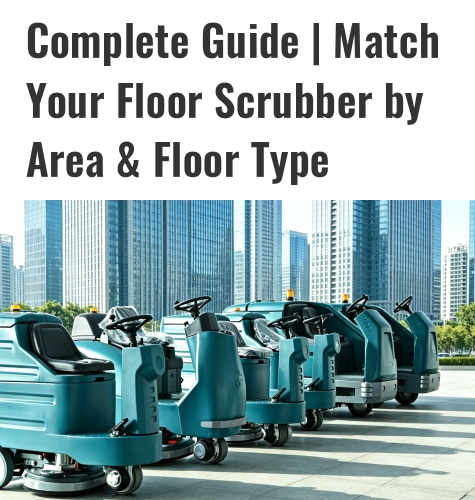
      If you’re the owner or a buyer for a factory, property management company, or retail store, I bet you’ve been driven crazy by cleaning at some point.   The floors remain dusty and dull, which not only hurts customer impressions but also gets you in trouble when management comes for an inspection; When it comes to large-scale cleaning, a few people work until dark and still can’t finish the job.   So, what should you look for when choosing a floor scrubber?   <3,000 sq m (e.g., small campuses, hallways, small workshops): Choose Jiechi’s push-type scrubber! Compact and agile, it fits in elevators and navigates narrow aisles. It’s incredibly easy to operate—cleaning staff can get the hang of it in just five minutes.   3,000–10,000 m² (e.g., medium-sized residential complexes, shopping malls, standard workshops): Choose Jiechi’s small-to-medium-sized ride-on scrubber! They ensure cleaning efficiency while maneuvering flexibly through various areas without being too bulky.   >10,000 m² (e.g., large industrial parks, underground parking garages, heavy industrial plants): Choose Jiechi’s large ride-on models or wash-and-sweep combination machines! Effortless continuous operation allows them to clean tens of thousands of square meters in a single day—no more relying on a large crew working around the clock.   Smart factories or facilities requiring 24/7 cleaning: Go straight for Jiechi’s industrial autonomous floor scrubbers! They automatically plan routes, recharge, and discharge wastewater, plus they support data-driven management—no human supervision required, freeing up your hands completely.   Beyond area size, match the machine to the floor type: - For epoxy floors and tile surfaces, choose soft brush decks to prevent scratching. - For concrete floors and areas with heavy oil stains, choose hard brush decks. You can also pair them with cleaning agents to remove even the most stubborn engine oil and grime.
  • How Fiercely Competitive Has the World Become in the Intelligent Era?
    Mar 02, 2026
    Recently, we came across the research data of the cleaning industry, which is truly striking: the recruitment of cleaning enterprises in the southeast coastal areas has surged by 80%, yet the profit margin is a meager 2%.   "The market is extremely competitive" has become a catchphrase across all walks of life.   💬How fierce is the competition in your industry now?   The Intelligent Era Is Corporate Cleaning Still Relying on Manual Labor Alone?   As practitioners in the field of professional large-scale cleaning equipment, we have seen numerous predicaments faced by those in the cleaning industry. The core of the fierce competition in the cleaning industry has never been "too many people with low prices", but rather still using "pure manual labor" to do "mechanized" work.   Dimension Real Data Industry Misconception Equipment Investment 70% of small and medium-sized cleaning enterprises lack systematic technical equipment Thinking that "purchasing equipment = increasing costs", without realizing that human-machine collaboration can reduce costs by more than 30%   If enterprises fail to calculate this account clearly, they can only get caught in the internal friction of low prices.Here are several real cases ⬇️   Case 1 A property management company of a residential community in Shanghai is responsible for the cleaning work of 3 communities. At the beginning of last year, they reported to us that:   The main road of the community covers more than 1,600 square meters. 5 cleaning workers worked non-stop from 8 a.m. to 12 p.m., yet there were constant complaints from property owners, and the client almost terminated the cooperation.   After understanding their difficulties, we recommended the Jiechi BA2100T Ride-on Sweeper. Soon after, they gave us feedback: this equipment is such a relief!   1 cleaning worker can operate it by sitting on it and clean more than 1,600 square meters of the main road in about 20 minutes, even sweeping away the dust and fallen leaves in the cracks, and the complaints from owners have decreased. The work that used to take 5 people 4 hours to finish can now be done by 1 person in less than half an hour, saving nearly 20,000 RMB in labor costs every month. What's more reassuring is that a single charge supports continuous work for 6-8 hours, covering both the community corridors and parking lots. Now, they have redeployed the saved labor to do refined cleaning work and finally renewed the cooperation smoothly. Case 2 A food processing factory, mainly engaged in the processing of pastries and cooked food, has been plagued by the problem of workshop cleaning for a long time. Food workshops have extremely high hygiene requirements, and failure in random inspections may even result in forced suspension of production for rectification.   At first, cleaning was entirely done by manual labor. Anyone in the food industry knows how troublesome it is to clean oil stains—it is labor-intensive and time-consuming, and poor handling may cause workers to slip and fall, creating potential safety hazards.   Later, they adopted the Jiechi Walk-behind Floor Scrubber, which is extremely flexible to operate. With a gentle push, all oil stains are cleaned wherever it goes, and the ground is left water-free, completely solving this big worry. After the improvement of the production environment, the order volume has also increased significantly. Case 3 A cleaning aunt at a RT-Mart store once shared her genuine experience of using the Walk-behind Floor Scrubber A3 with us. She said that the supermarket is crowded with people and has dense shelves, making it impossible for large floor scrubbers to maneuver. She used to mop the floor manually, walking tens of thousands of steps every day, and the mopped floor was prone to water stains, worrying that customers might slip and fall accidentally.   Later, the store was equipped with the walk-behind floor scrubber, which is compact in size and can easily weave through the shelves. The floor becomes dry immediately after mopping with no water stains left. The aunt said that it used to take her 4 hours to mop the floor every day, but now it only takes 2 hours. She can do other cleaning work with the remaining time, and her waist is not as sore as before. Facts have proven that instead of struggling in the vicious competition of low prices, it is better to spend a small amount of money on the right equipment. The labor and time saved are pure profits. Regardless of the industry, the core demands for cleaning are "saving time, saving labor, and achieving a thorough clean".   Founded in 2003, Jiechi is a time-honored brand that not only focuses on the R&D and production of cleaning equipment but also has served well-known brands such as China High-speed Railway, Midea, Hema, Country Garden, BYD, etc. With guaranteed quality and after-sales service, we can respond promptly to any problems.   The cleaning industry is now in the "stage of equipment popularization" and is starting to transition to intelligence. Robots cannot work completely independently yet, but the proportion of manual labor will gradually decrease in the future, and equipmentization is definitely an inevitable trend.   Comply with the market trend, and benefit early by adopting equipment early.

leave a message

leave a message
If you are interested in our products and want to know more details,please leave a message here,we will reply you as soon as we can.
submit

Home

Products

WhatsApp

contact